Before Abdulrahman Jamjoom built software that could answer a telephone, he built a robot that could hold a pen. It had wheels, exposed wiring and a name: jamBot. In photographs, the contraption wears an extravagant fringe of colored sticks and two round eyes. It looks ready for a children's birthday party, provided somebody brings a power supply.
The robot was a Harvard student project. Arini, the company Jamjoom now leads with co-founder Rami Rustom, is an enterprise software business. Between the two lies a surprisingly consistent question: how do you make a collection of separate parts do something useful together? The answer has taken him from a fabrication lab to shop counters, workplace messaging and the administrative machinery behind appointment books.
A pen, four wheels and an objection to limits
In 2018, Jamjoom was a Harvard senior studying computer science, with an interest in government and a taste for making things. Earlier creations included cardboard movie props, mountains and miniature villages. The materials were ordinary; the pleasure was turning them into something else.
For jamBot, he wanted a drawing machine that could travel across its working surface. Fixed machines had fixed boundaries. A moving robot offered another possibility. He used reclaimed acrylic, borrowed wheels and components from the lab, documenting both the construction and the compromises.
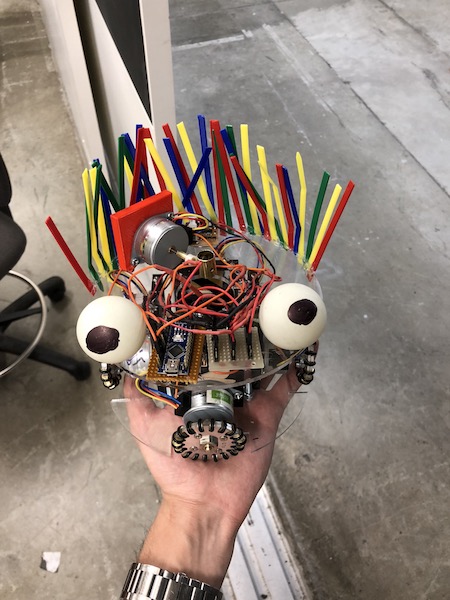
The machine drew a square. Jamjoom also recorded that its accuracy needed work. That combination gives the project its charm: a working result, accompanied by an unembarrassed account of what remained imperfect. A square is a modest exhibition. Getting a homemade machine to draw one is quite a day.
Read as an early chapter in a founder's career, the project suggests a preference for visible results. There is an object to examine, a motion to test and a line on the page. An impressive explanation cannot substitute for the line.
The startup that came with a burrito discount
By April 2019, Jamjoom was working on a different kind of connection. With fellow Harvard students Matteo Carroll and Vojta Drmota, he developed Axle, a debit card system offering discounts at participating Harvard Square businesses.
The early offer was concrete: students saved 10 percent on purchases at three shops, BerryLine, Tommy's Convenience Store and El Jefe's Taqueria. Carroll said the system removed fees associated with standard debit card transactions. Its ambitions were broader, but its first territory was a neighborhood people could cross on foot.
Axle's reported discount at participating Harvard Square shops in April 2019. Three businesses accepted the card at that stage.
El Jefe's general manager, Jon Eller, described the students arriving to ask whether the restaurant would participate. Early use at the restaurant was still limited to a handful of students. Across the system, Carroll reported 93 users.
There is something appealingly ungrand about that scale. Three merchants are three conversations, three decisions and three places where a product must make sense to somebody beyond its creators. A payment system becomes a business when the person behind the counter has a reason to accept it.
Axle belongs in Jamjoom's story because it puts entrepreneurship before graduation. The campus was already a place to try a commercial idea, with actual shops and actual transactions attached.

A partnership that began in Jordan
Jamjoom and Rustom met in high school in Jordan. Their eventual partnership at Arini came after separate computer science educations: Harvard for Jamjoom, MIT for Rustom. Jamjoom graduated in 2019; Rustom's founder biography lists MIT's class of 2021.
That history matters in a company built by two engineers. They knew each other before they were selecting a market or explaining a product to prospective customers. Their friendship supplied a relationship that could travel between schools, jobs and the uncertain beginnings of a business.
Jamjoom describes his own route as running from Saudi Arabia to Jordan and then the United States. In a conversation with AI Minds host Demetrios Brinkmann, he recalled wanting to create a startup before he had even finished at Harvard. Axle gives that ambition an early, tangible expression.
Learning inside somebody else's company
After Harvard, Jamjoom became an early engineer at Threads, an enterprise communication tool. He led search there. Rustom subsequently joined, and the two worked together leading its AI team.
The work included automating customer support, feedback on documents and the triage of notifications. These are the tasks that accumulate around the edges of office life. A message needs an answer. A document needs attention. A notification needs a decision about whether it matters now.
Search is a particularly revealing part of that experience. Information can exist inside a company and still be difficult to use. Someone has to retrieve the right piece at the right moment. Building workplace tools means meeting people where their work already happens, with its existing records and interruptions.
Threads later became part of Shopify. Jamjoom's own next chapter was Arini. His experience had given him a practical setting for AI: everyday work, performed repeatedly, where speed and usefulness could be judged by the people doing it.
The appointment book was already there
Jamjoom and Rustom chose their initial market by visiting dental practices and shadowing the people working in them. They observed the front desk and identified telephone handling and booking as a place to begin. The founders' account of Arini's launch puts those visits before the product explanation.
Arini joined Y Combinator's Winter 2024 batch with an AI receptionist that answered calls and scheduled appointments. Its pitch was easy to understand because the underlying activity was familiar. A telephone rings. Someone wants a slot in a calendar. The task involves both a conversation and an action.
Crucially, the software connected to the systems practices already used. Booking meant placing an appointment into an existing calendar. The caller's request had to survive the journey from speech to a usable record.
That is a demanding definition of completion. An engaging conversation can still leave an employee with more work. A successful booking must end with the details in the right place. For a founder with experience in search and workplace automation, the connection between talk and action was a useful place to concentrate.
The small courtesy inside a technical problem
On AI Minds, Jamjoom discussed the less glamorous problems behind a voice interface: interruptions, transcription and delays between turns. A system has to understand what somebody says while preserving the rhythm of an ordinary exchange.
He also described an adjustment that sounds almost too small to belong in an engineering discussion: asking for the caller's name early. In his account, that change helped callers feel more confident and improved conversion.
A name is technically a piece of data. In conversation, it is also a courtesy. The example is useful because it shows how closely interface design sits beside social expectations. People judge a voice through its timing and manners as well as its vocabulary.
The engineering problem therefore includes the listener's experience. A pause may be computationally understandable and conversationally awkward. An interruption may be messy for software and entirely natural for a caller. Jamjoom's discussion stays close to those ordinary frictions, where a product encounters human behavior.
A vendor should be able to take feedback
As CEO, Jamjoom has become more explicit about how buyers should evaluate AI. He compares the process with hiring: check experience, observe performance, offer feedback and see whether the work improves.
“Buying AI is more like hiring someone.”
Abdul Jamjoom
It is a useful comparison for a founder to make because it gives the customer a demanding role. A demonstration is only one encounter. The system must work in production, its shortcomings must be visible and the team behind it must respond when something needs to change.
Jamjoom's advice also allows for failure. He tells buyers to look at where the system falls short and how the vendor incorporates their input. That is a more interesting test than whether a polished presentation runs smoothly.
The implied relationship continues after the contract. Feedback has to lead to a changed result, then another round of observation. A ticket number, by itself, is a rather poor conversationalist.
More people in the room
Arini's enterprise ambitions became more visible in July 2025, when Eric Johnson joined as chief commercial officer. Johnson had founded and led Membersy. His remit at Arini included commercial strategy and enterprise partnerships.
At that point, Arini described a business expanding beyond its receptionist into consulting and engineers working directly with customers. The company reported that its receptionist handled more than 10,000 calls daily. The number was Arini's own account of its scale at the time, rather than a lifetime tally or a promise about every future deployment.
In September 2025, Jamjoom was announced as a speaker at the DSO Technology Summit in Nashville on AI and forward deployed engineers. The idea is straightforward: place engineers close to a customer's operations so they can understand the work and build around it.
That brings his career back to a familiar setting. The student at the shop counter, the engineer inside a messaging company and the founder watching a front desk all encounter people who know something the builder needs to learn. Across those settings, Jamjoom keeps choosing work that requires a conversation before the parts can fit.
jamBot's square was a small result you could see. Arini asks for a different kind of visible result: a completed booking, a working connection, a change that holds up during an ordinary day. The objects have changed. The insistence on making them work together has stayed recognizable.
Follow the work
- Arini · LinkedIn · X · GitHub · Facebook
- Jamjoom's fabrication portfolio and jamBot documentation
- The Harvard Crimson: the Axle launch, April 2019
- Listen: AI Minds, episode 049, with Demetrios Brinkmann
- Watch: Jamjoom on the DIG Official Podcast
- Watch: Arini's original product demonstration
- Jamjoom's thoughts on evaluating AI vendors
- Arini's July 2025 commercial team announcement
- Arini's blog · The Nashville speaking announcement