Danny Bessonov was a high school freshman when a joke acquired lawyers. He and Patrick Li had built a phone app around the viral “Damn Daniel” video. It took them hours. Soon it was climbing the App Store charts, and the people behind the video had representatives who wanted it removed. An afternoon’s amusement had become a product with an audience and a dispute attached. The boys had made something people wanted. Ownership proved rather less amusing.
The idea came together in the school library in February 2016, with their friend Aayush Gupta part of the conversation. Its appeal was almost defiantly simple: press a button, hear a familiar voice, repeat. A counter and leaderboard gave the repetition somewhere to go. The app reached the Top 25 games and Top 60 overall. By March 6, after the excitement ebbed, Bessonov and Li took it down.
“I doubt [their lawyers] knew we were high school kids,” Bessonov said afterward. There is a compact comedy in that sentence. On one side, professional representatives addressing a downloadable product. On the other, two freshmen who had started with a joke. The internet had allowed the product to travel farther than its makers’ everyday circumstances suggested.
Today Bessonov is co-founder and CEO of Avora in San Francisco. His early chart success is the neat anecdote that fits inside an introduction. But it leaves out the slower projects, the collaborators, and the work that continued after the button stopped talking. A short-lived app makes a good opening. For understanding how he builds, the less noisy parts of his history deserve equal billing.
The teenage app’s 2016 chart position
The app you opened between classes
That same year, Bessonov and Li were leading an update to Saratoga High School’s iOS app. They moved it from Objective-C to Swift, revised the interface, and added practical ways to navigate the school day. Development lasted more than five months. The work culminated in a February release, weeks before the meme app’s brief trip up the charts.
The updated school app included event dates, a planner, a progress bar for the current class period, and a grades button that linked to school services. None of those features required a celebrity sound clip. Their usefulness depended on being there when a student needed them. A progress bar counting down a lesson may also be one of the more honest products ever offered to a teenage audience.
Set the two projects beside each other and the difference in tempo becomes interesting. One arrived quickly and lived briefly. The other took months to improve a familiar routine. Both were software for people Bessonov could understand directly: classmates navigating school, and teenagers enjoying a shared joke. The school project shows him working on navigation and access well before his résumé filled with infrastructure and AI.
He also wrote for the school newspaper. By May 2018, its staff list included him among the sports editors. His bylines offer another view of a student often introduced through code: he could be on the reporting side of a school event, explaining what someone else was trying to build. That is a useful complication to the familiar picture of the teenager alone with a laptop.
A referee’s wrist and an interview itinerary
His early project record wandered well beyond sound buttons. In 2015, he was part of the team behind Reford, a WatchKit app intended to help soccer referees issue penalties and manage the match clock. Keith Ng, Victor Augusteo, Patrick Li, and Alex Aruj were also credited. The proposed connection between a referee’s wrist and an official scorecard gave a small screen a very specific job.
Reford was submitted to an Apple Watch hackathon and built with Swift and Xcode, with Adobe Illustrator also listed among its tools. Its premise was straightforward: a referee already has enough to watch. Bringing match controls to the wrist was an attempt to make the administrative part of the game easier to handle while the game continued.
Then came Forà, a 2016 hackathon project aimed at the logistics of onsite interviews. Bessonov, Li, and Pranav Angara were credited on a mobile application that combined travel services into the interview process. The team used Python, Flask, and travel APIs on the backend, with Swift and Objective-C among the mobile technologies.
A soccer official and a job applicant have little in common as markets. They do share a need to coordinate actions without losing track of the main event. These prototypes reveal a teenager trying software against different kinds of inconvenience. They were experiments, with names, teams, and submissions attached. Their value in his story is the evidence of practice: defining a task, joining tools together, and presenting the result.
Match clock + referee calls
Planner + school information
Onsite interview logistics
Learning to explain the bet
In March 2017, Bessonov and Li co-wrote a story about LA Hacks. They were also among the Saratoga App Dev Club members selected to attend. The article described an event opening itself to design, business, and the humanities, as well as programming. Bessonov was simultaneously a participant and someone asking how the event worked.
That overlap continued at Penn. Dorm Room Fund introduced him in its new-partner announcement as a first-year student studying computer science, statistics, and entrepreneurship. His earlier development experience included nFlate and whiteCryption. The introduction emphasized his interest in products, design, and user experience, rather than treating programming as a pursuit detached from the person using the result.
The same introduction supplied less corporate details: unsweetened iced tea, open-water swimming, stand-up, and improv. Those are pleasingly specific tastes. The tea arrives without a brand partnership; the comedy without a productivity lesson. They give the student behind the investment title some ordinary texture, which an inventory of employers alone cannot provide.
In May 2020, he wrote Dorm Room Fund’s explanation of its investment in Trefo, a robotic forestry startup. The argument concerned drones operating beneath the tree canopy, where measurements could capture detail that broader views missed. He connected the engineering approach to the needs of people managing forests and to the founders’ backgrounds.
The piece is useful evidence of another kind of work. Writing about an investment asks the author to explain why a technical choice matters to a customer and a business. Bessonov’s subject happened to be forest surveying. The task was translation: taking a specialized system and making the commercial reasoning readable. He was practicing that while still on the student side of the venture world.
“Since then, they’ve lived, traveled, and done their best work together.”The founders’ launch introduction
Second day, long partnership
At Penn, Bessonov met Justin Zhou on the second day of college. Their account of the relationship is unusually domestic for a startup introduction: they have lived together, traveled together, and worked together. A co-founder match can look tidy in a pitch deck. This one had time to accumulate shared experience before it acquired a company name.
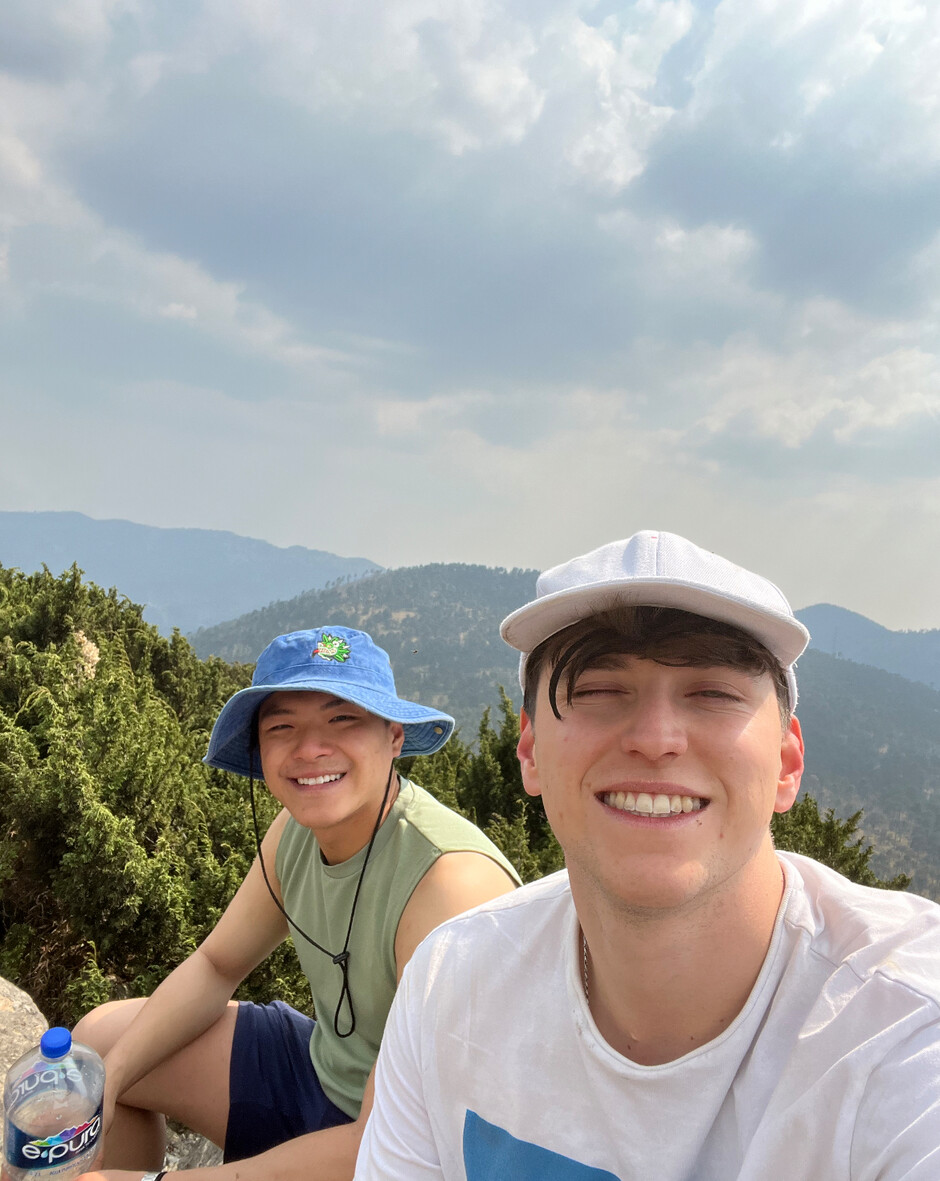
The photograph they included with their launch materials shows the pair outdoors, smiling in hats against a mountainous background. It is a modest glimpse of the travel they describe. There is no whiteboard, no manufactured office scene, and no attempt to dress a walk as a strategy meeting. Friends who would build a company together had also spent time outside one.
Bessonov graduated from Penn’s Management and Technology program with a master’s degree in computer science. His subsequent engineering record includes Ramp, Anduril, Lumos, and Wispr. At Ramp he worked on core payment features for Bill Pay; at Anduril, on encryption features for unmanned aerial vehicles. At Wispr, he led product intelligence.
Wispr’s welcome announcement also credited experience at Roblox and noted his interests in swimming and poker. The mix of work matters: payments, encryption, and voice software ask different things of an engineer. A résumé can make those jobs look like interchangeable company logos. The actual tasks place him near money movement, secured communication, and the way people interact with a computer.
His public code archive adds smaller artifacts to that employment history. There is a Philadelphia transit analysis project, programming-contest solutions, and ScheduleMe, described as a scheduling AI chatbot from LA Hacks 2017. These are traces of work across several scales. They make the later interest in software agents easier to place in a longer history of trying to organize information and action.
Building beyond the weekend
Bessonov and Zhou founded their company in 2024 and joined Y Combinator’s Fall batch. Its original launch name was ShowAndTell; today it is Avora. In their introduction, the founders described earlier work together on language-model customer-support agents using GPT Playground. The partnership had already been exercised on products before the accelerator introduction.
In June 2026, Avora announced a $2.3 million seed round led by CRV, with Y Combinator and scouts from Sequoia and Thrive participating. That is a company milestone, distinct from Bessonov’s personal finances. It also changes the time horizon of the story. A weekend prototype can end with a submission. A funded company has a team, customers, and work waiting the following morning.
The recurring feature of his career is collaboration. Patrick Li appears in the school app, the meme app, hackathon projects, and a newspaper byline. Zhou enters on day two at Penn and remains through the founding of Avora. Other teammates appear around particular projects. The history contains plenty of code, but it is populated by people.
The button belongs in this history because it happened, and because its absurdity survives the later job titles. Yet the school planner, the referee’s watch, the forestry investment essay, and the payment features tell a fuller story. Bessonov has repeatedly moved between making a thing and explaining why someone might use it. The charts supplied an early audience. The work since then has required him to keep earning one.