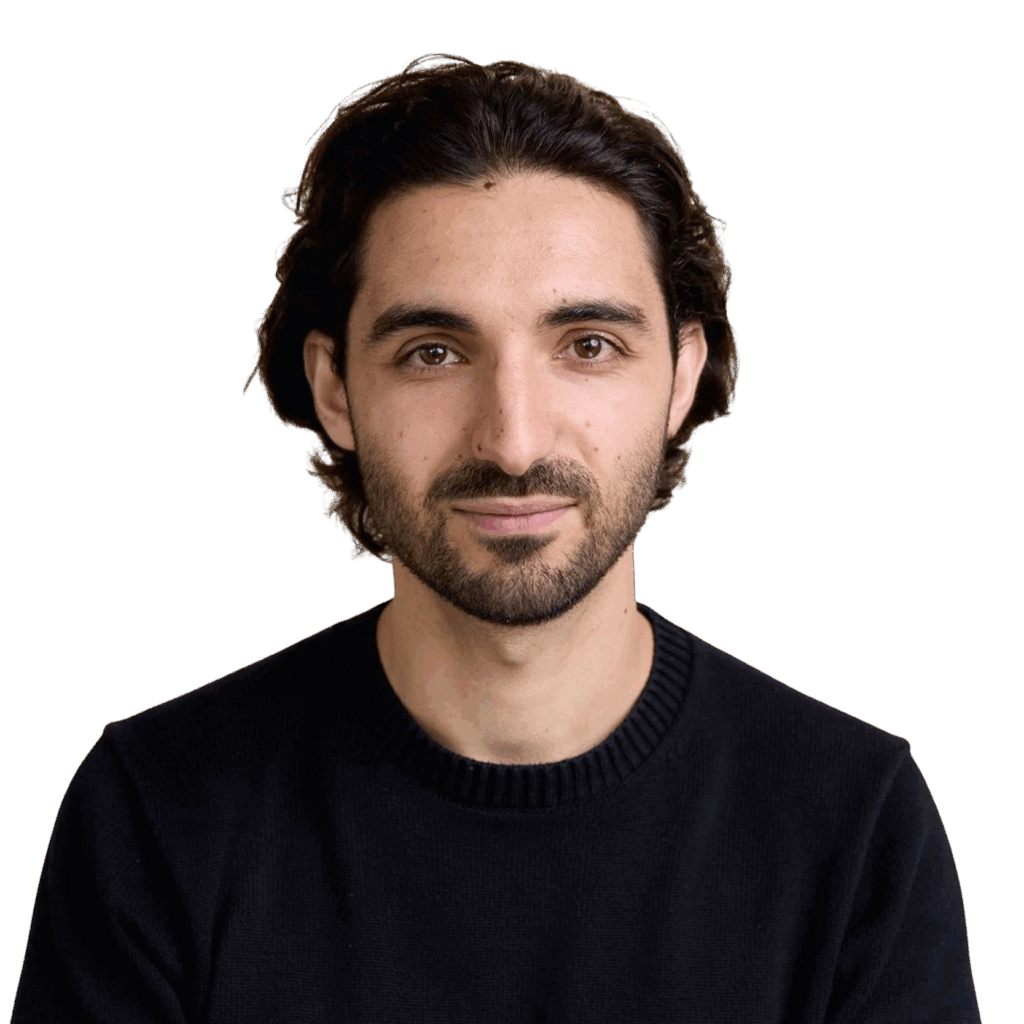
He was still in his senior year at Wharton when he sold his first company. Not a small acqui-hire. Not a polite "we'll give you a job and call it an exit." Lyft bought Halo Cars - the smart LED advertising screens Kenan Saleh had mounted on rideshare vehicle rooftops - within nine months of the company's founding. He hadn't graduated yet.
That's the kind of speed that gets misread as luck. It wasn't. Halo Cars won the Penn Wharton Startup Challenge, walked away with $45,000 in prizes, and had already proven that hyper-targeted ads displayed on car rooftops - shifting message based on location, weather, and time of day - actually worked at scale in the wild chaos of urban streets. Lyft recognized the infrastructure for what it was: a media channel it didn't yet own.
Kenan co-founded Halo Cars during his final year at Penn's Wharton School with a thesis simple enough to pitch at a party: ride-share vehicles are moving billboards that nobody is using. Smart LED panels on the roof, real-time targeting, and suddenly every Lyft in a city becomes a precision media placement. Lyft saw the logic and bought the whole thing before most startups finish their seed round.
From Founder to Operator - Then Back Again
After the acquisition, Saleh stayed at Lyft. Most founders who sell their companies spend six months in an earnout purgatory before quietly departing. Saleh did something different: he built a second business inside the first one.
As General Manager of what became Lyft Media - rebranded from Lyft Advertising - he grew the division from zero to over $10 million in annual revenue. He was, in effect, a founder again, but with Lyft's distribution, data, and infrastructure at his back. The ride-share advertising category he'd spotted as a college student was now a meaningful business line inside a public company.
That four-year stretch as an operator matters more than it might look on paper. When Saleh eventually moved back to the founding side, and later to the investing side, he brought something most VCs don't have: he'd felt what it means to be accountable for revenue, to scale a team, to make the number. His empathy for founders isn't performative - it's biographical.
The Exit File
Two companies built, two acquired - before joining institutional venture capital
Halo Cars
Smart LED advertising screens for ride-share vehicles. Hyper-targeted by location, weather, and time. Founded senior year at Wharton. Won major pitch competition. Acquired within 9 months of founding.
Stable Finance
Co-founded with Mario Cabrera. Consumer-facing stablecoin savings app making DeFi feel like a normal bank account - competitive on-chain savings rates for everyday people. Entire engineering team joined acquirer.
The DeFi Chapter Nobody Expected
After Lyft, Saleh could have gone straight to a venture seat. He had the track record, the network, and the Forbes 30 Under 30 recognition to walk into most firms. Instead, he founded again.
Stable Finance, co-built with Mario Cabrera, tackled what is genuinely one of the harder UX problems in crypto: making decentralized savings feel trustworthy and accessible to someone who has never heard the word "smart contract." The app offered competitive on-chain savings rates, wrapped in an interface that didn't require a PhD in blockchain to navigate. Aave Labs acquired it - and brought the engineering team along entirely.
Two acquisitions. Two different sectors. One consistent pattern: find a real problem at the intersection of technology and consumer behavior, build something that actually works, and don't wait around for permission to start.
The best founders see problems others walk past every day. A car rooftop is a blank billboard. A savings rate is a behavior change waiting to happen. The insight is never complicated - the execution is where everything separates out.
- Kenan Saleh's investing philosophy, distilledNow: a16z Speedrun and the $1M Check
Andreessen Horowitz's Speedrun program is designed around a specific premise: the most consequential early decisions happen before most investors are paying attention. The $1M seed check isn't a small bet - it's a full commitment at the moment when a company is still more idea than institution.
Saleh joined the Speedrun team in 2025 as an Investment Partner, focusing on early-stage consumer AI and what he describes as how new interfaces change user behavior. It's a thesis rooted in personal history: he watched ride-share vehicles transform into a new advertising medium, watched DeFi begin to look like consumer savings products, and now watches AI begin to reshape how people interact with software at the most basic level.
On the team alongside Andrew Chen, Emily Bennett, Jonathan Lai, Joshua Lu, Lejla Johnsen, Marcus Segal, and Troy Kirwin, Saleh brings an unusual credential: he has been on the receiving end of institutional money as a founder, has written his own angel checks into 50+ companies, and now deploys capital at scale. That arc from operator to angel to institutional investor is rarer than the venture capital industry likes to admit.
Consumer AI
Early-stage companies building AI products that end users actually touch. The interface layer, not the infrastructure layer.
New Interfaces
How voice, AI agents, and spatial computing change what people do - not just how they do it.
Seed Stage
$1M checks into founders at the earliest inflection point, through a16z Speedrun's high-conviction early program.
The Angel Years: 50+ Bets Before the Institutional Seat
Between running Lyft Media and joining a16z, Saleh was doing something unusual for a first-time operator with a liquidity event: he was angel-investing at volume. More than 50 startups backed across fintech, biotech, AI-enabled services, solar, robotics, and what he calls government efficiency. He also founded Distributed Capital, a syndicate built specifically to let other founders invest alongside him.
This isn't the typical "I backed a few friends' companies" story. It's a systematic, decade-long effort to build pattern recognition the hard way - by writing real checks and watching what happens. By the time he joined a16z, Saleh had already seen more founder pitches, deal structures, and post-investment dynamics than most people ever see on either side of the table.
Among the bets: SiC Systems (AI agents plus quantum computing, where he led initial funding), Hypercard, Babylon Biosciences, and Warp. The portfolio is eclectic by design. Saleh's thesis has never been sector-specific - it's been behavior-specific. Where does technology make something people already want to do dramatically easier, cheaper, or more compelling?
The Wharton Foundation - and Why It Doesn't Define Him
Saleh graduated from Penn's Wharton School in 2019 with a B.S. in Economics and minors in Computer Science and Biology. The triple combination - finance, code, biology - is either an accident of curiosity or the most deliberate course of study a future consumer AI investor could design. Probably both.
What Wharton gave him was less a credential than a laboratory. The startup competitions, the co-founders, the early VC internship in Indonesia - these were the reps that mattered. By the time he had a diploma, he also had an acquisition. The order in which those things happened says everything about the kind of operator he is.
He's spoken publicly about entrepreneurship through the lens of the Muslim American founder community, and through the Asian Founders Club. Not as identity politics but as a genuine attempt to make the VC game more legible to people for whom the unwritten rules are harder to decode. That's community-building as a long-term bet on a more interesting deal flow.
What He's Actually Betting On
The consumer AI thesis at a16z Speedrun is not about which large language model wins. It's about the interface stack above the model - the applications that will become the primary way most people interact with AI, and whether those interfaces create genuine behavior change or just automate what people were already doing badly.
Saleh has watched behavior change twice from the front seat. First when Lyft transformed the taxi industry and created entirely new advertising real estate in the process. Then when DeFi began to look, briefly, like it might transform personal finance for people who'd never touched crypto. Those are both incomplete revolutions, still in progress. Consumer AI might move faster.
The $1M bet at a16z Speedrun is small enough to move quickly and large enough to matter. For the founders Kenan Saleh backs, it's often the first real money - and with it comes something rarer than capital: an investor who has actually done it twice, failed at nothing he shipped, and still knows what it feels like to be the one asking for the check.