The milk kept disappearing. Pradeep Elankumaran’s daughter had turned two, and the family refrigerator seemed to answer every growth spurt with another trip to the supermarket. He was going three or four times a week. For a technical founder, repetition can feel less like routine than an accusation. The machine is clearly broken. Why is a person still doing this?
Elankumaran and Kevin Li put a small offer on Nextdoor in Mountain View: would anyone like milk, eggs, yogurt and bread delivered each week? Two hundred people said yes within two days. They talked to many of them and found a quiet population that wanted grocery delivery without treating a weekly shop like a luxury purchase. A household nuisance had become evidence.
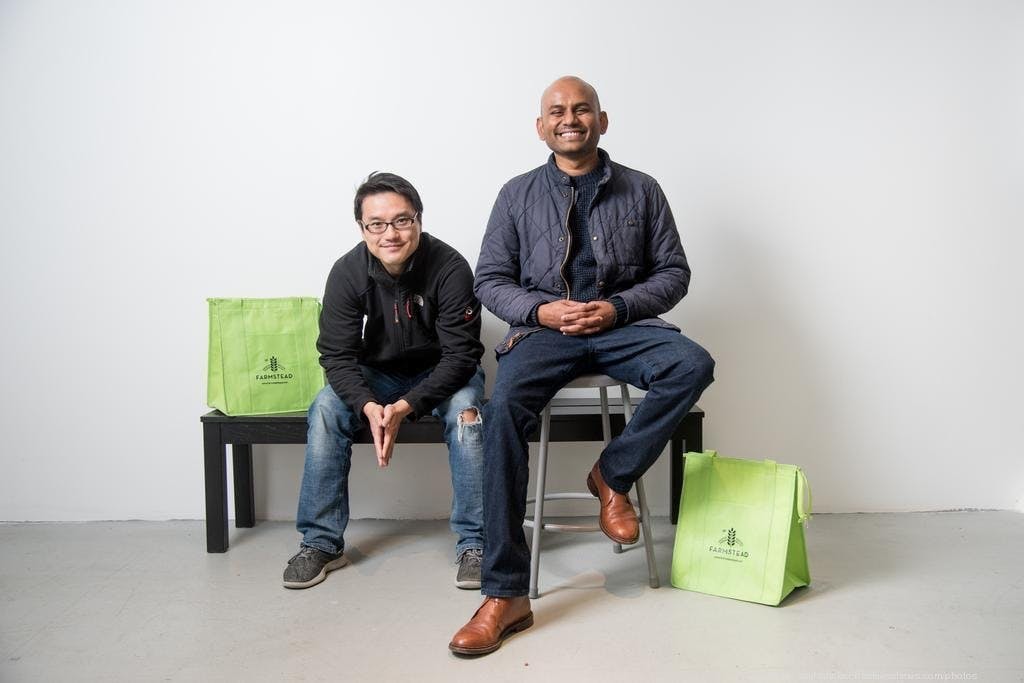
That experiment grew into Farmstead, a vertically integrated online grocer built around small warehouses, custom inventory software and batched delivery routes. The company expanded to five markets, reached double-digit millions in revenue, assembled a 200-person team and cut food waste from roughly 30 percent to 1.5 percent. The numbers matter. The opening scene matters more. Before the warehouse and the prediction software came a practical question asked in public.
A telescope pointed at ordinary life
Elankumaran studied physics and astronomy at the University of Maryland, with a focus on computational astrophysics. His undergraduate work included N-body code and the spin limits of loosely bound asteroids. The subject is celestial; the habit is portable. Observe a system. Build a model. Run it. Check whether reality agrees.
He began his technology career as an intern at a now-defunct Washington search engine, then joined an engineering consultancy as its first employee. That job gave him a quick tour of how several companies turned ideas into software. By 2011 he and Brendan Lim had founded Kicksend and entered Y Combinator’s summer batch.
Kicksend started with large-file sharing and moved toward a more tactile problem: getting photographs off phones and into people’s hands. Its apps let customers order prints through CVS, Target, Walgreens and Walmart, alongside home delivery. Elankumaran says it reached millions of users and millions in revenue, and the product appeared on the Today Show. Lyft eventually acquired the company.
He stayed at Lyft to work on driver growth, helping improve conversion as the service entered new markets. At Yahoo, he worked on growth, the silent-video messaging app Livetext and early technology joining live video with digital advertising. These were different products, but each put him close to the awkward seam where software meets behavior: a driver signing up, a person choosing to send a video, a family trying to remember what is needed for Saturday.
Software enters the warehouse
Farmstead was not a digital wrapper around an existing supermarket. Elankumaran and Li leased smaller warehouses and wrote software for inventory, sourcing, quality checks, picking and packing. Drivers carried several nearby orders on the same route. The ambition was almost old-fashioned: regular groceries, store-level prices and delivery without an added fee.
Perishables punish vague thinking. An unsold T-shirt can wait; a peach keeps its own calendar. Farmstead treated grocery as a prediction problem, using demand and inventory data to reduce waste while keeping goods available. The unglamorous details were the product. A clever interface could not rescue a missing carton of eggs.
Elankumaran’s advice to founders from that period was equally grounded: focus on customers, learn what they need and build durable relationships with co-founders. His partnership with Li survived the warehouse years and continued into jo. Longevity between founders rarely arrives as a feature on a product page, though customers live with its consequences.
the repetition
with people
the system
An assistant with homework
After spending six months talking to language models for hours each day, Elankumaran began building an AI that would live on the computer. jo, founded with Li in 2023 and part of YC’s Winter 2024 batch, now describes itself as a personal agent for work and life. With permission, it connects context across email, calendars, messages, notes, work apps, photos and browsing. Its examples are domestic and specific: find the two emails that need decisions, rescue the plan buried in a soccer group, notice a double-booking and draft the note.
The design wager is that a useful assistant should carry some of the remembering. A blank chat box is wonderfully general but still waits for its owner to realize what to ask. jo aims to surface what matters and help a person follow through while leaving control with that person. The product has changed shape since its first voice-first macOS release, but the target has stayed steady: reduce the coordination tax of ordinary life.
Elankumaran’s approach to his own time has a pleasing lack of theatre. He has said that raising two children made timeboxing mandatory. Tasks became calendar events. Repetition went to code whenever possible. A Casio watch sat on his desk and beeped each hour, a low-tech shepherd for a wandering attention span. Some founders purchase an operating system. He used a wristwatch that had declined to be worn.
The irritation laboratory
In 2026, the research inside jo became unusually visible. Elankumaran released pi-mem, which gives coding agents persistent memory through three tiers of plain Markdown rather than a vector database. He released pi-reflect, which reads session transcripts, finds moments when a user had to correct an agent, and proposes precise edits to the agent’s rules.
The raw material is comic and familiar: “no,” “not that,” “I literally just said.” Elankumaran noticed that irritation is information. In one published run, the correction rate fell from 0.45 to 0.07 before rising when he began a demanding Rust project. The graph did not behave like marketing copy. New work produced new mistakes. The rules had more to learn.
When corrections become a signal
He also published camofox-browser for browser automation and ane.cpp, an experiment in running Qwen language models directly on Apple’s Neural Engine while bypassing CoreML. On an M3 Max, his posted results reached 11.66 generated tokens per second for one quantized 4B stream and 28.62 tokens per second across four concurrent streams. The GPU and CPU remained available for other work.
Raw speed is only part of the point. jo needs small background streams that can classify, index and summarize without draining a laptop or sending every sensitive detail away. Elankumaran writes openly about the bottleneck, dispatch overhead, and lists failed experiments alongside the useful optimizations. The field guide records more than 40 tests. A dead end, properly labeled, becomes a small public utility.
One pizza, several minds
His latest organizational idea is the “one pizza startup”: two technical founders who can hold the product in their heads while supervising several concurrent coding agents. Traditional teams gain hands and also acquire communication paths. Two people have one pairwise channel; six people have fifteen. Models let a small team open more implementation threads without immediately multiplying the human conversations.
Elankumaran is careful to call this a capacity model, not a productivity claim. Code volume does not create product-market fit. The possible advantage is more high-quality attempts before money and patience run thin. Humans still choose the bets, guard architecture, review the work and decide what is good enough to reach a customer.
There is a quiet reversal here. For years, the technical founder was expected to graduate from the editor into meetings, hiring plans and coordination. In Elankumaran’s version, powerful coding tools make technical judgment more central. The founder can remain near the product, asking whether a change deserves to exist and whether it behaves properly once it does. Management becomes less about distributing tickets and more about protecting the quality of the loop. The difficult part was never typing every character. It was deciding which problem had earned another afternoon.
This is the same old product loop under new lighting. The telescope has moved from asteroids to agent transcripts, grocery shelves and laptop chips. Measure the system. Notice where energy leaks out. Change one thing and look again.
Outside work, Elankumaran solo backpacks, camps, makes landscape photographs and reads heavily, with a bias toward fiction. These details soften the engineer’s appetite for instrumentation. A landscape resists the dashboard. A novel takes its own time. Both reward attention, perhaps the one resource all his companies are really trying to return.
Kicksend returned the photo. Farmstead returned the grocery-store hour. jo is chasing the fragments scattered across calendars, inboxes and browser tabs. The tools change. The annoyance remains wonderfully recognizable. Somewhere, a carton is empty, a message contains tomorrow’s plan, and Pradeep Elankumaran is wondering why a person still has to remember it alone.