Steve Y. Lin called his parents with news they did not welcome. In the summer of 2012, he told his parents he was leaving Harvard to start a business serving restaurants. They had worked in a restaurant themselves. They understood the hours, the demands and the attractions of an office job. Their son had reached Harvard. Now he wanted to return to the problem they knew all too well.
There is a familiar version of the college dropout story in which leaving becomes proof of genius. Lin’s is more interesting when the university gets less of the attention. The question is why a young person with another path available would choose to spend his working life helping people answer takeout calls. The answer begins years before that conversation, behind the counter of his family’s business.
A fourteen-year-old with a shift to cover
Lin began working in the family restaurant at fourteen. He took phone orders, delivered food, waited tables and packed takeout. While still in high school, he also helped manage the business. School supplied one timetable; the restaurant supplied another. A customer’s dinner rarely waits politely for homework to be finished.
That range of jobs matters. An order passes through several hands before it becomes somebody’s meal, and Lin had worked at several points along the route. The person on the telephone wants attention. The person preparing the food needs clear instructions. The owner needs both exchanges to happen while everything else keeps moving. The work asks for coordination, often from whoever happens to be standing nearest.
His parents wanted the stability of a conventional career for their children. Their reservation about his plans deserves to be taken seriously. Having done the work themselves, they had reasons to hope that education would open a different door. Lin’s decision gave the family’s experience an unexpected second use: it became the basis of a business idea.
The first system had two people in it
Steve and his brother Dennis began by answering calls themselves and keeping orders in a spreadsheet. It is an appealingly unceremonious beginning. Before a company can sell the convenience of handing off a task, somebody has to discover what that task actually contains. In this case, the founders put themselves on the receiving end.
A spreadsheet has limited glamour, which is one of its virtues in this story. It directs attention to the transaction: somebody wants food, somebody records the request, somebody has to prepare it correctly. The initial machinery made the founders responsible for those handoffs. It also offered a direct test. Would an owner entrust this part of the business to somebody elsewhere?
The early experiments date to 2012 and 2013; the company’s rebranding account gives 2015 as its founding year. Those dates describe a business taking shape over time. Calling parents with an idea, getting a first product into restaurants and building an organization are separate achievements. The interval between them is where a considerable amount of entrepreneurship tends to hide.
- 01A customer calls
- 02Steve or Dennis answers
- 03An order enters a spreadsheet
Small tools. A very specific job.
Dennis brought his own restaurant experience and a background as a CPA and fund auditor. Today he is Tarro’s president, responsible for client success and services. Steve is CEO. The partnership keeps the practical work of serving restaurants close to the people who set the company’s direction.
When the founder installed the hardware
One early customer provides a useful glimpse of Lin before the business grew. At Golden Way, a restaurant owned by Mr. Chen, Steve personally installed the hardware. The detail is small enough to survive the usual polish of a founder biography. There was a customer, there was equipment, and the chief executive was the person getting it into place.
Installation is a revealing place for a technology business to meet reality. Equipment must fit into an existing workplace. People already have routines. A service that sounds tidy in a demonstration has to earn its place among the things an owner actually uses. Someone who has spent time behind the counter can at least recognize the importance of making the change manageable.
It would be easy to make too much of one installation. Still, it puts Lin’s ambition at a useful scale. A company may hope to serve thousands of restaurants. Each restaurant begins as one owner deciding whether to let it in. The founder showing up with the hardware is a reminder of how personal that decision can be.
The offer he chose to leave on the table
In 2021, Lin declined an offer to buy the business for more than $200 million. He later explained that he saw substantial work still ahead for restaurant customers. A sale would have offered an ending; he chose to keep building.
The following year, the company raised its first institutional capital at a $450 million valuation. That was a valuation of the business at the time of the financing. It was also a change in the conditions under which Lin would pursue his plans: a bootstrapped operation now had institutional backing.
Put beside the Harvard decision, the offer reveals a recurring question in his career. When is it sensible to leave the path you are on? In 2012, he left a prestigious institution. In 2021, he stayed with the company he had built. The choices ran in different directions, but both prolonged his commitment to restaurants.
There is no need to turn that into a rule for other founders. A rejected offer can be wise, costly or both, depending on what follows. What makes this one useful to understanding Lin is the work he chose to continue. His attention remained on a customer whose problems he had first encountered as a teenager.
Leaves Harvard to pursue the restaurant business.
Declines a buyout offer of more than $200 million.
A new name with a larger job description
By July 2024, Wonders had become Tarro. The name expands to Technology All Restaurants Run On. It is a substantial assignment to give five letters. Lin described the change as reflecting a broader business: voice ordering, delivery and marketing, with products for Chinese restaurants, sushi businesses and pizza shops.
The progression follows the practical life of an order. Taking the call is one job. Getting dinner to the customer is another. Encouraging that customer to return introduces a third. For Lin, broadening the company means taking responsibility for more of the work around the meal.
Tarro now advertises a combination of human agents and AI assistance for phone ordering, alongside delivery and SMS marketing. Its website says more than 3,000 restaurants use its services. The technology has grown considerably more elaborate than the founders’ spreadsheet, while the original customer remains recognizable: an owner trying to keep a restaurant running.
The human component is especially relevant to Lin’s story. His first experience of the industry involved speaking to customers and passing along their requests. Tarro’s current model retains people in that conversation. A restaurant’s menu may be written down, but an order still arrives in the language of somebody deciding what to have for dinner.
The counter follows him into the company
Lin’s work has also taken him into the Fuzhounese community. In October 2022, he appeared on the Building Blocks of Innovation panel at Fuzhou America’s TAKE-OUT ONLY conference at Baruch College. The program placed entrepreneurs alongside people working in community organizations, the arts and education. Its title made room for the restaurant experience as part of a wider set of stories.
That setting adds another dimension to a career often summarized by university and valuation. A family restaurant can be a workplace, a means of supporting children and a place where those children learn responsibilities early. For Lin, it also became a subject he could discuss with other builders. The experience had traveled beyond the family counter.
“Our hiring approach focuses on recruiting multi-faceted individuals who are comfortable wearing many hats.”
Steve Lin, 2024
His description of hiring has a familiar sound for anyone who has worked a small restaurant shift. Several demands can arrive at once; a narrow job description offers little shelter. Inside a growing technology company, that preference becomes a search for people able to work across responsibilities. The setting changes, but the usefulness of adaptability carries over.
There is an affectionate irony here. Education was meant to offer a route away from the family business. Lin used what he learned, including time at General Catalyst, to build a company around its difficulties. The restaurant kept supplying questions even after he had left the counter.
What a quieter telephone could mean
Lin’s stated ambition is to help restaurant owners recover time and improve the economics of their businesses. It is a practical aim with a personal history. He had seen his parents’ work from close enough to participate in it. He knew the satisfaction of serving customers and the amount of a family’s day the business could occupy.
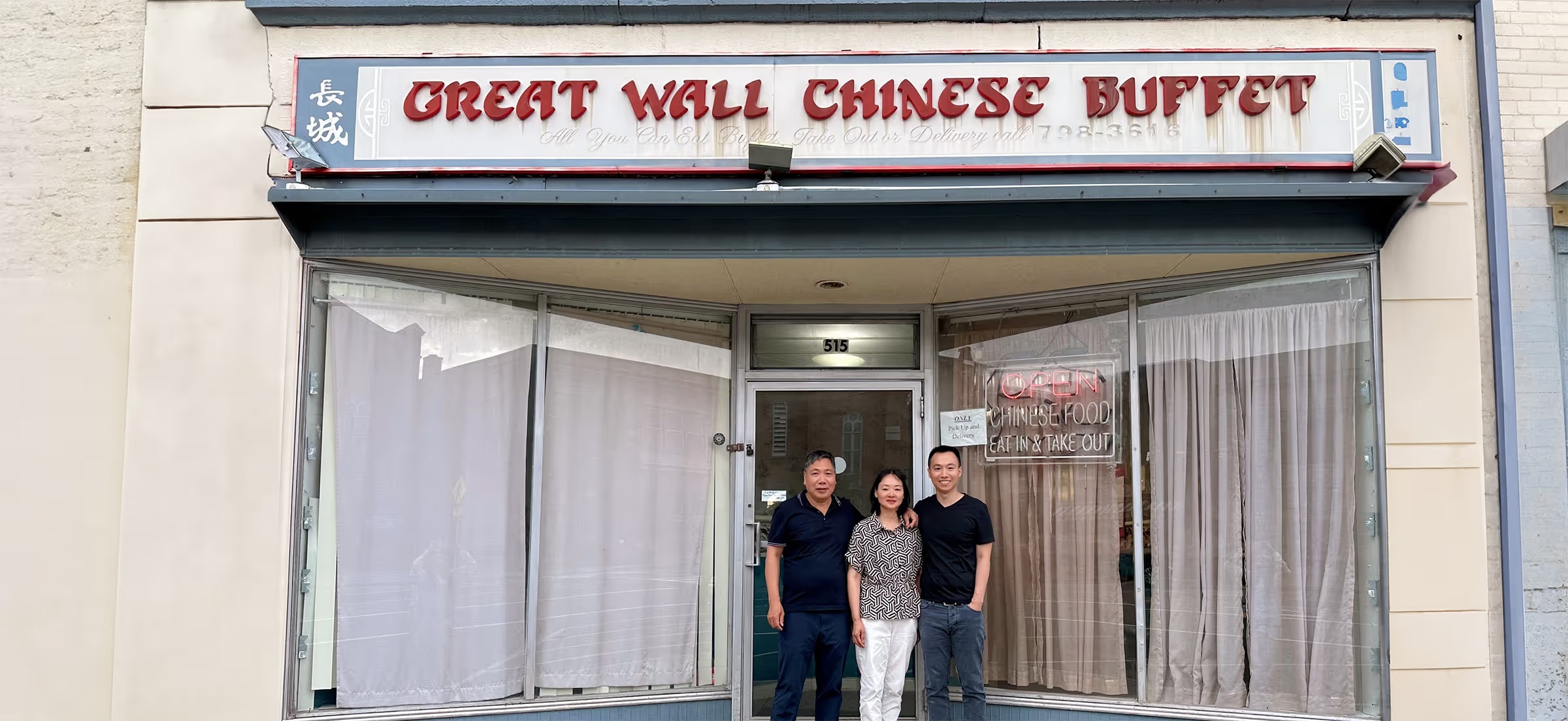
The family photograph makes a fitting place to return. Above the three people standing outside is the Great Wall Chinese Buffet sign; behind them is the doorway to a working life Lin knew before Harvard. His company has changed its name and added products. The reason he entered this business is still visible there, at the entrance.