Founder · Investor · Operator
Nitesh Banta
He gave up a venture seat to build the software he kept wishing his portfolio companies already had.
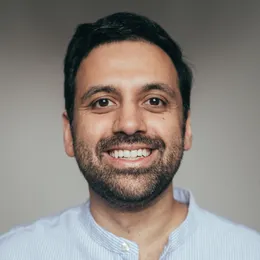
// The investor who decided backing the idea wasn't enough - he wanted to ship it.
He gave up a venture seat to build the software he kept wishing his portfolio companies already had.
// The investor who decided backing the idea wasn't enough - he wanted to ship it.
Nitesh Banta runs B12 out of New York, and the company does something that sounds almost rude in a software industry built on tutorials: it does the work for you. Type in what your business is, and a finished website appears in about sixty seconds, polished enough to launch. Then a team of human experts and a stack of AI quietly keep it alive - the blog posts, the SEO, the email marketing, the invoicing. The customer mostly watches it happen.
That premise - software that finishes the job instead of handing you the manual - is the single idea Banta has been circling his entire career. He frames it as a generational shift from "do-it-yourself" SaaS to "do-it-for-you" SaaS. Most founders pitch a feature. Banta pitches a change in who does the labor.
The customers are the people software usually forgets: solo accountants, two-person law firms, a wellness practice run off a phone. They don't want a website builder. They want a website. B12 collapses the difference, and Banta has staked a multi-decade mission on the gap between those two sentences.
B12 has two founders, and they met in middle school. Banta built the company with Adam Marcus, a computer scientist he'd known since before either of them could legally drive. "Adam and I have known each other since middle school and always worked well as a team," Banta has said. "We both have a passion for using tech to help small businesses." Most co-founder stories start with a hackathon or a mutual investor. This one started with a school hallway.
The pairing matters because it splits the work cleanly. Marcus brings the systems and the algorithmic design engine; Banta brings the market read and the conviction to keep raising against it. When the AI hype cycle hadn't arrived yet, that conviction was most of the company.
"I believe technology is a force for good."
Banta went to Harvard. The detail that actually changed his trajectory was a summer interning on Google's Customer Insights and Analytics team, where he watched technology scale impact across the entire planet and decided that was the only game worth playing. He did a stint in consulting at The Parthenon Group, started an early venture called Summer Workation, and got close to the peer-to-peer car-sharing company Getaround before the startups pulled him fully in.
In 2010 he joined General Catalyst as an investor, working out of an office in Harvard Square - a short walk from where he'd first caught the bug. Over roughly five years he backed Mark43, Handy, Brainly, and BigCommerce. In 2012 he co-founded Rough Draft Ventures, a fund built specifically to write checks to student entrepreneurs, helping launch the now-familiar idea that you don't need to graduate before you start.
He was good at investing. He left anyway. "After five great years as a venture capitalist," he wrote when he stepped away, the pull toward building something himself won. The investor had seen enough decks promising the do-it-for-you future to decide he'd rather ship it than fund it.
"At B12, our mission is to help people accomplish more as they work."
When B12 raised its early money in 2016, the press framing was almost a dare: it was just a matter of time before AI could design your website, and B12 was early to the inevitable. Banta's whole thesis was a timing call. The technology to fully automate a quality website didn't quite exist yet, so B12 wired humans into the loop and let the AI take over more of the work each year as it got good enough. He's described the company as combining project-management automation, a proprietary algorithmic design engine, and teams of experts to deliver professional results at accessible prices.
The capital followed the patience. A $12.4M round in 2016 from Breyer Capital, Founder Collective, General Catalyst, and SV Angel. A $15.7M Series A in 2021 led by Tola Capital, with General Catalyst, Breyer, and Naval Ravikant joining. Total funding north of $40M, in service of a product that, to the customer, just looks like a website appearing out of nowhere.
The sixty-second number isn't marketing fluff so much as the literal user experience he's chasing. A prospective customer describes their business in plain language, and B12 generates a complete, personalized site they can launch on immediately - a polished starting point rather than a blank canvas and a weekend of frustration. Everything after that, from copy edits to scheduling to online payments, is meant to feel like delegation, not configuration. The product's success metric, in Banta's telling, is how little the customer has to do.
Banta has a phrase for the category he thinks B12 belongs to: "intelligent software" that "seamlessly integrates AIs and human expertise to build products with simple user interfaces and incredible capabilities." The interface is deliberately dumb-simple; the engine underneath is anything but. The whole point is that the complexity disappears for the person using it. A florist or a tax preparer should never have to think about hosting, schema markup, or conversion-rate optimization. The software thinks about it for them.
There's a democratization argument underneath all of this that Banta makes sincerely. The tools that let a Fortune 500 marketing department run a slick web presence were, for a long time, simply out of reach for a one-person firm - too expensive, too technical, too time-hungry. Folding AI and a shared pool of human experts into one subscription is his way of pushing enterprise-grade capability down to the people who need it most and could never afford a full team. He frames it as supporting a global workforce, not replacing it.
That conviction has a personal root. Banta has talked about how, in B12's earliest days, angel backers wrote checks when "there was nothing to invest in" - no product, no metrics, just two people and a thesis. He found that early faith "incredibly comforting," and he's said paying that forward to the next generation of founders is part of why he does this. Rough Draft Ventures was the first expression of that instinct. B12, in a way, is the second.
Ask Banta why investors keep backing B12 and he won't lead with the AI. "The number-one factor is our amazing team," he says, pointing to a group with deep expertise in automation and product. On hiring he leans data-driven but anchors the whole thing in personal trust - the same instinct that made him build a company with a friend of twenty-plus years rather than a stranger with a better resume.
His advice to founders running low on fresh capital is unglamorous and exactly what you'd expect from someone who spent years on the other side of the table: "Be deliberate around your 3- and 6-month milestones. Use the time you have to accomplish the goals that will have the biggest impact on your business." No magic. Just sequencing.
In 2022 B12 made its website builder free and launched a "Firm of the Future" award, leaning harder into the professional-services niche - accounting, legal, mortgage, and adjacent categories where a small firm lives or dies by whether clients can find it online. Banta talks about wanting to be "the platform that powers those businesses and helps future-proof them."
He's not coy about the horizon. "We have a multi-decade mission to power our platform with the ever growing set of AI technologies that will be developed." Most founders measure in quarters. Banta measures in decades, which is either a red flag or the only honest way to talk about a bet on a technology curve that hasn't finished bending. He caught that curve early, wired humans alongside it, and has been waiting for the rest of the world to agree.
It's a strangely patient posture for someone who spent years in venture capital, an industry that prizes the fast exit and the clean narrative. Banta seems to have absorbed the opposite lesson from his time funding other people's companies: that the businesses worth building are the ones that take a decade to look obvious. B12 is a wager that the future of small-business software is invisible labor - a quiet engine that handles the parts nobody wanted to learn. If he's right, the 150,000 firms already on the platform are the early proof, not the finish line. And the kid who once watched Google scale impact across the planet gets to do a smaller, stubborner version of the same thing: handing leverage to the people who never had a team.
His handle is @nbanta everywhere - Twitter, Instagram, Medium, LinkedIn. Consistency as a personal brand.
He funded student startups out of a Harvard Square office before he ever sat in the founder's seat himself.
B12's pitch to investors was essentially a clock: AI building your website was inevitable. The only question was when.