The water pump was supposed to be off. In 1978, at Langley Air Force Base in Virginia, Steve Heinz discovered that its water bill was running about $8,000 a month higher than it should have been. A winter freeze had broken the pump, and water had been escaping into Chesapeake Bay for months. The bills had kept arriving. They had also kept getting approved.
It is an unglamorous beginning for a software career: a broken pump, an invoice, an institutional shrug. Yet the episode contains much of what would occupy Heinz for the next several decades. A number could announce a physical problem long before an organization bothered to look. Paying attention was the first engineering task.
He would build a company around that task, sell it to Enron, recover its assets after the collapse, and start again with his sons. Through all of it, the utility bill remained an unlikely object of devotion. Most people regard one as a small monthly insult. Heinz saw information someone had already paid to collect.
A computer in the right department
Heinz graduated from the United States Air Force Academy in 1976 with a civil engineering degree. Even as a cadet, he was interested in how buildings used energy: a dormitory heating improvement he proposed was adopted by the Air Force. Later, as a facilities engineer and energy manager, he encountered the difficulty of turning scattered consumption records into something useful.
At Penn State, where he earned his master’s in architectural engineering in 1980 through an Air Force-sponsored program, the department had acquired a microcomputer. Heinz took its available programming class. Here was a way to put an engineering question into a machine and ask it repeatedly, across accounts and buildings, without rebuilding the calculation each time.
He founded OmniComp in 1980 and began developing FASER Energy Accounting. Its commercial release followed in 1982. Bill checking, tracking, reporting, and evaluating savings became a business. Universities, government organizations, retailers, schools, and property managers were among the users. Their buildings differed; their paperwork had a family resemblance.
- 1980Heinz establishes OmniComp.
- 1982FASER reaches commercial users.
- 1996Enron buys OmniComp and FASER.
- 2001 →After Enron’s collapse, Heinz acquires the energy-information assets.
- 2010Good Steward Software becomes EnergyCAP, Inc.
The buyer that became the detour
In 1996, Enron bought OmniComp and FASER. The acquisition placed Heinz’s work inside a much larger energy business. Then Enron filed for bankruptcy in late 2001. A product built to help customers understand their spending had become entangled with a corporation whose own accounts would become infamous.
Heinz acquired the energy-information assets and launched Good Steward Software. The software had customers, a history, and useful work left to do. Ownership had failed to provide a secure ending. Rebuilding offered a continuation, though one with distinctly fewer people on the payroll.
“I picked up the pieces of my business, so to speak.”
Steve Heinz, recalling the restart
At first, he was the only employee. Chris joined in 2003 as the first full-time salesperson, working from a guest bedroom. Matthew, Chris’s twin, followed after the business could afford office space. John joined in 2005. By 2012, the company had 42 employees and the family members ran separate departments.
The detail that matters is the guest bedroom. It brings a story about corporate bankruptcy back to the scale on which work actually resumes: somebody needs to make the next sale. There is no ceremonial ribbon for that. There is a room in a house, a product to explain, and a customer deciding whether to trust it.
Four relatives, separate jobs
The sons had not been waiting eagerly to enter the family company. Heinz had to persuade them. That makes the eventual arrangement more interesting than a tidy succession story. They joined a rebuilding effort and developed responsibilities within it, rather than simply occupying places reserved for them.
In later reflections with Chris, Heinz described dividing work around individual strengths and the importance of shared purpose. A family surname can make an introduction easier; it cannot settle every question about who should handle sales, people, or product. Separate responsibilities gave the business a practical structure around those relationships.
There was growth to show for the effort. Good Steward Software reported that 2009 revenue rose 50 percent over 2008, its eighth consecutive annual sales increase. In January 2010, the company took the name of its software, EnergyCAP. The rebuilding business had acquired an identity customers already recognized.
The founder who still knew the report numbers
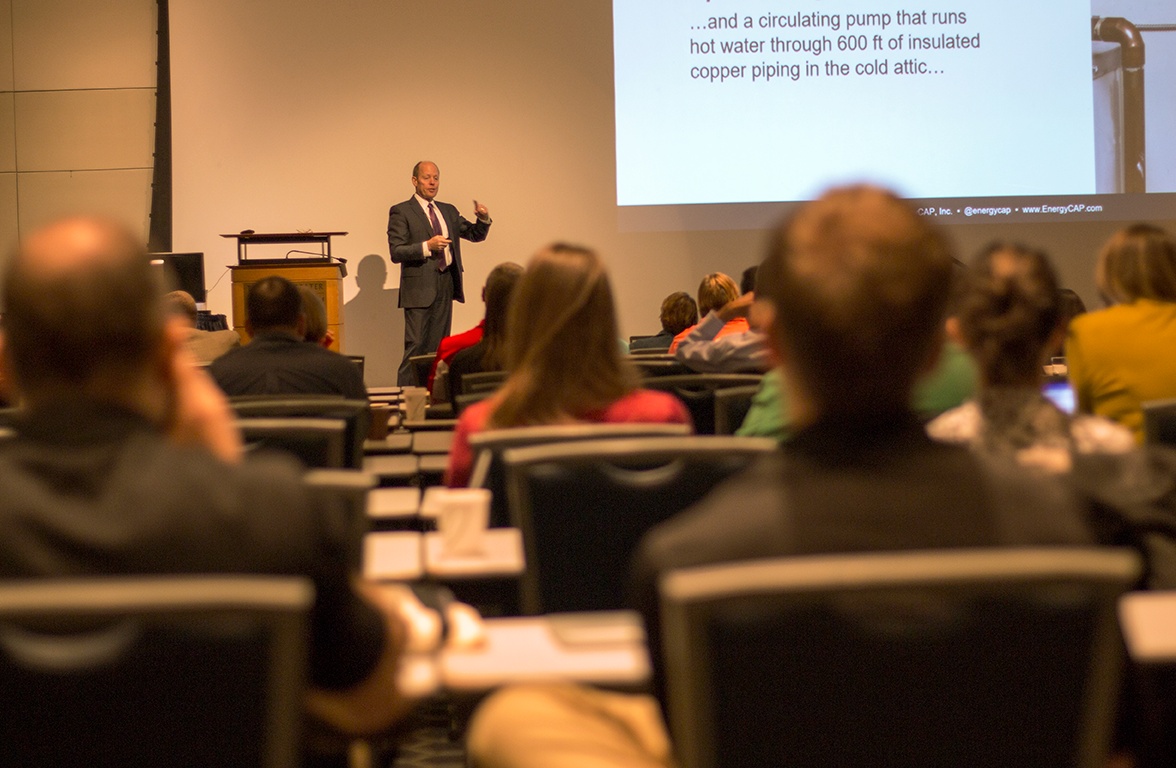
For a sense of Heinz at work, consider his closing presentation at the 2017 Catalyst conference. His productivity tips included finding meters with inconsistent units, checking bills that had failed to arrive, and using historical trend reports to catch errors. The founder was talking about report identifiers and the difference between gallons and kilogallons.
It is a revealing level of detail. A unit change can turn a sensible chart into nonsense. A missing invoice can quietly damage a budget. These are small administrative failures with consequences for people who must decide whether a building is performing properly. Heinz’s advice addressed the places where the daily work could go wrong.
He kept teaching. A 2019 guide selected ten useful reports from a library of more than 300. EnergyCAP Academy later offered an energy-management course with 11 lessons led by him. Teaching software that specifically requires knowing which problems users face, then explaining where to look before they give up and open another spreadsheet.
He also encouraged customers to show their work. His 2019 Dashboard Challenge invited users to share their custom dashboards, with a $100 gift card for the winning design. The prize was modest. The underlying idea was useful: a good display could travel from one organization to another, carrying a better question with it.
Before claiming a saving, check the weather
One recurring problem in Heinz’s field is deciding what an improvement actually accomplished. A smaller bill may reflect lower consumption, a cheaper rate, a shorter billing period, or a mild winter. Anyone can celebrate a declining line. Establishing why it declined takes more care.
Heinz taught measurement and verification through cost avoidance: compare current performance with a baseline adjusted for relevant changes. EnergyCAP’s approach includes weather, billing-period length, floor area, and commodity prices, with additional adjustments available for occupancy, schedules, and equipment changes. The arithmetic gives managers a way to separate their work from circumstances they did not control.
Conceptual illustration of measurement and verification; no customer results are plotted.
Campus energy accounting adds another complication. A university may generate steam or distribute utilities itself, then allocate costs among buildings and departments. In his 2019 conference guidance, Heinz addressed the calculations, splits, and explanations that make those internal bills defensible. A number has to survive the meeting where someone asks why their department is paying it.
Recognition arrived along the way. The Association of Energy Engineers named Heinz its 2013 International Energy Engineer of the Year. The honor put a public label on work whose most useful outcomes often involved an error caught, a comparison corrected, or a problem investigated before another bill arrived.
A second transaction, a different job
In March 2021, Resurgens Technology Partners invested in EnergyCAP. At the time, the business served more than 2,100 organizations. The partnership aimed to expand its commercial reach, technology, and product range, with acquisitions among the possibilities. The terms were not disclosed.
Heinz’s advice to his younger self, offered through the transaction’s adviser, was to prepare earlier for a sale or investment. Spend time building the value of the business several years before the transaction, he suggested. Product, pricing, and market decisions made well beforehand could matter later. It was the perspective of someone who had already experienced more than one version of an exit.
He eventually stepped away from daily operations while remaining a board member and investor. In a 2022 conversation with Chris, he considered how purpose changes across different stages of life. Family, faith, and work all belonged in that discussion. Leaving the chief executive’s chair created room to reconsider how he wanted to spend his time.
The question he sent back to Penn State
In 2021, Heinz committed $200,000 to endow Penn State’s Good Stewardship Scholarship in Architectural Engineering. It supports fourth- or fifth-year undergraduates pursuing the mechanical systems option and participating in university research. He was returning support to the department where access to a computer had helped change his direction.
Good Stewardship Scholarship
“Am I being a good ancestor?”
The question Heinz uses to consider his legacy
The scholarship makes that question concrete. An institution once supplied him with tools and teaching; now his gift could help another student use them. The benefit would arrive on someone else’s timetable. That seems an appropriate extension of a career spent asking what today’s decisions will look like when the next set of numbers comes in.
AI arrives. The bills still need checking.
At Catalyst Atlanta in 2025, Heinz looked back across 50 years of energy management. His practical refrain was compact: turn equipment off when unnecessary, reduce its load when possible, and keep it tuned. New tools had expanded the possibilities, while the ordinary tasks still demanded attention.
In a September 2025 webinar with Thomas Diliberti, he returned to collaboration among finance, facilities, sustainability, and energy teams. Their responsibilities overlap even when their vocabularies differ. Shared, accurate information lets a billing question become a maintenance investigation, or a facilities improvement become a financial result that someone can explain.
He was back among customers at Catalyst Converge in Orlando in September 2026, joining a panel with leaders from Pepperdine, Lobo Energy at the University of New Mexico, and Baltimore City. The discussion included AI and the question of when new facilities technology is worth adopting. EnergyCAP introduced its Insights reporting and alerting capabilities at the same conference.
Heinz’s current advice is to prepare reliable data for those tools. The argument has the familiarity of an old engineering habit. A machine can help identify an anomaly, but an organization still needs trustworthy records and people prepared to respond. Somewhere, a bill has arrived. He would like someone to read it.
Read, watch, follow
- EnergyCAP - company website
- Steve Heinz on LinkedIn
- Watch: 2013 AEE acceptance speech
- Listen: rebuilding after Enron
- Penn State: the Good Stewardship Scholarship
- Catalyst Converge 2026
- The family business, in Inc.
- The early engineering story, in Scientific American
- EnergyCAP’s official history
- The 2013 AEE recognition
- Reports, teaching, and practical advice
- Measurement and verification
- 2025 webinar: finance meets facilities
- The 2021 investment announcement