Jim King was working on accounts receivable at the Stevens Point Brewery when a computer salesman supplied a more consequential piece of business. A school district needed software for salary negotiations. Would he care to bid? King did. In 1981, he offered to build Merrill’s system for $4,500. He later discovered the nearest competing bid had been $17,000.
There was a calculation behind the price. More than fifty other Wisconsin schools might want something similar. King was considering the next customers while quoting for the first. When the finished system was demonstrated to other districts, only three attended. All three bought it. As disappointing turnouts go, this one had excellent manners.
The setting suits him: a programmer already doing practical work, a conversation with someone who knew a customer, an administrative problem waiting for an answer. The eventual scale of Skyward can make that beginning seem inevitable. At the time, there was a bid to write and a system to deliver.
A garage with a school district attached
Jim and his wife, Jean, had founded Jim King & Associates in 1980. The company began in their garage in Stevens Point, Wisconsin, offering custom software design on a consulting basis. Merrill’s personnel and salary-negotiation project gave that general service a particular direction.
School administration is an unglamorous place to discover a business. Salaries must be calculated. Records must be maintained. The paperwork continues when the classroom empties. These needs gave King’s programming a purpose that administrators could recognize without a lengthy explanation.
By the company’s fortieth anniversary in 2020, its work included student information systems and human resources and finance software. Skyward counted more than 2,000 customers and deployments in ten countries. King’s own description of the motivation was plain: “The foundation of Skyward was always built around my passion to help others through technology.” The sentence brings a large company back to the size of a task: someone has work to do; perhaps a program can help.
The customer who stayed
Merrill gives King’s story an unusually long second act. Four decades after becoming the first customer, the district was still using Skyward. A founding sale had become a working relationship measured in generations of software.
Superintendent John Sample described the transition from an older point-and-click system to a web version as a major change. He had initially been reluctant, then found the newer approach better. That is a useful detail in a founder’s biography. A customer can stay while the product changes substantially; staying does not require standing still.
The district’s finance director, Brian Dasher, emphasized implementation and making good use of the system rather than maintaining parallel spreadsheets and databases. The relationship included people to call for help, product updates, and a sales representative who checked in. King’s original programming assignment had grown into that continuing obligation. Winning the bid gave him a customer. The forty years afterward gave the customer ample opportunity to judge the decision.
A mother as the usability test
Jim’s younger brother Cliff later offered a compact explanation of the founder’s approach to design: Jim wanted software their mother could use. It is a family anecdote with a demanding specification hiding inside it. A developer cannot settle the argument by saying the code works if the person at the keyboard cannot work out what to do.
Cliff, speaking as Skyward’s CEO in 2017, described a business that listened to customers and treated service as part of the product. The software helped districts carry out administrative work and produce required state and federal reports. Users were school employees with jobs of their own, rather than a captive audience for a programmer’s cleverness.
The family test is amusing because it is familiar. Many people have explained a computer screen to a parent. King’s standard put the burden back on the builder. A feature that needs a resident interpreter is asking quite a lot of the school office.
Two brothers, more than one kind of work
Cliff joined Jim and Jean in 1981. He went on to hold several management positions and served as CEO from 2008 through 2018. When Jim spoke about his brother’s contribution in 2021, he credited Cliff with helping make the company’s growth possible.
That acknowledgment complicates the tidy founder portrait in a welcome way. A company can begin with one programmer’s contract and grow through abilities that do not all belong to that programmer. Skyward’s account of Cliff emphasized his attention to people and the company culture he helped shape.
Jim’s response placed his brother inside the explanation for the business, alongside himself and Jean. Family ownership can sound abstract from a distance. Here it consisted of people doing different jobs over many years. The name on the earliest business was Jim’s. The work required a longer list.
The local graduates behind the software
A snapshot from 2002 shows how firmly the business had become connected to its surroundings. Jim was a University of Wisconsin-Stevens Point alumnus, class of 1968; Cliff was also a graduate. Both had begun as programmers and handled their own marketing before moving into administrative work.
At that point, the company employed 43 programmers, about 80 percent of them UW-Stevens Point graduates. Across departments at its Stevens Point headquarters, it employed 63 university alumni, alongside graduates of other Wisconsin institutions and Mid-State Technical College.
Those numbers make the hometown connection tangible. A university supplied people who could build and support a software business. The business supplied work those graduates could do locally. For King, expanding a market beyond Wisconsin did not require cutting the ties that helped him serve it. The company’s growing reach and its local hiring story were happening at the same time.
An intern gets a bigger assignment
Scott Glinski’s route through Skyward offers another view of King as an employer. Glinski joined as an IT intern in 1987, the company’s seventeenth employee. There was a delay before he could start because the office had run out of space. Even an entry-level appointment apparently required a real-estate solution.
Later that year, Jim asked him to help open the company’s first branch office in Minnesota. Glinski accepted. His work expanded from installing computers and showing districts how to use them into customer service, sales, and management.
He eventually became president and then CEO. The career stretched across decades, but the early assignment is revealing on its own. Jim had asked a recent intern to help carry the business into another state. A family company was also becoming a place where someone arriving from outside the family could accumulate responsibility. The history of its leadership includes both routes.
Passing the chair across the table
In February 2020, Jim announced that the board had unanimously selected his son Jerry to succeed him as chairman. Jim had held the chair for twelve years. He wanted to give the next generation its turn and allow himself more time to enjoy life.
Jerry’s own Skyward career had begun as a software developer in 1991. His later responsibilities included administration, finance, human resources, facilities, and oversight of the company’s new headquarters construction. The handoff followed years of work inside the business.
Jim and Jean said they would remain on the board as mentors and advisors, and Jim expressed their commitment to keeping Skyward in the family. His stated ambition had acquired a different timescale. He was talking about what the next generation would inherit and how it would lead. After years of building an organization, he was making room for other people to run it.
“The time has come to pass the torch to the next generation and take some time to enjoy life.”
Jim King · February 2020
A return to the school gates
King’s education came back into the public story in 2022. Pacelli Catholic Schools named Jim, a member of its class of 1963, and his late brother Cliff as Distinguished Alumni Award recipients. Jim was also scheduled to deliver the keynote at that year’s high-school graduation.
The recognition connected professional success to service in the community. Pacelli described Jim’s support for the school and noted the brothers’ habit of sharing recognition with their company. The award brought a former student back into view through the work he had done after leaving.
There is a pleasing circularity in a school-software founder returning for graduation. His business had spent decades serving the administrative needs of schools. Now his own school was asking its graduating class to consider his example. The invitation put the person back into a story otherwise easy to tell with employee counts and customer totals.
Room for the next programmer
Jim and Jean’s Skyward Scholars Program gave that connection to education a practical form. Announced in 2022, the endowed program supports incoming UW-Stevens Point students pursuing programming careers. Its design provides partial tuition scholarships for up to four consecutive years, with five additional students selected each year.
At full operation, up to twenty students could benefit at once. The program also supports curricular activities in computing. The four-year structure matters: it follows students beyond the initial excitement of arriving on campus and into the sustained work of completing a degree.
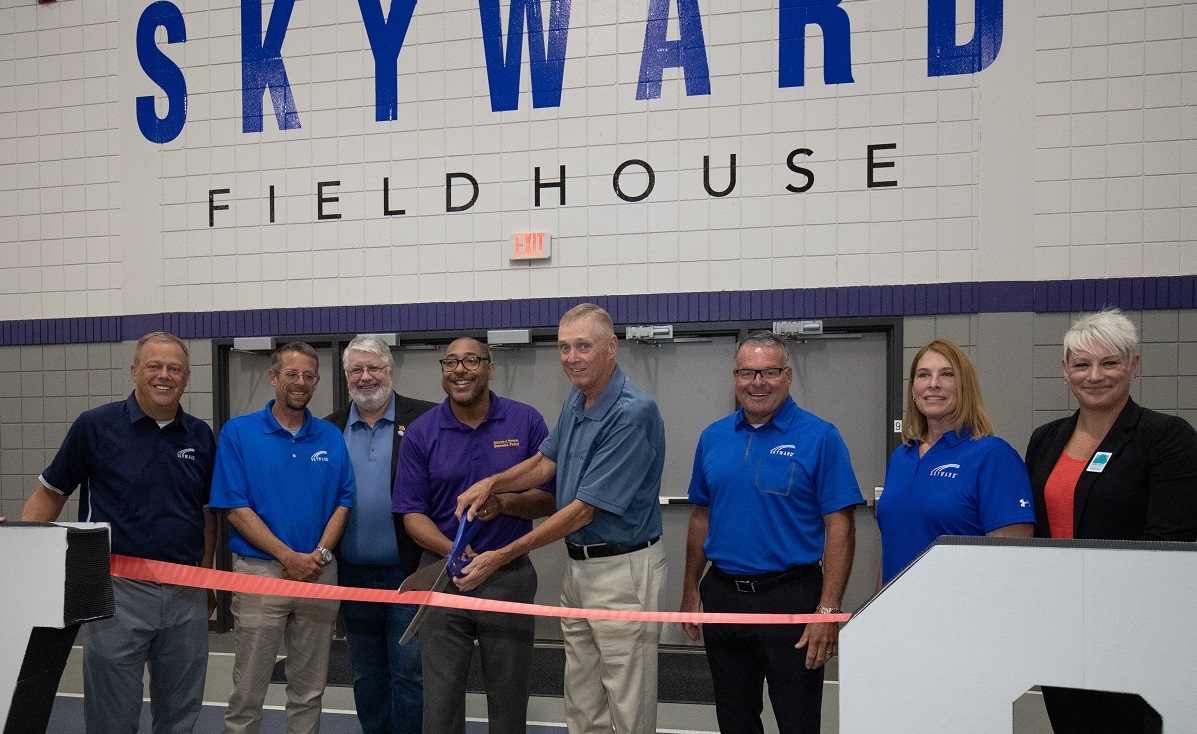
The university named its multi-activity center Skyward Fieldhouse in recognition of the support. A building name is the visible part. The scholarship mechanism is quieter, recurring each academic year. For a programmer whose first school project became a continuing business, it is a fitting form of generosity: useful support designed to keep working.
Partial tuition support for students pursuing programming careers at UW-Stevens Point.
In April 2025, the university recognized Skyward with a UW Regents Business Partnership Award. It highlighted the scholarship fund and a campus internship center serving forty to fifty interns a year. More than forty percent of the company’s workforce were university alumni.
The connection Jim helped establish was still producing new beginnings. Students could learn close to their classes, gain experience, and see a possible working life nearby. The garage had long since served its purpose. There were other people now who needed somewhere to start.