A child asks whether any animal can live without water. At Atlanta’s Ron Clark Academy, science teacher Daniel Thompson puts the question to his voice-controlled assistant. Information about kangaroo rats appears on the classroom screen. Thompson keeps teaching. The interesting part is the distance he does not have to travel: back to the computer, through the browser, away from the children.
Merlyn Mind built its business around that distance. Its assistant lets teachers operate classroom technology by speaking or using a remote. A presentation advances; a video pauses; a timer starts. These are small actions, almost beneath the dignity of an AI sales pitch. Yet a lesson consists of small actions, and an interruption can arrive wearing the modest disguise of a mouse click.
- Teachers control familiar classroom tools with voice and remote commands.
- The product grew from a dedicated hub into computer and display-based assistants.
- Promethean acquired the education technology assets in September 2025.
The machine that could answer, but could not teach
Co-founder Satya Nitta had already encountered the grander ambition. At IBM, he worked on using Watson to teach students directly. The project lasted five years and consumed $100 million, according to reporting on that earlier effort. It ended in 2017. Those were IBM’s costs, before Merlyn existed.
A machine’s ability to produce an answer had proved an inadequate substitute for the work of teaching. Knowing when a pupil needs encouragement, when confusion conceals embarrassment, or when a discussion deserves another minute is a different problem. Nitta’s subsequent company chose to help the person already doing that work.
Founded in 2018 by Nitta, Ravi Kokku and Sharad Sundararajan, Merlyn Mind brought together former IBM researchers around a narrower task. Its public principles include a wonderfully untechnical sentence:
“Teachers are irreplaceable.”Merlyn Mind’s responsible-AI principles
That sentence supplies the product’s organizing idea. The teacher remains responsible for the lesson. The assistant takes instructions about the tools. A school can introduce AI without making a chatbot the central relationship in the room.
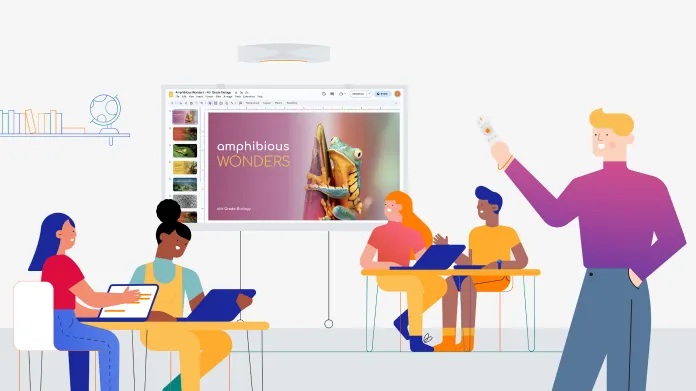
A very ordinary kind of magic
The original system, launched in 2021, was called Symphony Classroom. It combined an AI hub, microphones, a speaker, software and a remote. Teachers could work with their existing displays and resources, including Google Slides, Google Drive, Nearpod and Newsela. The company announced $29 million in funding to date, led by Learn Capital, alongside pilots in more than 50 classrooms across over 20 schools.
Later, Merlyn Origin placed the assistant on the teacher’s computer. Its remote and USB receiver work with a desktop application and browser extension. Merlyn Display brings similar capabilities to selected Newline interactive panels. The product family offers different entry points into classrooms that already have different equipment.
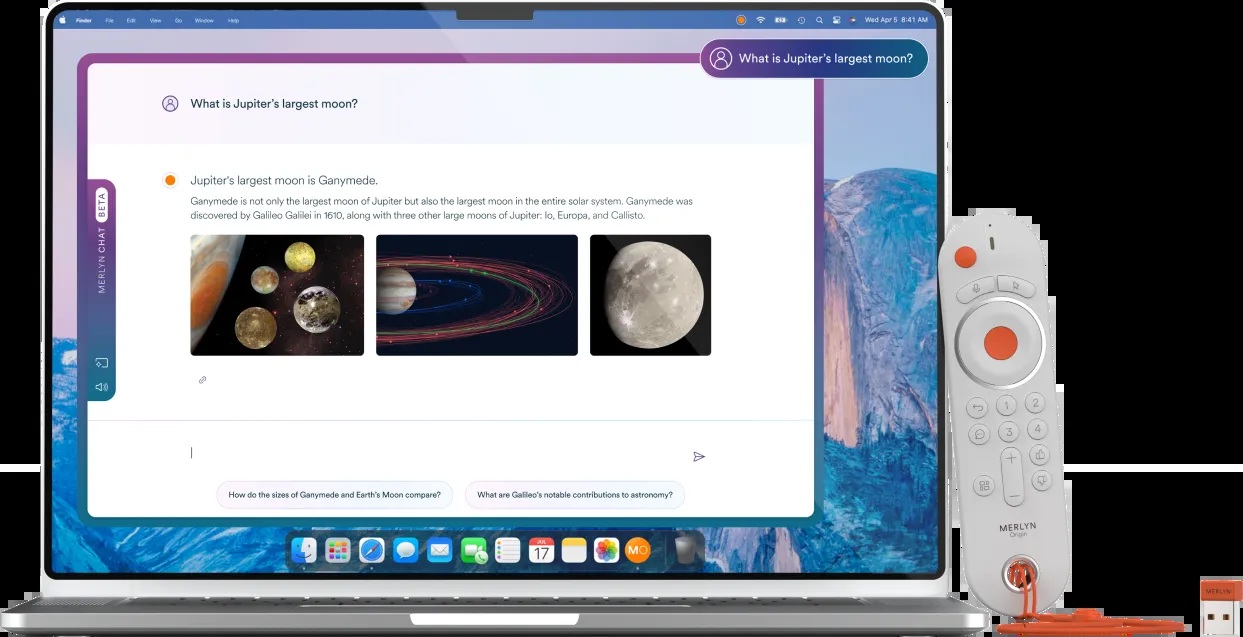
Origin also offers classroom chat, a Lesson Builder and a Rubric Builder. The chat returns educational answers with references and follow-up questions; the preparation tools draft materials for teachers to examine. This moves Merlyn beyond navigation into content, while keeping the educator responsible for choosing what reaches the class.
The buyer is a school. The test is a lesson.
Merlyn sells into education through institutions and resellers. Hardware and subscriptions belong in the same purchasing conversation: the company’s customer agreement describes licenses with defined durations and different subscriptions for different offerings. A historical Trafera promotion offered up to five three-year Symphony Classroom packages at $899.99 each, with freight extra. That price belongs to that promotion, rather than today’s procurement budget.
The comparison depends on the job. For changing slides, a conventional presentation remote is an obvious alternative. For drafting a lesson, teacher AI software offers another route. A tutoring chatbot addresses a different interaction. Merlyn’s distinctive proposition is the combination of classroom control and educational assistance while the teacher moves among students.
Installation deserves attention. Origin’s deployment guide calls for the desktop app, browser extension, USB receiver and school sign-in. Administrators need to prepare the network and devices. Voice control saves little time if a teacher spends the beginning of each lesson troubleshooting access. Familiar workflows and dependable setup are part of the product’s value.
Count the commands. Then watch the teacher.
Merlyn’s Origin page reports more than 30 daily actions for active users and more than 100 for super-users. These are company-reported activity figures, rather than evidence of improved attainment. They do suggest the intended rhythm: repeated assistance throughout a day, instead of an impressive demonstration followed by a forgotten device.
A Caldwell County Schools case study described more than 50 teachers using the assistant. Lower Creek Elementary teacher Anna Bruton offered a useful, unglamorous verdict: “Merlyn is something you can use all day, every day.” The remark is customer testimony published by the company. Its appeal lies in frequency. Something useful once makes a good demonstration; something useful repeatedly can become a habit.
The partner buys the machinery
Promethean began distributing Symphony Classroom in 2022. In September 2025, its parent Mynd.ai announced the acquisition of Merlyn’s education software and related intellectual property. The agreement excluded Emergence AI assets. This was an education technology asset purchase, an important distinction from buying the entire company. Promethean said it planned to adapt the technology for ActivSuite and Explain Everything.
The brand’s subsequent reports include a January 2026 Speed Award recognition and Origin’s adoption at Philadelphia’s Gesu School. Neither an award nor a classroom anecdote settles the larger question of educational impact.
For anyone building tools, the copyable lesson is specific: observe a task people repeat, fit the tools they already use, and make improvement visible in ordinary work. In classrooms with unsupported equipment or unreliable setup, the proposition weakens. Generated answers still need a teacher’s judgment. Merlyn’s most persuasive promise remains modest enough to test: let the teacher keep moving, and see whether the lesson moves more easily too.