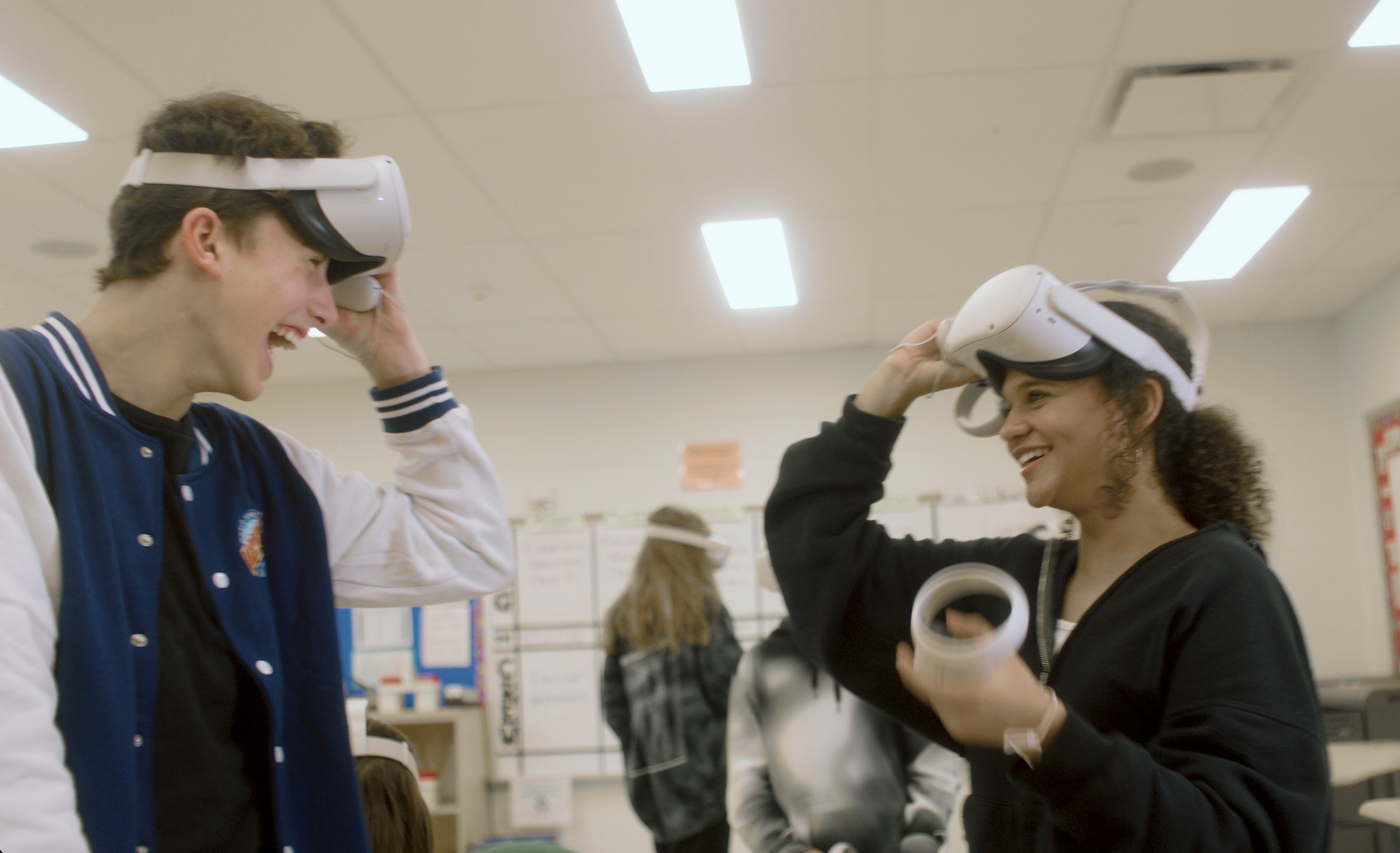
A classroom in Pomona, and a tsunami
Somewhere in California right now, a 14-year-old is standing inside a tsunami. She is not on a beach. She is in a classroom, in a Meta Quest, watching a wave that is taller than her math teacher form, crest, and come down on a coastline she has never visited. Before the lesson ends, she will have estimated its volume, predicted its run-up, and - almost as an afterthought - written down an exponential function. The function is the easy part. The standing-inside-the-wave part is the lesson.
This is what Prisms looks like in 2026. Not a slide deck about virtual reality in education. Not a pitch. A wave, and a kid, and a piece of math that finally lands.
What Anurupa Ganguly saw before she built anything
The official story of American math education is that it is broken. The unofficial story is that it has been broken for so long the brokenness now looks like the floorplan. Kids memorize procedures. They forget them. They sit for a standardized test. They forget those. Somewhere in the middle, a generation decides that math is a thing that happens to them rather than a thing they do.
Anurupa Ganguly spent more than a decade inside that floorplan. She trained as an engineer at MIT, then taught math and physics, then ran the secondary math office for Boston Public Schools, then served as senior director of teaching and learning at the New York City Department of Education. That is roughly every seat at the table - student, teacher, district leader - and from each one she watched the same thing: students arriving at the symbol before they had the experience.
She decided the order was backwards.
The unfashionable case for a VR headset in school
In 2020, "VR in the classroom" was something between a cliché and a punchline. Most edtech pitches that used the phrase produced novelty - a butterfly garden, a planet, a heart you could rotate. Engagement up, learning flat. Ganguly's bet was different. She argued that VR was not a visualization trick. It was an embodied cognition tool: a way to give students a body inside a problem before asking them to abstract it.
If that sounds suspiciously like a learning-sciences paper, that is because it was one first. The National Science Foundation funded early prototype work. MIT's Venture Mentoring Service helped with the rest. By the time the rest of the world remembered what the Oculus Quest was, Prisms had a curriculum.
What you actually do inside a Prisms lesson
You put on a Meta Quest. A teacher sets the scenario. You walk - really walk - through a public health outbreak, a population curve, a coastal flood model, a chemistry reaction. You manipulate variables with your hands. Sometimes you fail the scenario and watch the curve go vertical. Sometimes you keep it flat. Either way, you are inside the function before you ever name it.
Then comes the symbolic part: the equation, the graph, the teacher pulling the class back to the whiteboard, the pencil work that, according to everything we used to think about math class, should have come first. Prisms inverts the order. The kid abstracts up from experience, not down from notation.
For teachers, there is a companion web dashboard with learning analytics, real-time progress, and curriculum alignment - the deeply unglamorous infrastructure that makes the deeply glamorous part work at scale.
The Lesson Catalog (so far)
Grades 7-11. Algebra I & II, geometry, biology, chemistry, middle-school math and science. Calculus, statistics, and data science are in development. The company has signaled an expansion toward grade 14 - early college - by fall 2025.
The short, fast history of Prisms of Reality
- 2020Anurupa Ganguly founds Prisms of Reality with early NSF support. The pandemic is, accidentally, a market.
- 2021First problem-driven math curriculum launches in VR; pilots begin in a handful of school districts.
- 2022Prisms announces it is delivering outcomes-driven math in 15 states and raises $4.25M in earlier funding.
- 2023Andreessen Horowitz leads a $12.5M Series A. The pitch is no longer "VR in education." It is "the spatial learning company."
- 2024MIT News profiles the company; reach climbs to roughly 300,000 students across 35 states. Gates Foundation funds multistate studies.
- 2025Subject coverage expands toward calculus, statistics, data science. Early college pilots announced.
The numbers, which are doing some heavy lifting
Edtech is a graveyard of charming demos. The graveyard is full because the demos rarely move scores. Prisms' early data is, to its credit, doing the unfashionable thing of moving scores. An independent study found an 11% lift in algebra performance. The Gates Foundation is funding the larger, multistate version of that question, which is the kind of question only takes a few years and several million dollars to answer well.
Where Prisms shows up, in numbers
Built by teachers, which is more rare than it sounds
Most edtech is built by people who left the classroom. Prisms is built by people who, in many cases, never quite did. Ganguly has been explicit about this: the company is unusually full of former educators, and the product reflects it. Lessons start from instructional problems, not engineering ones.
There is also a quieter, more political claim underneath the company: that immersive technology should not be a luxury experience reserved for kids whose schools can afford it. Prisms has gone out of its way to ship into rural Kentucky and Ohio districts as well as urban systems. Educational equity is in the brand documents. It is also, less politely, in the customer list.
Who Prisms works with
Meta Quest as the hardware platform. The Gates Foundation as a research partner. The National Science Foundation as an early prototype funder. MIT's Venture Mentoring Service in the background. School districts ranging from Pomona, CA to Philadelphia, PA to Bullitt County, KY.
The end of the worksheet, or at least a serious dent in it
The honest tension at the heart of Prisms is not whether VR works in classrooms. The honest tension is whether American schools - underfunded, exhausted, and politically combustible - can absorb a new modality fast enough to matter. Hardware costs are falling. Teacher trust is, slowly, rising. The roadmap is widening from middle school into early college, and from math into the rest of the natural sciences.
If Prisms is right - if the order really is experience first, symbol second - then the worksheet is not going away because someone disliked it. It is going away because something simply teaches better. That is a quieter kind of revolution than edtech is used to. It is also harder to fake.
Back to Pomona
The student in Pomona takes off the headset. The wave is gone. The classroom is back. On the whiteboard, the teacher writes y = a·b^x, and for the first time in this kid's school career, those letters are not strangers. They are a souvenir from a place she just walked through.
This is what Prisms is doing. It is not making math fun, which is the lowest bar in edtech and arguably a slur. It is making math real first. The fun, when it shows up, is a side effect of finally getting to do the thing.