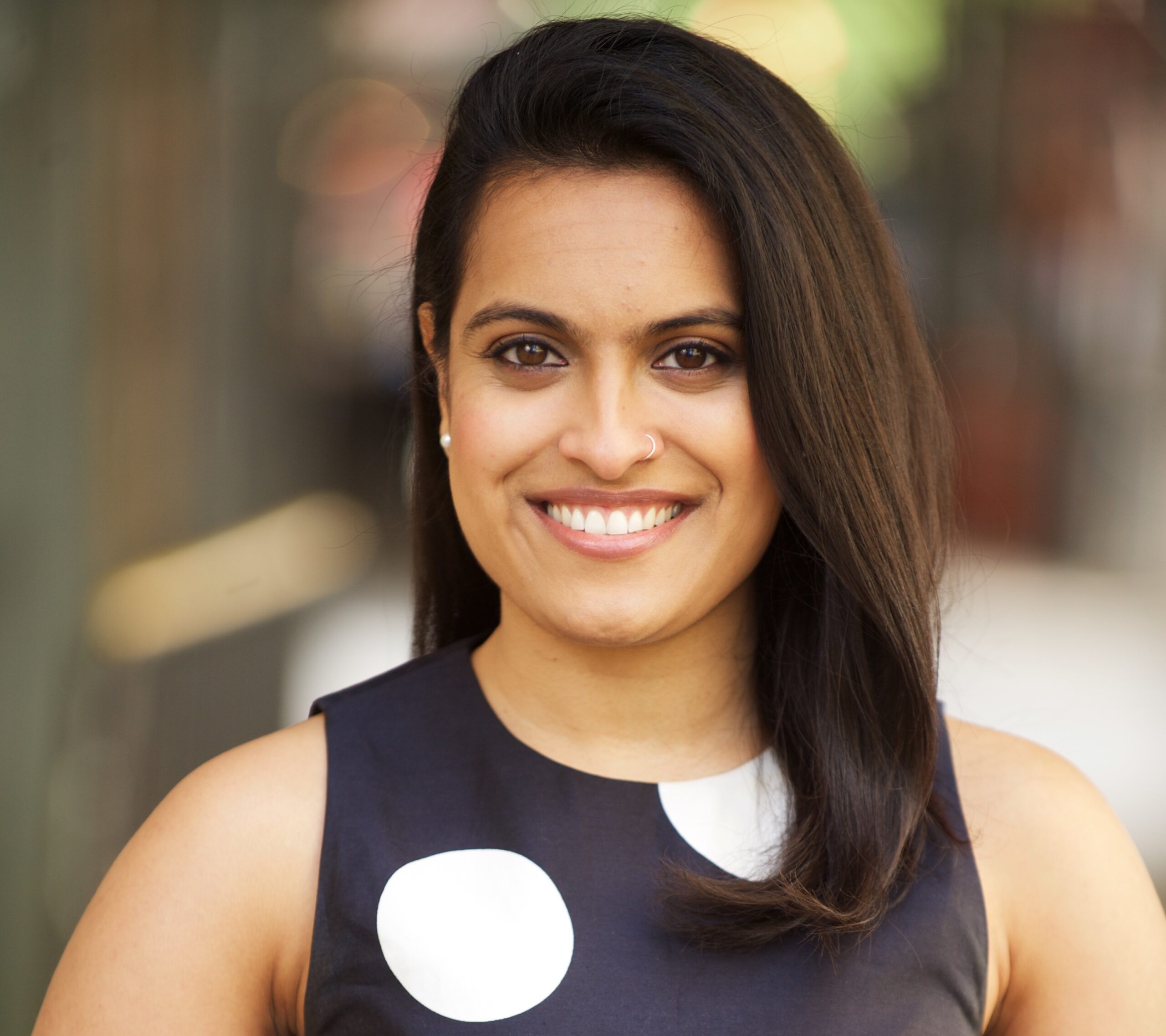
There's a particular kind of student Anurupa Ganguly has never stopped thinking about. Not the one who breezes through algebra. The one who stares at a quadratic equation and genuinely cannot picture why any of it matters. The one who might end up in a field that uses math every day - engineering, architecture, public health - but whose path there closes at age fourteen because nobody ever showed them the geometry behind a flood-resistant building or the statistics inside a breaking news graph. Anurupa Ganguly spent over a decade in American classrooms and education offices watching that door close. Then she built a key.
The company is called Prisms. The premise is simple and quietly radical: students should encounter the physical reality of a concept before they learn its notation. You feel the slope of a hill in your hands before you write the derivative. You step inside a data visualization before you calculate a mean. You solve a real problem - designing the foundation height for a house in a flood zone - before you ever see the formula that formalizes your answer. It's the way humans actually learn things. It just never scaled before VR made it possible.
Ganguly's path to this idea was not a straight line from MIT to Silicon Valley. She earned her BS and M.Eng in Electrical Engineering and Computer Science at MIT - graduating in 2009 - and then did what almost nobody in her cohort did: she went to teach math and physics at Boston Public Schools. Then she moved to Mumbai to recruit and train teachers. Then she ran the secondary mathematics office back in Boston. Then she became Director of Mathematics and Engineering at Success Academy Charter Schools in New York. Then Senior Director of Teaching and Learning at the NYC Department of Education. She collected the entire map of American K-12 before she sat down to redesign it.
"We intend to become the next textbook. The next textbooks will be spatial and experiential."- Anurupa Ganguly, Founder & CEO, Prisms
She founded Prisms in June 2020, with initial support from the National Science Foundation - not a venture capital term sheet. The research came before the pitch deck. The National Science Foundation SBIR grant meant the first version of the product was built to prove an educational hypothesis, not to acquire users. That sequence matters: it's why the results hold up when researchers look at them. When an independent study found an 11% increase in Algebra I test scores between control and treatment groups, there were actual controls and actual treatment groups. When teachers report that a lesson that used to take three to four weeks now lands in one, there are teachers who have taught it both ways.
The scale came later. A $4.25M seed round in June 2022, led by Andreessen Horowitz with co-investors GGV Capital and Nate Mitchell - the co-founder of Oculus VR. Mitchell's involvement was not incidental. He spent years building the hardware that made immersive experiences possible, and he saw Prisms as one of the most serious answers to what all that hardware is actually for. A $12.5M Series A from Andreessen Horowitz followed in January 2023. By 2024, Prisms was live in 300+ school districts across 35 states, with over 300,000 students inside VR headsets solving math problems they'd previously only read about.
Ganguly is specific about what she is not building. This is not gamification. Students are not earning badges for multiplying fractions. They are standing inside a river delta learning about water flow dynamics because there is a real village downstream that needs a dam. They are walking through a geometrically accurate representation of a theorem to understand why it's true, not just that it is. The distinction between "doing an activity" and "building a conceptual foundation" is the thing she keeps returning to in every interview, every talk, every pitch. It is also, she would argue, the thing traditional education keeps getting backwards - presenting notation first, meaning later, and wondering why so many students conclude that math is not for them.
"I really do believe that a better math education is going to save our Democracy."- Anurupa Ganguly
Her motivation is personal in the way that tends to actually sustain a company through hard years. She grew up watching women navigate systems that weren't built for them - and she has spoken about building Prisms specifically to support underserved students breaking generational barriers in STEM, similar to the women who raised her. When she talks about equity in math education, it doesn't read as marketing language. It reads as the reason the company exists on days when everything else is hard.
The platform now runs on Meta Quest and Pico VR headsets. There are 80+ full-length content modules covering Grades 7-11 in math and science. Teachers get a web-based dashboard that tracks student progress in real time, making the invisible cognitive work of spatial reasoning suddenly measurable. The company provides both hardware and software to schools, handling the logistics of an infrastructure most districts have no experience managing. The name "Prisms of Reality" - now shortened to Prisms - captures the founding idea: every mathematical concept is a prism that refracts the world into its underlying structure, and students deserve to see that light directly, not just read about it in a textbook.
Anurupa Ganguly speaks at Aspen Ideas. She speaks at ASU GSV Summit and AWE USA. She appears on TechCrunch's Found podcast, on the a16z podcast about the Classroom of 2050, on every education technology circuit worth knowing. She has a personal website at anurupa.com. She has an MIT mentorship profile. And she has a company that is, by measurable evidence, making students better at math in 35 states. In edtech, that last part is the rare one.