A teacher opens a student essay in Google Docs. There is a stack of papers to review, tomorrow’s lesson to plan, and a class in which the same reading passage will be too easy for some children and too hard for others. The obvious AI solution is a blank chat box. The practical problem is that the essay is already open somewhere else. Brisk Teaching decided the useful place for an assistant was inside the work.
That decision sounds almost embarrassingly small. Arman Jaffer says his team designed the original browser extension while working from a closet in 2023. By July 2026, he said more than two million teachers used Brisk. The distance between those two facts is the subject of this story: a company that first won attention by removing clicks, then had to learn that a district buys much more than convenience.
- Brisk’s Chrome and Edge extension works across Docs, Word, slides, PDFs, web pages and videos.
- Teachers can create resources, adjust reading levels, inspect writing and draft feedback; Boost adds teacher-controlled student activities.
- The teacher plan is free. District plans use custom, per-student pricing and add guidance, oversight and curriculum alignment.
- The crucial question is whether quick AI output can remain faithful to the lesson a school actually teaches.
The tab is the territory
The usual education software pitch begins by asking a teacher to visit another destination. Brisk arrived as a small “B” in the browser. Open an article, YouTube video, PDF or student document, and its tools can use that material as context. A teacher can turn a video into quiz questions, create slides from an article, lower the reading level of a text, or draft comments on a student’s writing. The output remains something to edit and own; Brisk’s getting-started guide explicitly tells teachers to review comments before posting them.
That placement is Brisk’s competitive choice. ChatGPT, Claude and Gemini can generate teaching materials; education-focused rivals such as MagicSchool also offer specialized tools. Brisk’s pitch is that the teacher need not copy an entire day’s work into a separate window. There is less ceremony between seeing a problem and asking for help. In a profession accustomed to too many tabs, that counts for something.
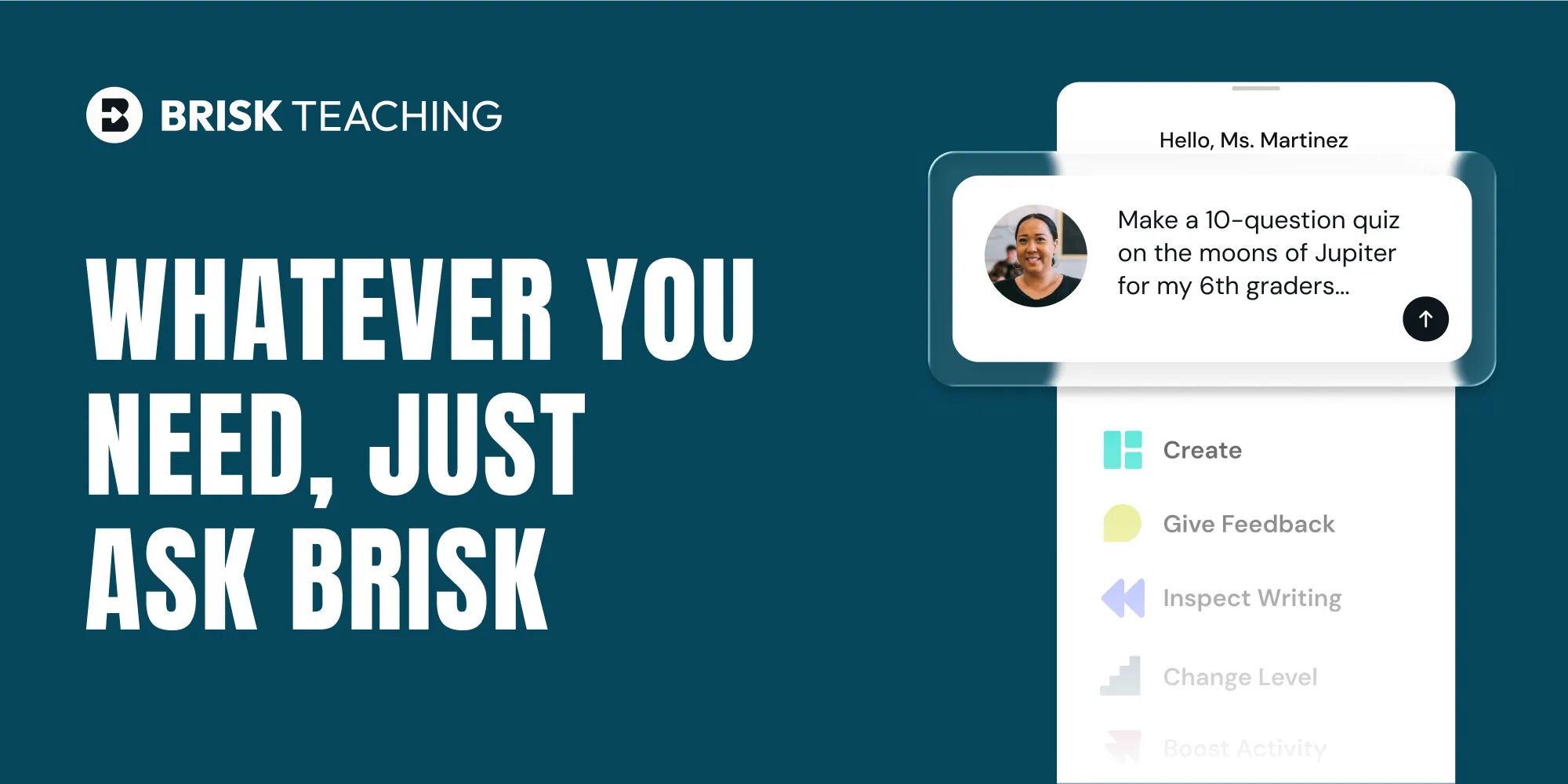
The products now travel farther than the original extension. Brisk Next is a planning and creation workspace; Brisk Boost lets teachers assign student-facing activities with AI assistance and monitor how students respond. The company’s help pages describe more than 20 tools in the free plan, including a lesson planner, quiz maker, rubric maker and a short podcast generator. Paid plans add batch feedback, standards alignment, intervention tools and administrative visibility. In 2026 the interface moved from hunting through menus to describing what one wants in a conversation.
What the skeptics saw
In Barbers Hill, Texas, the earliest advocates were middle school English teachers who found Brisk themselves. The district, which serves about 8,000 students, tried other AI products and worried about abandoning sound instructional practice for shiny software. Its technology coaches began with small demonstrations and one-to-one help. Some of the teachers who had resisted AI went on to train their colleagues. That is an unusually revealing adoption story: the product did not persuade everyone through a central memo. It became legible in the places teachers already worked.
One high school teacher described using Brisk to produce timely, targeted comments on writing. Another used Boost so seniors could “chat” with Chaucer while studying The Canterbury Tales. The example is amusing, but it also points to the line Brisk has to walk. A simulated medieval author can open a discussion; it cannot replace a teacher’s reading of the text, or the judgment needed to tell historical play from historical fact. The valuable part is the teacher’s decision about when the activity helps.
“We don’t want to get distracted by the bright and shiny things.”Elaina Kloecker, technology integration coach, Barbers Hill ISD
The case study offers a useful account of what changed skeptical minds: fit, followed by training. Coaches showed an existing task becoming easier, let educators try it, and had early users explain it to peers. That sequence is repeatable. It also depends on conditions schools control: access to the browser extension, a clear privacy review, time for professional learning and teachers willing to check the work before it reaches students.
Free is a way in. Alignment is the sale.
Brisk’s economics are straightforward at the entry point. Its teacher plan costs $0. A new user receives a 14-day trial of premium features and then returns to the free tier. Schools and districts can buy Premium or Intelligence with custom quotes. Brisk says district pricing is based on student enrollment, a choice that matches how schools budget and avoids choosing which individual teachers get access. No standard district dollar price is published.
What does the institution pay for? The answer has grown from a toolbox to a system of permissions and context: administrator controls, usage visibility, onboarding, professional development, standards and rubrics, and, with Intelligence, a district’s adopted curriculum and pacing. The district is purchasing a way to make teacher experimentation coherent across classrooms. Brisk lists education service agencies and purchasing networks as routes into that market.
The funding explains the pace, though it is easy to misread the numbers. Brisk announced a $5 million seed round in September 2024, bringing total funding at that point to $6.9 million. In March 2025 it announced a $15 million Series A led by Bessemer Venture Partners, with Owl Ventures, South Park Commons and Springbank Collective participating. Investor money is the company’s cost of building and expanding; it is not a public measure of what a school pays or proof of learning gains. Revenue and a current valuation are not publicly established here.

The lesson plan has a boss
A fast worksheet can still be the wrong worksheet. It may miss the adopted reading sequence, pitch a concept too early, or use the wrong standard. Brisk’s 2026 Curriculum Intelligence announcement treats that mismatch as the next problem. Jaffer put it plainly: “AI doesn’t need to generate more content. It needs to understand what you’re teaching.” The new district offering is designed to ground suggestions in curriculum, scope and sequence before a teacher starts. It is a harder promise than “make a quiz.”

It may also prove the more durable distinction. A generic model can draft twenty questions in seconds; a district needs to know why those questions belong in this unit, this week. Brisk says its tools draw on customized OpenAI and Anthropic models, rather than a single provider, while its own layer supplies the school context. Its connector now lets users call Brisk tools from Claude or ChatGPT. In other words, even as the interfaces multiply, the company wants its instructional context to travel with the task.
That ambition brings ordinary constraints. AI-generated math can still need extra checking, a limitation Brisk acknowledges. District adoption requires an approved extension, data agreements and teacher training. A perfect administrative dashboard cannot rescue an inaccurate comment left unreviewed. Brisk says it does not use teacher or student inputs to train AI models, and points to SOC 2 Type II compliance, an ISTE review and a Common Sense privacy rating. Those assurances help schools ask better procurement questions; they do not relieve a teacher of checking an answer.
Start with a task teachers already do in a tool they already use. Pilot it with a few willing classrooms. Keep the teacher’s review step visible. Only then scale the rules, training and measurement.
The closet origin makes a tidy anecdote, but the more useful observation is less romantic. Brisk found an opening by shortening the distance between a teacher’s problem and a workable first draft. Its next test is whether it can keep that speed while honoring the slower, particular business of teaching: a chosen curriculum, a child’s actual work, and a teacher’s final call.