In the fall of 2012, three Yale undergraduates went looking for a market nobody else wanted. Everyone in education software was chasing test scores. Aaron Feuer, Xan Tanner, and David Carel went the other way and asked a question that sounds almost quaint: what do students actually think of school? They built a tool to survey them, then survey their teachers and parents too, and started signing up school districts one at a time. By the spring of their senior year they had about 25.
That side project is now Panorama Education, a Boston company whose software sits inside more than 2,000 school districts and touches roughly 15 million students - somewhere around one in four public-school kids in the United States. Most parents have never heard of it. The counselors, principals, and district data teams who use it every morning very much have.
The customer list runs from single schools to more than half of the 100 largest districts in the country - names like New York City, Clark County in Nevada, Dallas, and Hawaii's statewide system. That is a specific kind of customer. A district does not buy on a whim, does not switch every year, and does not care about a slick demo if the tool cannot survive contact with a real school's messy data. Winning that buyer slowly and keeping them is the whole game, and it is why distribution into districts, more than any single feature, is Panorama's real moat.
01 / The problemToo much data, not enough action
Walk into any large district and you will find data everywhere and insight almost nowhere. Attendance lives in one system. Grades in another. Behavior referrals in a third. Test results in a fourth. A survey about how safe kids feel, if it exists at all, is a PDF in someone's inbox. By the time a struggling student has set off enough separate alarms for an adult to notice, the semester is often lost.
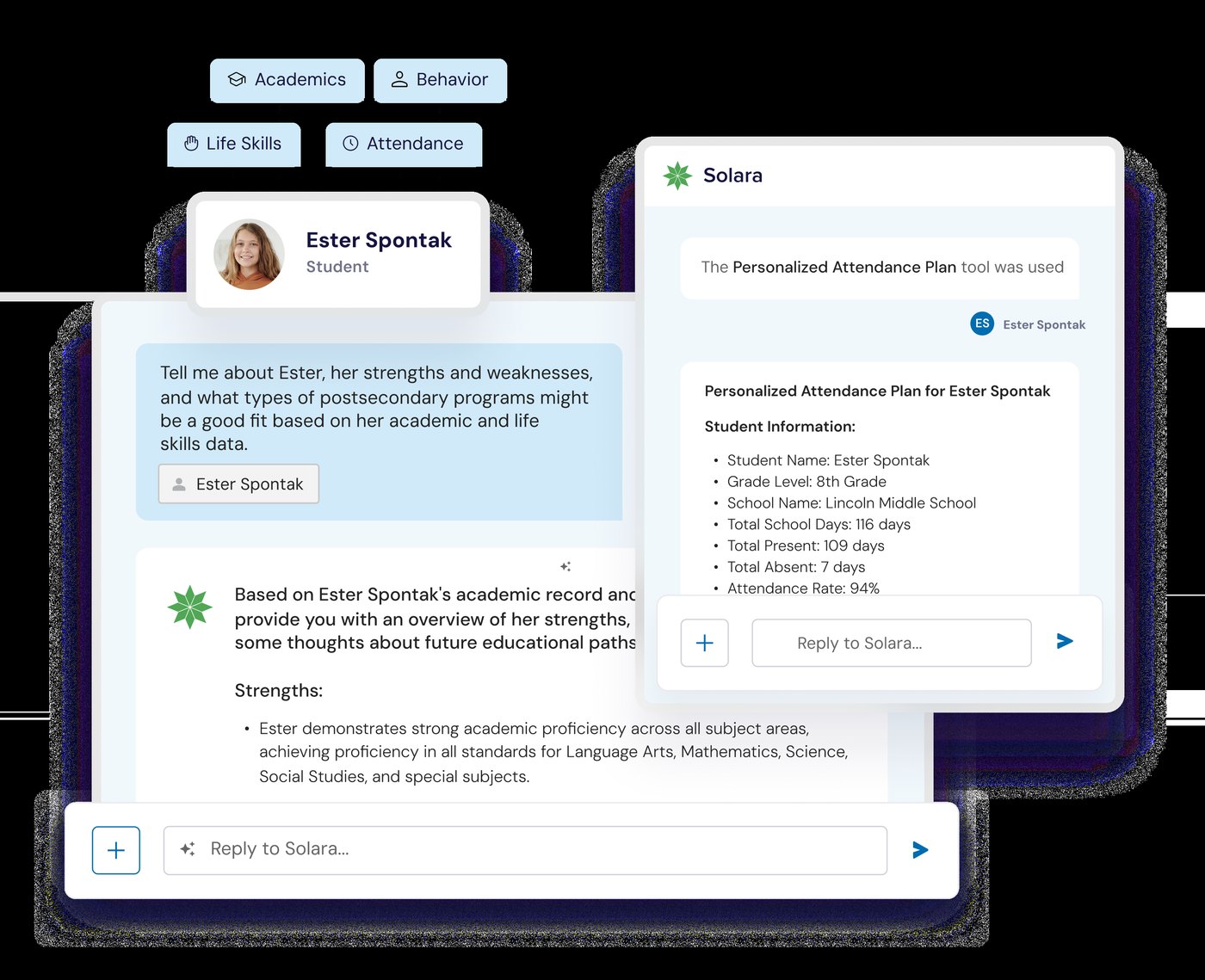
Panorama's core product, Student Success, is built to close that gap. It pulls those scattered feeds into one profile per student and flags who is trending off track - the early-warning signal that a kid is heading toward a failed course or a missed graduation before it happens. This is the unglamorous discipline schools call MTSS, a multi-tiered system of supports, and it is exactly the sort of plumbing that decides whether a well-meaning intervention ever reaches the right child.
02 / The originSelling feelings as a data category
Feuer did not arrive at student surveys by accident. Before he was a CEO he was a student activist in Los Angeles who pushed to give young people a formal voice in how their schools were run. Panorama is, in a sense, that same idea wearing a software subscription. The founders' wager was that the "soft" stuff - belonging, school climate, a growth mindset, whether a family feels welcome - could be measured rigorously and connected to the hard outcomes everyone already tracked.
To make that credible, they did something counterintuitive early on. In 2014 they teamed up with the Harvard Graduate School of Education, built validated survey instruments with academic researchers, and then gave the questions away by open-sourcing them. Handing your crown jewels to the public sounds like a mistake until you notice what it bought: trust, a foothold as the standard, and a reason for districts to bring Panorama in the door. Charity and distribution strategy can be the same move.
03 / The lineupFrom surveys to a platform
A survey tool is a feature. A platform is a business, and Panorama spent a decade turning one into the other. The pieces now fit together as a loop - listen, connect the data, act, measure - and each product is a step in it:
Surveys & Engagement gathers honest input from students, families, teachers, and staff on climate, safety, and social-emotional skills. Panorama SEL turns that into validated measures. Student Success is the MTSS hub where the surveys meet attendance, grades, and behavior. Playbook attaches a next step - a library of more than 1,000 evidence-based strategies - so a flag comes with a suggested response instead of a shrug. Pathways, launched in 2024, tracks credits and requirements to keep seniors on the road to an on-time diploma.
The expertise holding this together is not only engineering. Panorama's surveys were built with academic researchers, and the company has kept research close ever since - its Student Success platform earned a research-based learning-analytics certification from Digital Promise, and it publishes findings tying its tools to attendance and academic gains. In a market full of vendors selling dashboards, Panorama's pitch has always been that the questions on the screen and the interventions it recommends are grounded in something more than a designer's guess.
04 / The pivotWhen the dashboard starts writing the plan
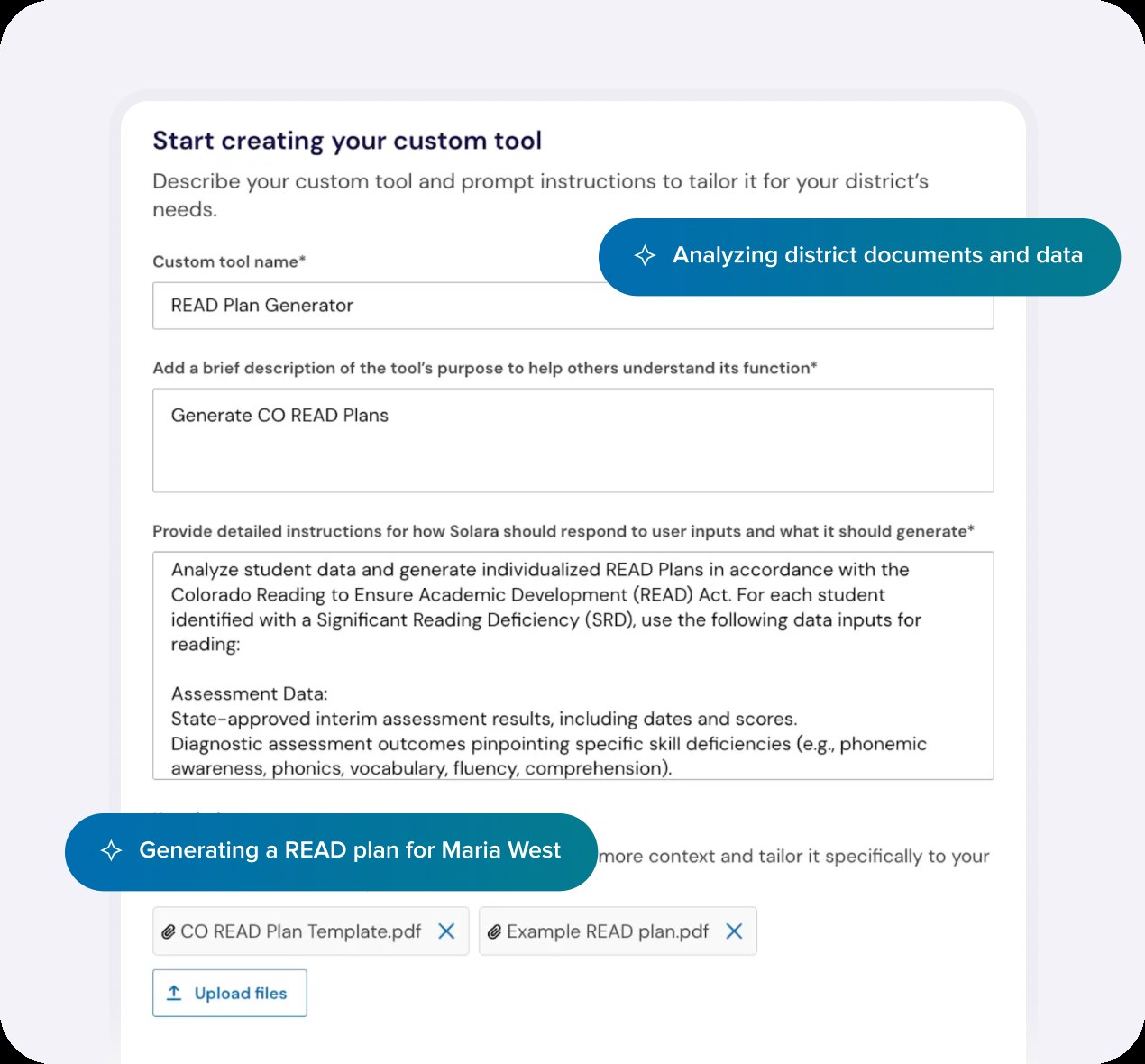
The most interesting thing Panorama has done recently is decide that showing a district the problem is no longer enough. In October 2024 it launched Solara, a district-controlled, privacy-focused AI platform for K-12. Instead of a generic chatbot, Solara drafts the work educators actually dread: an intervention plan, a family letter home, a first pass at IEP or behavior documentation, differentiated materials for a mixed classroom. The dashboard is learning to act.
In April 2025 Panorama bought Class Companion, an AI feedback and tutoring startup, and folded it into Solara to give students real-time feedback on their assignments. The strategic logic is clean: a chatbot that already knows the whole student is worth more than one that knows nothing. In early 2026 Solara was named EdTech AI Platform of the Year at the EdTech Breakthrough Awards.
05 / The moneyWho bet on measuring belonging
Panorama has raised roughly $105 million across four rounds, and the cap table reads like a list of people who think education is a systems problem. One of the earliest checks came from Mark Zuckerberg's Startup:Education - years before the Chan Zuckerberg Initiative backed the company again. Emerson Collective led the 2017 Series B. General Atlantic led a $60 million Series C in 2021.
The business runs on the classic B2B SaaS engine: annual subscriptions sold to districts and state education agencies, priced by student or by district. A district often lands with surveys or a single module and expands into Student Success, Pathways, and Solara over time. Private-company estimates put revenue in the mid-$40-million range and headcount around 400, though Panorama does not disclose its financials.
06 / The fieldWhere Panorama sits in the market
The K-12 data market is crowded and consolidating. Renaissance now owns Illuminate Education; PowerSchool is the incumbent behind many district information systems; BrightBytes, Hanover Research, and Rethink Ed all circle nearby. What separates Panorama is where it started. Most competitors bolted feelings onto an academic-records product. Panorama built the student-voice layer first and connected everything else to it, which is why its early-warning story leans as hard on belonging and climate as it does on grades.
- Founded2012, Yale
- HeadquartersBoston, MA
- CEOAaron Feuer
- Reach~15M students · 2,000+ districts
- Total raised~$105M (through Series C)
- FlagshipStudent Success (MTSS)
- AI platformSolara + Class Companion
There is a real tension underneath all of this, and it is worth naming: a company that holds academic, behavioral, and emotional records on 15 million children is holding something delicate. Panorama leans on privacy and security certifications and district-level control precisely because trust is the product as much as the software is. Get that wrong and the whole thesis collapses.
07 / The through-lineFourteen years, one idea
What is striking, looking back, is how little the core idea has drifted. A decade of edtech fads has come and gone. Panorama is still running the same loop it sketched in a dorm room - ask students, connect the data, suggest a move, check whether it worked - just at the scale of half the country's biggest districts and now with AI drafting the move. Staying that boringly on-thesis for fourteen years is its own kind of edge.
For a district leader, the promise is simple to state and hard to deliver: fewer kids falling through cracks nobody was watching. Everything Panorama has built - the surveys, the dashboards, the intervention library, now the AI - is in service of the moment a counselor sees the student who needs help while there is still time to give it.