A teenager can get a bill passed and still lose the argument to inertia. Aaron Feuer learned that distinction in Los Angeles, where he grew up, attended public school and became president of the California Association of Student Councils. He wanted students to have a formal say in how their schools worked. The campaign succeeded in Sacramento: California adopted legislation promoting student feedback surveys. Then came the quiet anticlimax. The machinery of government had moved; daily life in schools barely seemed to. Feuer had won a policy and discovered a product problem.
That frustration contains the compact version of his career. Feuer did not abandon the belief that students should be heard. He changed the mechanism. Years later, reflecting on the stalled result, he put it plainly: “Maybe the answer isn't just fighting for something, maybe the answer is building it.” The sentence sounds neat now because Panorama Education exists. At the time, it was a decision to trade the moral clarity of a campaign for the finicky work of forms, scanners, software and school procurement.
The prototype wore a paper coat
Feuer arrived at Yale in 2009 carrying two interests that are often seated at different tables: programming and education reform. He had coded since childhood. After his freshman year, a university fellowship let him combine the two in a project called Classroom Compass. Its purpose was direct: let student council members run teacher-feedback surveys on paper. A few schools used it, but adoption was slow. By his junior year Feuer was impatient with the pace, which is another way of saying the prototype had taught him where the friction lived.
In early 2012 he recruited classmates Xan Tanner, David Carel and John Gerlach to overhaul the idea. Yale fellowships and a pitch competition supplied a combined $50,000. The group kept only the skeleton of Feuer's original code and built a broader, 360-degree feedback system. They named it Panorama Education. The fresh version could gather responses from students, families, teachers and staff, then turn them into reports that a district could read without commissioning a bespoke research project.
The early technical details were gloriously unglamorous. Schools could use ordinary white paper instead of costlier Scantron sheets. Returned surveys were scanned. Feuer wrote algorithms that rotated crooked pages, overlaid a grid, found the filled bubbles and recorded the choices. In startup mythology, code is often presented as a magic wand. Here it behaved more like a patient clerk with excellent eyesight. Its value came from respecting the actual conditions of a school office.
“Education is the ends, and technology is one of the means.”Aaron Feuer
A company before the cap and gown
Panorama did not wait for graduation to become real. By spring 2013 it had state contracts, a full-time employee and student employees. The team won the Yale Venture Challenge and its $12,000 first prize. Feuer was simultaneously a college senior and a chief executive, a combination that sounds dashing until one imagines the calendars. Panorama had paying customers before it entered Y Combinator's Summer 2013 batch.
The founders nearly dismissed the accelerator. They thought they understood education better than a program that had funded few education companies. Yale alumnus Michael Seibel offered a useful puncture: their hardest problems were not peculiar to schools; they were problems of building a company. The team applied. Later that year Panorama announced a $4 million seed round that included Y Combinator, Google Ventures, Yale, Ashton Kutcher's A-Grade Investments and the education initiative backed by Mark Zuckerberg and Priscilla Chan.
One early customer made the company's loop feel almost literary. Los Angeles Unified School District, the system in Feuer's hometown, adopted Panorama for roughly 550,000 students. The teenager who had tried to institutionalize student feedback in California returned through a purchase order, now offering a way to collect and interpret it. Colorado and Connecticut education agencies were also early clients, and a partnership with Teach For All began taking the surveys abroad. Within a year of graduation, Forbes included Feuer in its 2014 30 Under 30 list for education.
Feuer's age drew attention, but his answer to the credibility problem was not swagger. School district chiefs were “both clients and mentors,” he said in 2013, and he described humility as central to the company's progress. That posture makes practical sense. A founder can know the software intimately and still know very little about the political, contractual and human weather inside a district. Listening was not decoration around the product. It was a way to keep the product attached to reality.
He also received an unusually specific hiring lesson from Zuckerberg after the two met around Y Combinator: choose people whose company you would enjoy, and people you would be willing to report to if the hierarchy were reversed. The advice fits a business that asks schools to expose their own blind spots. A team selling feedback cannot be too grand to receive it. Feuer's public comments repeatedly return to this inversion, with expertise moving both ways between vendor and district instead of issuing from the software company alone.
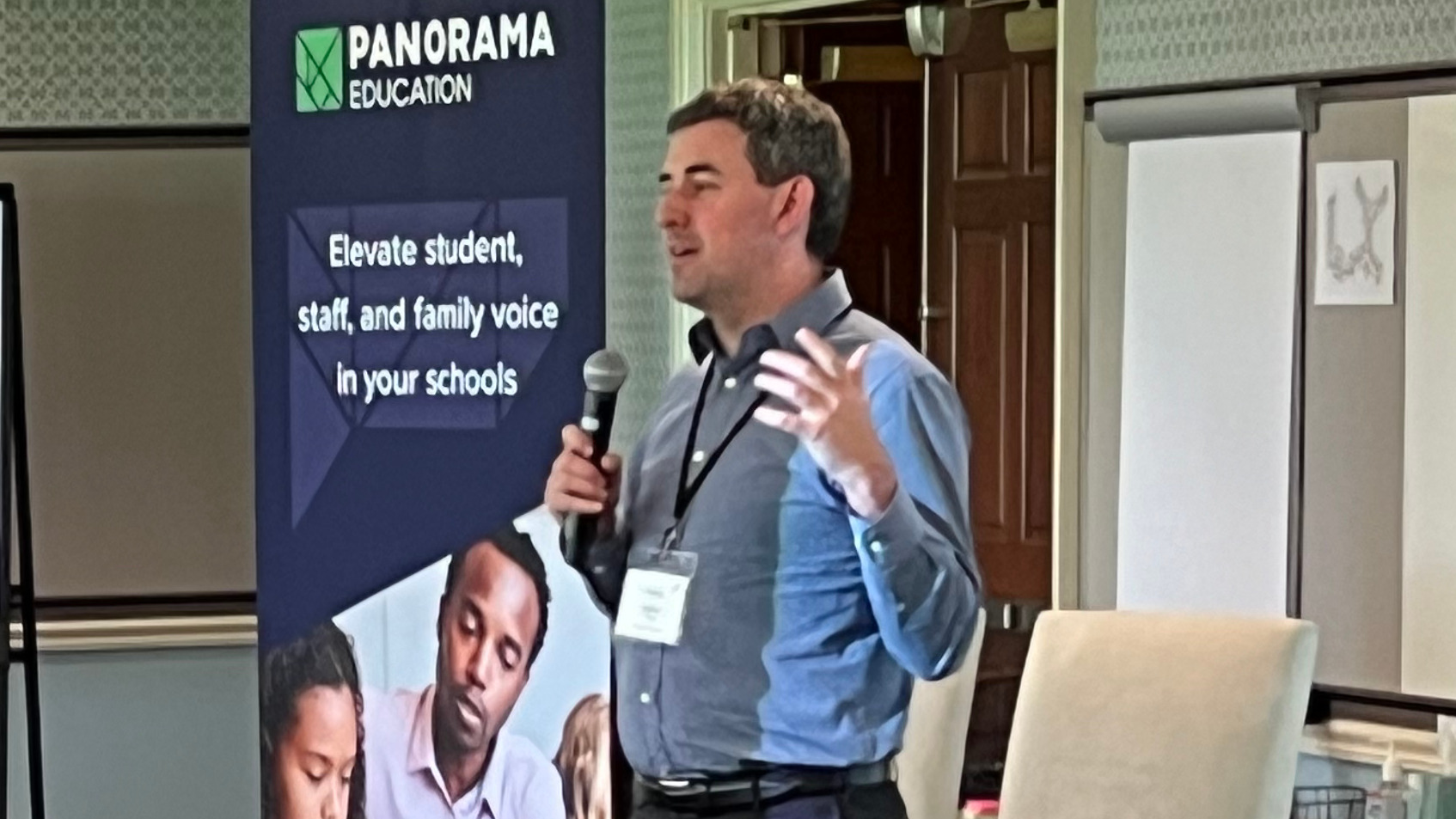
The view widens
The company grew by widening what counted as a meaningful signal. Early school data conversations leaned heavily on test scores. Feuer argued that the things educators cared about also included engagement, belonging and whether students felt ready for college, work and life. Panorama's surveys gave those softer-looking experiences structure. Its platform later connected them with harder operational records: academics, attendance and behavior. The point was not to admire a dashboard. It was to spot a student who needed support while there was still time to offer it.
In a 2020 conversation, Feuer described a readiness framework with six areas: academic readiness; critical thinking; social-emotional learning; college knowledge; career knowledge; and transition skills. The list resisted the comforting fiction that a diploma alone settles the question. Districts could ask former students what had actually helped after graduation and work backward. Feuer noted that writing a check, managing a credit card or getting a driver's license can become genuine barriers. Education, viewed up close, contains many small hinges.
From one voice to a connected view
Funding followed the widening product. Panorama announced a $12 million Series A in 2015 and a $60 million Series C in 2021. It also bought capabilities rather than building every adjacent tool itself. The 2023 acquisition of Mesa Cloud added graduation support. The 2025 acquisition of Class Companion pushed the company further into personalized learning and AI-assisted feedback. Panorama now says more than 2,000 districts in all 50 states rely on it, covering 25,000 schools and 15 million students.
The skeptic ships AI
That scale raises the stakes of Panorama's newest chapter. Feuer has called himself generally skeptical about AI in education, particularly when novelty arrives before evidence. Yet he is also placing AI inside the company's products. The apparent contradiction disappears once his test is clear. The question is not whether a model can produce an impressive response. It is whether a district can use the technology safely to improve literacy, attendance, special education, classroom engagement or the amount of time a teacher gets back.
Privacy sits at the front of his argument. Schools are awash in rapidly built tools, and Feuer has urged districts to govern which applications are allowed, where student information goes and whether vendors meet established security standards. He speaks less like a futurist selling weather from the next century and more like an operator worrying about the locks. In K-12 education, that instinct is neither fussy nor optional. A system designed to see a whole student also holds an unusually sensitive portrait.
In late 2025 Feuer began hosting Leading & Learning with AI, a Panorama podcast built around district leaders trying the technology in practice. The format suits his old pattern. He asks what is working, what is not and what changes for students. Episodes move through AI literacy, chronic absenteeism, student support and classroom implementation. The CEO who once treated district leaders as mentors now records the conversation and invites a larger room to listen.
The useful product is the bridge between a signal and the moment someone can still help.
What stayed the same
Panorama in 2026 bears little visual resemblance to Classroom Compass. The paper forms are no longer the story. The company's scope stretches from surveys to multi-tiered support, graduation pathways, instruction and AI. Feuer's job has changed too, from lead developer writing page-recognition algorithms to CEO overseeing a company with national reach. Founders sometimes outgrow their original problem. In his case, the problem expanded around a stable idea: important information is wasted when institutions cannot translate it into action.
There is a temptation to summarize this as policy versus technology. Feuer's path is more useful than that tidy contest. His student organizing gave him the problem, the constituency and an early view of institutional limits. Programming gave him a different lever. School leaders gave the company the knowledge it lacked. Capital supplied time and reach. Each method corrected the others. Even the failed quiet after the bill was productive; it showed him that consent without implementation is a beautifully framed door painted onto a wall.
Feuer has said that education offers a chance to help millions of children lead extraordinary lives, and he has wondered how much human potential the world fails to capture. It is a large aspiration. His working method remains conspicuously concrete: listen to students, connect the scattered evidence, show an educator what matters, protect the data, make the next action easier. The distance between 15 million students and one filled bubble is vast. Panorama's story is the effort to cross it without losing sight of either end.