A child pauses over a word. For a teacher listening beside the desk, the pause is useful: perhaps the vowel is unfamiliar, perhaps the word is, perhaps the child needs another attempt. Across a classroom, however, many such moments happen without anyone close enough to hear. Individual attention has a timetable problem.
Amira Learning has made that problem its business. Its software listens while students read aloud, offers help when they struggle, and gives educators information about what to teach next. The appealing part is wonderfully ordinary. Reading practice becomes an occasion for someone - or something - to pay attention.
- The job: listen to oral reading and respond to specific difficulties.
- The buyer: schools, districts, and education ministries.
- The move: connect assessment, lessons, and practice in one reading suite.
- The test: better reading, measured beyond minutes on a screen.
01 / The shortage is in the listening
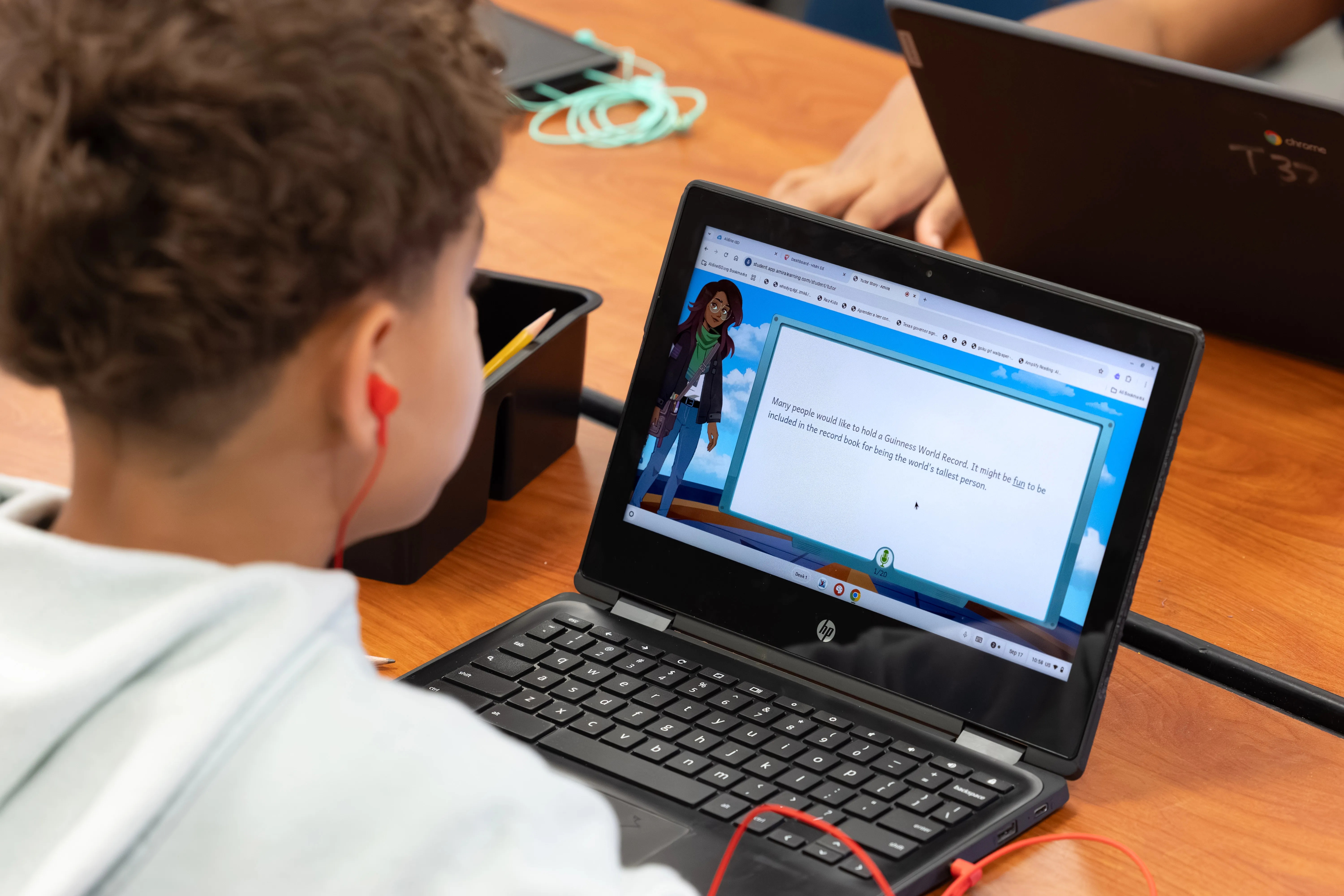
The classroom version starts with a computer and a headset. A student chooses a story, reads it aloud, and receives coaching around the words that cause trouble. Instruction Partners’ September 2026 product profile describes a system that notices mispronounced sounds, skipped words, and stalls, then adjusts the choices offered in the next session.
This gives Amira a particular place in education technology. The input is a child’s attempt at reading; the response is attached to that attempt. A useful intervention has to arrive while the difficulty still matters. An end-of-term score can identify a problem. Help with the troublesome word can get the reader moving again.
The alternatives include a human tutor, a teacher-led reading group, and literacy software such as Lexia or MindPlay. Microsoft Reading Coach also offers AI-supported reading practice. Amira’s commercial proposition is the connection between oral-reading feedback, assessment, and the teacher’s curriculum. A buyer should compare that entire workflow, rather than count how often each vendor says “AI.”
02 / A research project learns to sell
Amira’s ancestry makes the chatbot boom a rather late arrival. Carnegie Mellon’s Project LISTEN developed an automated tutor that displayed stories and listened to children reading. Its university description explains how it adapted the Sphinx speech recognizer, intervened when readers got stuck, and offered spoken and graphical feedback informed by expert teachers.
That lineage matters because reading aloud is a demanding use of speech technology. The system must attend to an imperfect performance, including the very errors a learner needs help correcting. Simply turning speech into tidy text would throw away part of the evidence.
Mark Angel and Pete Jungwirth founded Amira in 2018, according to the announcement of its later Wonderscope acquisition. Both had worked at Renaissance Learning: Angel as chief technology officer, Jungwirth as head of engineering. Their expertise joined a research tradition to the practical business of getting reading software into schools.
Investors backed the translation. Owl Ventures led an announced $5 million Series A in 2019, with Houghton Mifflin Harcourt among the participants. A company announcement put the 2021 Series B at $11.3 million. CB Insights reports another $20 million round in April 2022. These are financing events, not a measure of educational success.
In June 2024, Amira merged with Istation. The announcement described a combined base of four million students across 50 states and 17 countries. Istation contributed assessment, instructional content, and established district relationships. The business logic is legible: a listening tutor can reach more classrooms when it travels with tools and relationships those classrooms already use.
“With Istation, we have multiplied scale and deepened experience”
Mark Angel · June 2024 merger announcement
03 / Three products, one unfinished sentence
The current Reading Suite packages that ambition into three connected jobs. Amira ISIP Assess handles benchmark assessment, screening, and progress monitoring. It includes dyslexia risk screening: a flag for further attention, which should be interpreted alongside a student’s broader evaluation.
Amira Tutor provides reading practice and short interventions. Amira Instruct turns student evidence into differentiated lesson planning and curriculum-aligned recommendations. The suite supports English and Spanish, with Amira Lectura addressing biliteracy. That gives dual-language classrooms an explicit place in the product.
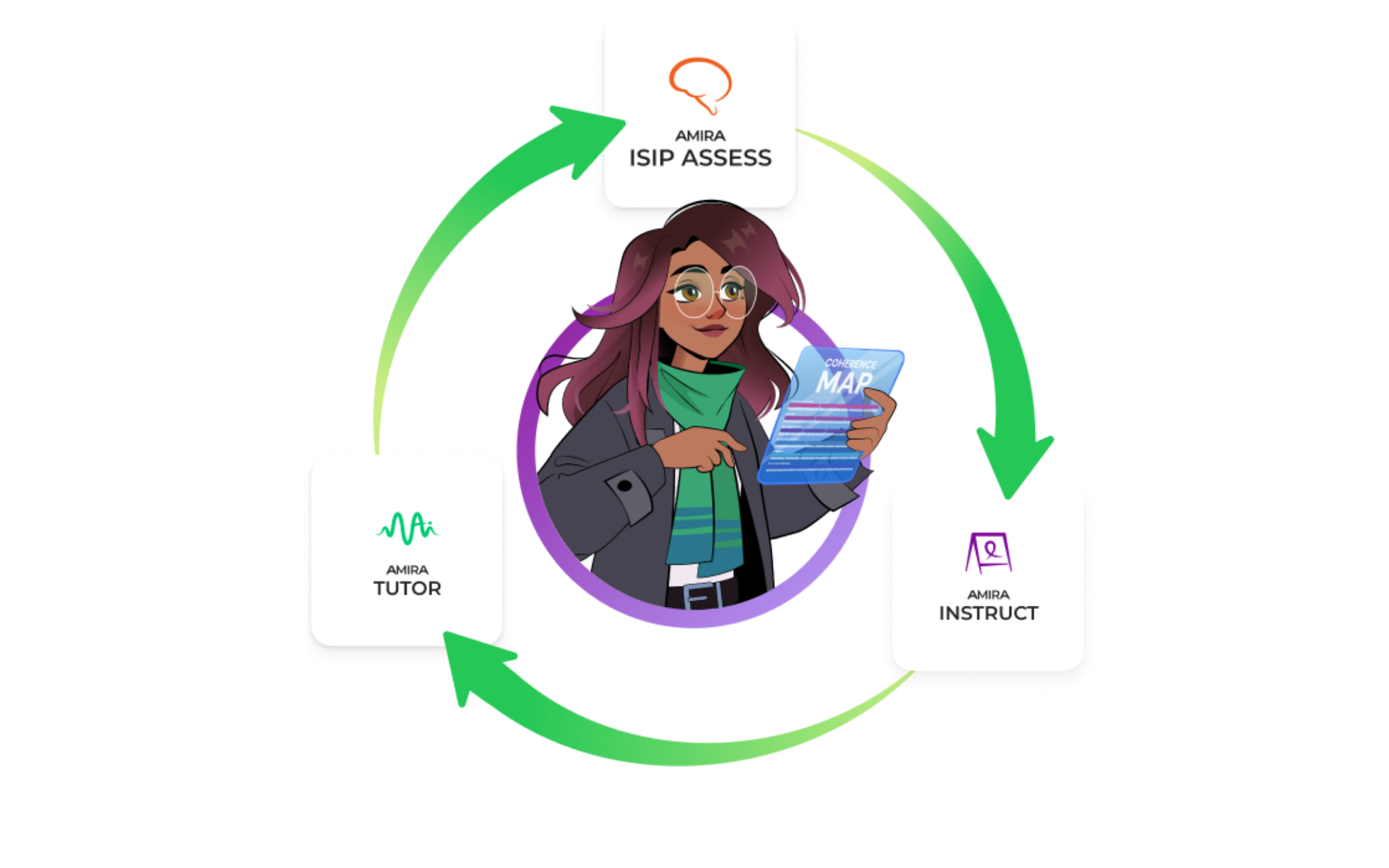
The point of this architecture is the handoff. A report that records a weakness but leaves the teacher to reconstruct the next lesson creates another administrative job. Amira is trying to make the evidence useful at the moment instruction is being planned. Whether that succeeds depends partly on the recommendations and partly on the teacher’s ability to use them.
04 / The bill is smaller than the timetable
Amira sells licenses into an institutional market. Schools and districts purchase access; state agencies can fund it; partners can distribute it. Students use the tutor, teachers use its reports and planning tools, and administrators decide whether the results justify another contract.
One public quote makes the cost concrete. For a September 2025 start, Dietrich School District was offered 120 annual Reading Suite licenses for $3,600, plus ten teacher licenses at no charge. That works out to $30 per student for that quoted year. The document is a useful example of a transaction, rather than a promise that every district can buy the same package today.
Explore the license arithmetic at Dietrich’s quoted rate.
There is another budget: the school day. Amira’s Tutor page recommends regular weekly practice and highlights 30 minutes a week. A license cannot reserve those minutes. Someone must arrange the devices, help students get started, and ensure that useful practice actually happens. An inexpensive seat can still be an expensive missed opportunity.
05 / Read the study, not just the number
Evidence is where a reading-software profile ought to slow down. A June 2025 report prepared by Instructure for Amira examined a matched sample of 79,084 Louisiana students across 12 districts, using 2023-24 data. It compared users with similar nonusers and classified its findings as ESSA Level II, or moderate evidence.
Users had statistically higher outcomes across the grades studied, but the size of the differences varied. In grade two, the reported effect for all users versus nonusers was 0.08; in grade four, it was 0.03. Those numbers are standardized effects, not percentages of reading growth. The design was quasi-experimental, so matching strengthens the comparison without supplying random assignment.
Moderate evidence
Selected in 2026
Adoption, usage, and learning gains answer different questions.
Boston University selected Amira for its inaugural EVAL EdTech Evaluation Challenge in March 2026. The university announced a planned randomized trial, and its recruitment page describes comparisons involving AI tutoring, one-to-one human tutoring, and typical classroom instruction. Selection for that work is a meaningful commitment to another test. The results will matter more.
Amira’s own reach claims are a separate category of evidence. It reports more than five million students worldwide. That establishes the company’s account of its footprint; it cannot tell a district how much a particular child will learn.
06 / The teacher remains in the loop
Growth also makes small classroom experiences harder to dismiss. On October 1, 2026, Axios reported Iowa’s expansion alongside a parent who said the tool had hurt her daughter’s confidence and raised concerns about communication and voice privacy. One family’s experience cannot settle efficacy. It does reveal something a state adoption count leaves out.
Amira says districts control audio retention. Its Trust Center also distinguishes retention choices from participation in model improvement: switching one off does not automatically switch off the other. That distinction deserves a clear explanation when a school introduces the product. Families need to understand the actual settings their district chose.
The practical limits are straightforward. Poor audio can frustrate a listening task. Irregular practice weakens a practice-based intervention. A report needs someone to interpret it, and a child who becomes discouraged needs an adult who notices. These are implementation considerations, not claims that the same difficulty affects every student.
07 / Borrow the habit, not the sales pitch
The useful idea to copy is the sequence. Notice a specific difficulty. Give a relevant response. Arrange another opportunity to practice. Check whether the skill improved. Amira has organized a software business around that sequence; teachers can use the same discipline when reviewing any proposed intervention.
A sensible school pilot would protect practice time, examine student responses, and compare learning on a measure beyond software usage. The dashboard might show more minutes. The question is whether those minutes helped a reader. That is the standard the product’s own premise invites.
Amira’s ambition began with listening and now extends into the machinery around it: assessment, planning, distribution, and classroom routines. Its next chapter will depend on keeping those systems close to the small event that started the story. A child reaches a difficult word. What happens next?
Keep listening
Explore the product, the conversation, and the latest reporting.