A Scantron answer sheet is a peculiar sort of interface. It asks you to compress everything you know into a darkened oval, then submit the evidence to a machine. The student remembers the pressure. The teacher has a different interest: how soon can this stack of paper become something useful?
That second question explains the company better than the first. Scantron sells the route from a human response to a usable record. Sometimes the route runs through a dedicated scanner. Sometimes it runs through an ordinary copier and a browser. Sometimes Scantron’s staff handles the collection and processing. The bubble is merely the most recognizable entrance.
- Scanners and forms remain part of the business; software and managed services broaden it.
- TestFlex scores paper and online assessments without a dedicated Scantron scanner.
- Customers span schools, universities, government, healthcare, and corporate teams.
- Regent acquired Scantron in 2024. The former certification business belongs to Meazure Learning.
The clever part was putting the machine on the desk
Founded in 1972 by William E. Sanders, Scantron entered a world in which automated testing already existed. Its contribution was commercial as well as technical. Historical research on educational testing describes inexpensive school-level scanners, including arrangements with rent-free machines, supported by sales of scannable forms. A school could gain access to scoring equipment without recreating a large testing bureau.
The arrangement made the answer sheet unusually important. Each test created another reason to buy forms. The machine helped establish the habit; the paper supplied the repetition. For a teacher, the attraction was more immediate: less hand scoring and results closer to the moment of instruction.
There is a business lesson here, provided one resists turning it into a magic formula. Lower the barrier to the recurring task, and the recurring task may support the business. It works when the tool actually saves work and the consumable remains useful. An installed machine alone does not guarantee either condition.
A scanner that does not need a computer
Scantron still makes products for that local, immediate job. Scantron Score is a standalone scoring machine, rated at 30 to 40 tests per minute. Standard scoring requires power, but no connected PC. It can print correct answers on the sheet and handle up to four test versions in the same batch.
Those are modest-sounding features with practical consequences. Different test versions need not become separate piles. Feedback need not wait for someone to open a spreadsheet. For deeper reporting, results can travel by USB into Remark software. The classroom machine and the analysis software have distinct jobs.
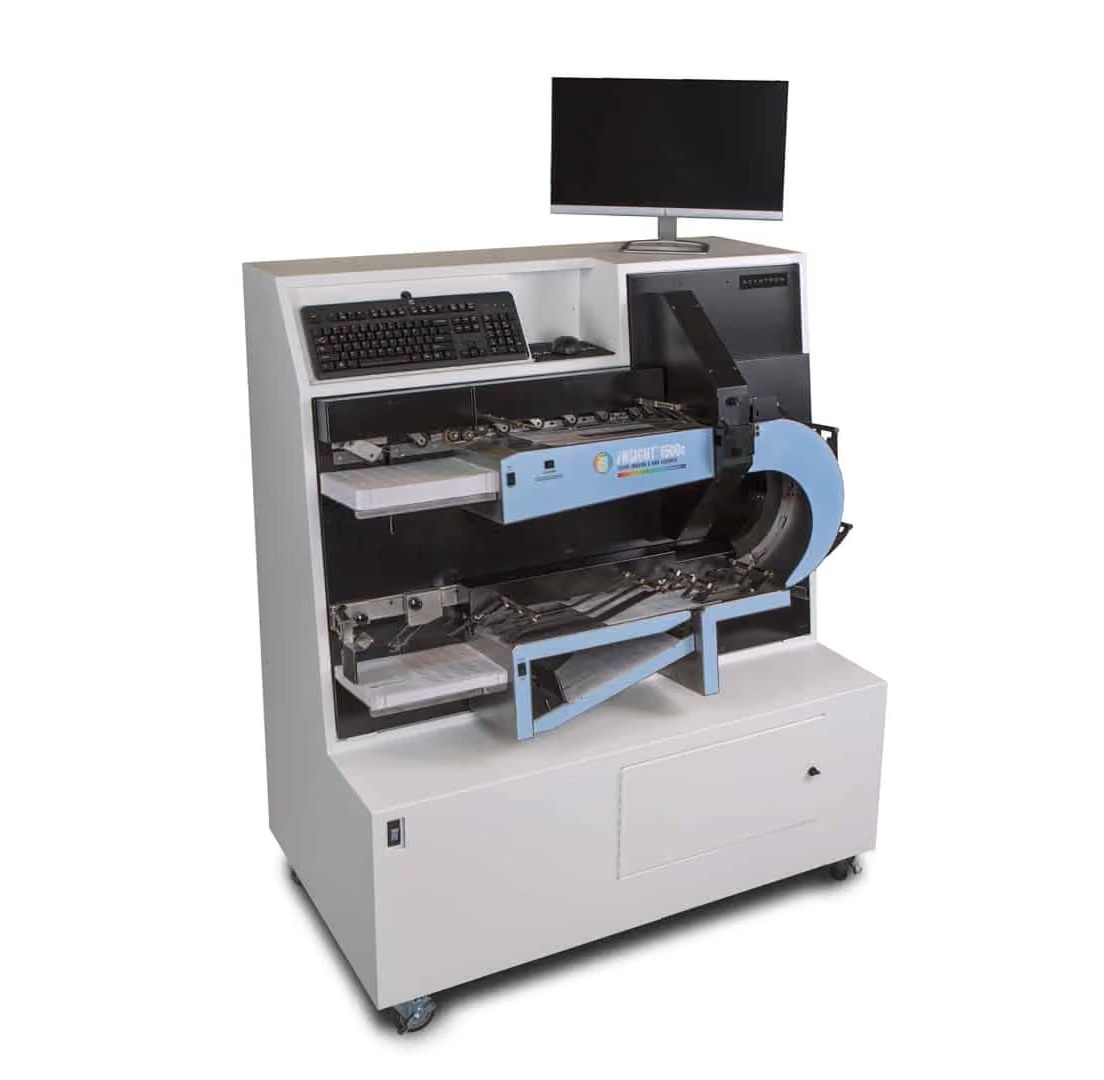
At the other end of the catalogue sits the iNSIGHT 1500c. Its published rating is up to 15,000 letter-size sheets per hour. A 750-sheet input hopper, color imaging, and a separate stacker for flagged forms address the less romantic work of processing large batches. Rated throughput is a specification, not a promise about every operator’s finished workload.
The copier gets promoted
Now consider TestFlex. Scantron’s browser-based assessment product lets users print answer sheets on plain copy paper and scan completed tests with existing imaging equipment. Online submissions enter the same assessment workflow. A specialized scanner and preprinted forms cease to be prerequisites.
For a company associated with selling both, that is a consequential choice. The product shifts the purchase toward an annual software subscription. It also changes the starting conversation. A school can ask how its existing copier, browser, and learning management system fit together before asking which new machine to buy.
TestFlex lists integrations with Canvas, Brightspace D2L, Google Classroom, and Moodle. Multiple-choice scoring is automated; essays and short answers can be graded on screen. The distinction matters. A useful assessment platform should make the routine parts faster while giving an instructor room to judge the answers that require judgment.
This is the strongest interpretation of Scantron’s present strategy: keep the customer’s familiar ways of collecting answers, then reduce the work between collection and feedback. Paper and online testing become options inside a workflow rather than rival identities.
The real expense is often the handoff
Forms still have a visible price. On October 1, 2026, Scantron’s store listed a pack of 500 882-N-E forms at $121. That works out to 24.2 cents each before shipping and tax. It is one format’s price, not the cost of an entire testing program. Equipment, software, staff time, and support belong in the calculation too.
$121 ÷ 500 sheets
882-N-E store listing / October 1, 2026
The company’s software catalogue addresses costs that do not appear on the paper invoice. Remark converts scanner responses into data and reports, including item analysis. Evasys handles questionnaire design, scheduled invitations and reminders, paper and mobile responses, and reporting. Those steps can consume more institutional attention than the act of filling out a questionnaire.
“We went from about 4 hours down to 40 minutes.”
Laurie Morris / editorial specialist
Customer testimonial published by Scantron
That is a customer account, not a controlled benchmark. Still, it points toward the right buying question: which stage of our own process keeps everyone waiting?
A university collecting course evaluations has a distribution and reporting problem as well as a scanning problem. A corporate training team needs responses attached to the right participants. A government survey may need physical collection alongside digital records. Faster capture is valuable when the rest of the chain can use it.
Three ways to avoid typing it all again
Scantron Offset adds a service option for organizations that lack the staff or capacity to manage the chain themselves. Its offering covers design and distribution, collection, digitization, validation, automation, and reporting across paper and digital workflows. The buyer is contracting for work to be done, rather than simply acquiring tools.
Run physical capture in-house.
Bring existing devices into the process.
Have a team manage the data lifecycle.
That range gives Scantron a particular place in the market. It crosses physical capture, assessment software, and institutional operations. A small classroom has cheaper options: ZipGrade advertises phone-based grading and a $6.99 annual paid plan. Dedicated OMR alternatives include Sekonic and DATAWIN. Online-only quiz tools may already live inside a school’s learning platform.
The comparison should turn on volume, workflow, integration, and support. An individual teacher processing occasional quizzes and a university processing thousands of evaluations are buying different things. Scantron’s breadth is useful when those requirements cross paper and digital boundaries; it can be excessive for a simple task.
The name survived. The boundaries moved.
Corporate history complicates the familiar brand. Transom Capital Group acquired Scantron in December 2019. In June 2022, Meazure Learning bought its certification and licensure business, including the test-center network, assessment software, exam-development and psychometric teams. Those capabilities should not be casually counted as today’s Scantron offering.
In May 2023, Scantron Technology Solutions announced its rebrand as Secur-Serv. Regent then announced its acquisition of Scantron from Transom on August 30, 2024. A directory entry describing the old two-division company can therefore send a buyer toward the wrong expectation.

The present team reflects the work behind the products. Scantron describes US-based development and support, with operations centered in Minnesota and a secondary hub in Lancaster, Pennsylvania. Dedicated forms and quality roles are a reminder that reliable data capture involves print specifications and physical handling alongside software.
Keep the pencil. Check the dependencies.
The least glamorous document may be the most useful one for an existing customer: Scantron’s compatibility table. It identifies discontinued hardware, unsupported software, and differences in operating-system support. A scanner that still feeds paper can nevertheless belong to a workflow whose software needs replacement.
A sensible pilot follows the whole chain: create the assessment, identify respondents, collect a batch, inspect exceptions, and export the result where it belongs. Cloud tools need browser access and suitable scans. Dedicated OMR requires compatible forms. Automatic scoring cannot rescue a badly written question or decide whether an examination measures the right knowledge.
What another organization can copy is the discipline of locating the handoff that wastes time. Preserve the part people can already do, automate the repetitive transfer, and measure the result on actual work. Scantron’s most interesting move is giving customers more ways to make that choice. The pencil has done its part. The institution must decide what happens next.
Try the workflow for yourself
Scantron website ↗ · TestFlex ↗ · Offset services ↗ · Compatibility guide ↗ · Company blog ↗
TestFlex tutorials ↗ · YouTube training tutorial ↗
LinkedIn ↗ · X ↗ · Instagram ↗ · Facebook ↗