Imagine being a parent with two children at the same school. A newsletter arrives. Then a year-group update. Then an announcement containing the date you actually need, tucked beneath a photograph of a very successful bake sale. The school has communicated. You have acquired a small administrative job. Somewhere between those two events lies a business opportunity.
- Finalsite connects school websites with communications, enrollment and marketing.
- Its useful trick is reducing the work between a published notice and a parent taking action.
- Buying the software still leaves decisions about timing, ownership and access in the school’s hands.
Finalsite occupies that awkward space between an institution’s good intentions and a household’s limited attention. It sells to schools, but the experience it helps create belongs to families. A parent looking for tomorrow’s calendar and a prospective student looking for next year’s application are visiting the same organization with very different errands.
01 Sixteen emails, one warning
At Chinese International School in Hong Kong, some parents received up to sixteen emails a week. Missed reminders produced more reminders. The PTA began summarizing notices on WhatsApp. A red-rainstorm warning exposed delays in urgent messaging. Communications director Cheryl Lee and consultant Liz Kingston helped redesign the process.
Using Finalsite, the school built a searchable communications hub, separated essential notices from optional reading, scheduled distinct weekly messages and reused posts across its website, email and app. It also prepared emergency messages and trained two staff members for early-morning alerts. Finalsite’s case study reports more than 1,000 parent app downloads within weeks.
“We’ve saved so much time and significantly reduced mistakes.”
Cheryl Lee · Chinese International School
The lesson travels well beyond education: a communication problem can survive a beautiful redesign if nobody changes the routine behind it. Here, the publishing routine was part of the solution.
Website
App
A publishing pattern, not three fresh writing assignments.
02 The front door has a back office
Finalsite’s website offering combines its Composer content management system with design, hosting and support. Schools can commission a custom design or choose a theme. The website portfolio illustrates the range: Highline Public Schools launched a district site and 32 school sites in less than three months, according to Finalsite’s account. Cor Jesu Academy pairs its design with a Blackbaud data integration.
That combination explains where the company fits. A general website builder supplies a canvas. Finalsite supplies a school-oriented publishing environment and the people who help implement it. Its competition includes specialist platforms such as Apptegy and ParentSquare, as well as the option of assembling a general CMS, admissions software and communication tools separately. Breadth makes Finalsite worth considering; it does not settle every buying decision.
The back office matters because a website cannot maintain a family directory through attractive typography. Finalsite’s integration documentation describes data flowing from a school’s student information system into contact lists, directories and portal access. It also describes automatic refreshes and support for existing authentication systems. These are unglamorous features with a glamorous consequence: fewer opportunities to keep the wrong list beautifully up to date.
03 The relationship continues after “send”
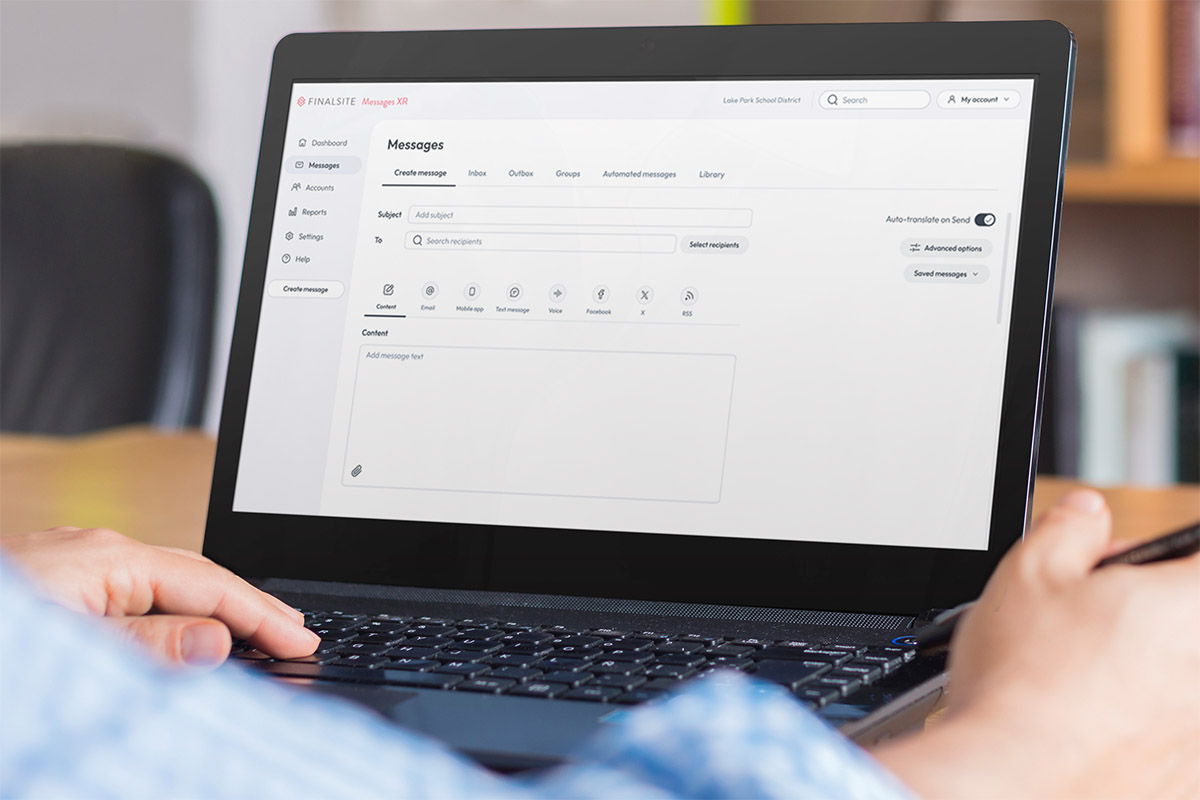
The communication portfolio includes mass notifications, email tools and two-way chat. Finalsite describes Chat as supporting direct messages, group conversations and rooms connected to student information system data. The company reports six billion messages across its communication products in the preceding year. That figure measures traffic, not comprehension. A district still has to decide who needs a message, whether it is urgent and which channel deserves it.
Enrollment extends the relationship further. Finalsite’s admissions and registration software manages applications, documents and personalized checklists. Its current offering also covers waitlists, lotteries, reporting and tuition billing. Explore helps families find schools through maps and profiles before moving toward registration. For a school team, the attraction is practical: the public-facing invitation and the process that follows can sit within the same supplier’s portfolio.
The acquisition of SchoolAdmin added enrollment expertise to that proposition. Blackboard K-12 Community Engagement followed in September 2022, bringing products including Web Community Manager, Connect, Reach and mass notifications. On September 28, 2026, Finalsite announced the addition of RevTrak, a payments provider it says serves more than 13,000 schools nationwide. These deals describe an expanding perimeter around the school-family relationship. An acquisition announcement, however, is not proof that every product already shares a seamless workflow.
04 A chatbot inherits the school’s homework
Ask AI gives website visitors another route to information: they can ask a question instead of guessing which menu contains the answer. Finalsite says the assistant draws on school webpages and approved documents, supports more than 45 languages and provides administrator analytics. The pitch is particularly relevant after office hours, when a family’s question arrives long after the person who usually answers it has gone home.
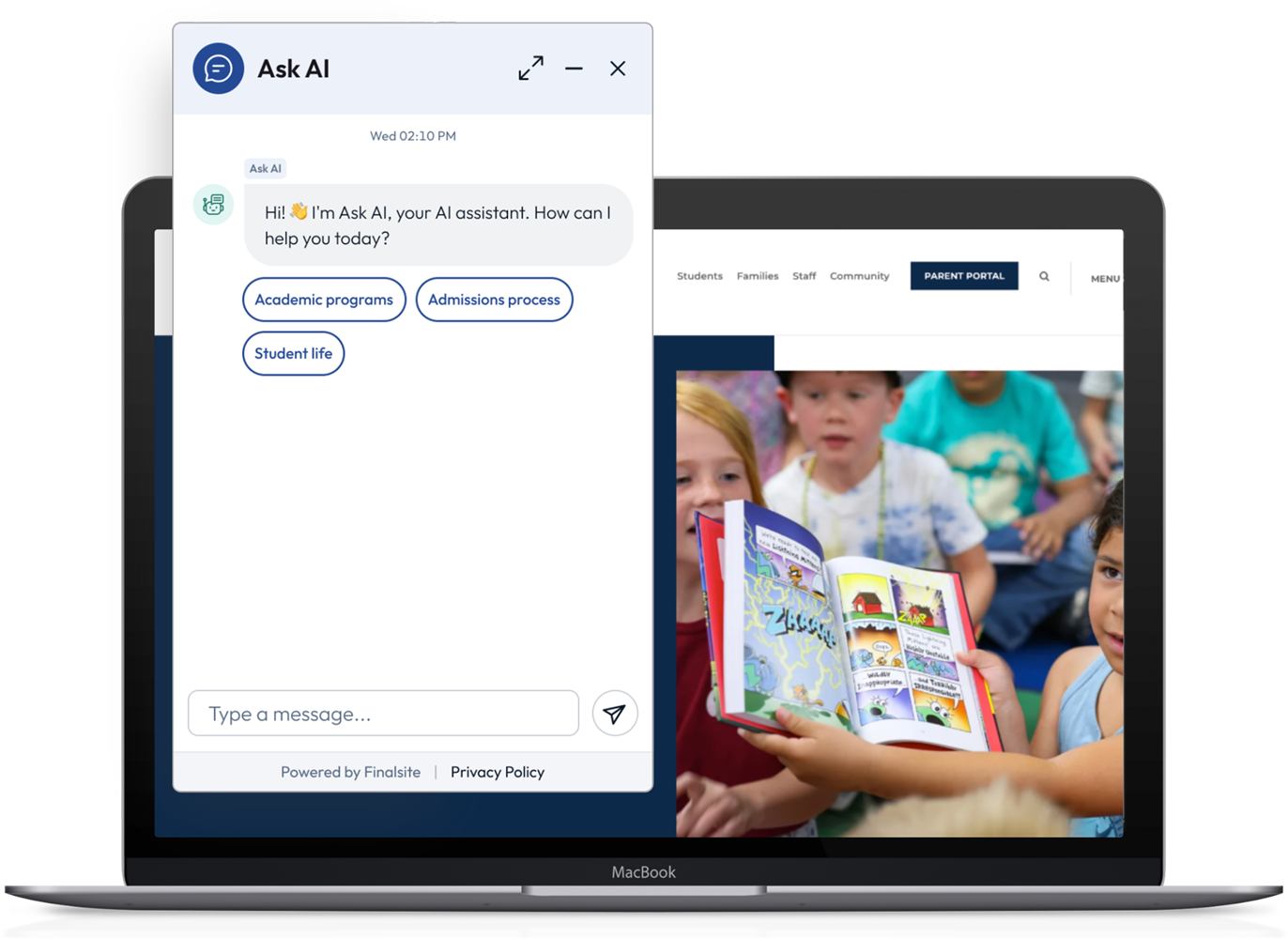
Princeton Day School branded its assistant “Ask Paws,” after its panther mascot, and supplied documents including lunch menus and admissions material. Finalsite’s case study reports hundreds of interactions within a month. The useful second-order effect is the record of what people ask. Repeated questions can reveal an answer that is missing, poorly labeled or buried. My reading: that record can be a website editor’s task list as much as a chatbot performance report.
There is a condition attached to the convenience. Schools must keep the approved information current and review the experience. A new conversational interface does not make an old deadline current. Buyers should test ordinary questions, ambiguous questions and the point where a family needs a person rather than another answer.
05 The cheaper bid that did not win
Finalsite operates a business-to-business subscription model, accompanied by design and service work. One published offer for SchoolPointe clients advertises pricing beginning at $5,000 annually. It is a specific offer, not a reliable estimate for a large district buying several products. The sensible budget includes the contracted modules and the school’s own migration, training and publishing work.
A 2025 Jackson Public Schools evaluation makes the tradeoff unusually concrete. Its mass-communications and data-integration rubric lists Finalsite at $64,200 and ParentSquare at $138,500 in total quoted cost. Finalsite scored 48.7; ParentSquare scored 52 and was recommended. The committee cited inclusive two-way SMS and multilingual support among its reasons. It found the Finalsite proposal limited for families without smartphones or consistent internet access.
ParentSquare was recommended. These are proposal totals from one evaluation, not annual list prices or equivalent universal packages.
This is a dated assessment of those proposals, not a verdict on every current product. It does show the buying question clearly: can the actual family use the channel? A platform can be broad, competently designed and cheaper in a particular bid, yet lose because the district values a different route to parents.
06 Shared convenience, shared dependence
Finalsite’s breadth also concentrates responsibility. The company acknowledged a ransomware attack in January 2022. Its later client letter reported that the forensic investigation found no observed indicators of direct file access or data exfiltration. It announced an additional $1 million investment in product security and reliability, beyond ongoing spending and a $2.5 million infrastructure, security and stability investment announced in 2020.
Its current security page describes segmented cloud infrastructure, controlled access and centralized monitoring. Those are the company’s stated practices. For a school buyer, the operational takeaway is to examine recovery arrangements and maintain an independent way to communicate when the primary system is unavailable. The channel for announcing a disruption should survive the disruption.

That school experience is part of its service proposition. Finalsite describes a remote-first culture and a team spanning educators, communicators, designers and developers. Veritas Capital announced its acquisition agreement in December 2021, with financial terms undisclosed. Today the leadership page names Jim Calabrese as CEO; founder Jon Moser built the business that this broader portfolio grew from.
What can another organization copy? Start with the task a family is trying to finish. Give each piece of information an owner. Reuse an approved item rather than rewriting it in several places. Prepare urgent messages before the urgent morning. Then test the result with the people who receive it. Finalsite’s software can support that work. The most persuasive reason to buy it is a better answer to a mundane question: what happens after we press publish?
Take a closer look
Explore the products, school stories and conversations behind the company.