In a conventional classroom, the teacher holds the chalk, the student holds the homework, and the parent learns what happened somewhere between dinner and a parent evening. Edmodo put those people in one digital room. The teacher made the room, invited the others, posted the work and kept the conversation within school walls. The idea was simple enough to travel. The business behind it was not.
- Founded in 2008 by former school technology workers, Edmodo made a teacher-controlled social network for K-12 classes.
- Its free service reached more than 90 million registered users in 400,000 schools, according to its 2018 owner.
- Paid apps, assessment tools and school services struggled to turn that audience into dependable revenue.
- Edmodo.com closed in 2022; its later government-focused platform closed in 2024.
The teacher held the invitation
Nicolas Borg and Jeff O'Hara had worked in school technology before they launched Edmodo in 2008. They had seen the distance between how students talked online and how schools communicated with them. Edmodo borrowed the familiar grammar of a social feed - posts, replies, groups - but put a teacher at the door. Students and parents could join a class only when a teacher invited them.
That small decision shaped the product. A teacher could post a prompt, distribute a worksheet, set an assignment, run a quiz, collect work and give feedback. A student could find class material beyond the school day; a parent could see the conversation without borrowing a child's login. Colleagues could exchange resources in professional groups. It was less a digital textbook than a staffroom and classroom joined by a hallway.
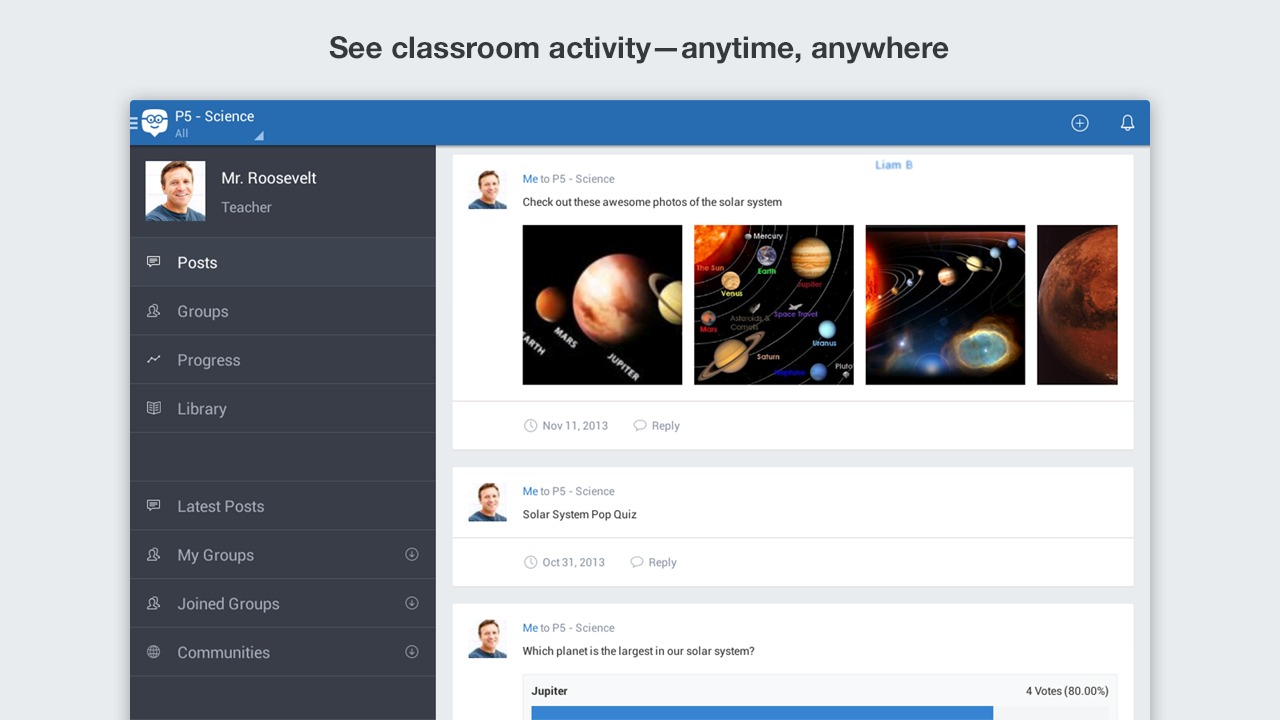
That familiarity mattered in schools, where a clever feature is useless if it adds another hour to a teacher's week. A single class code could bring students into the same place as assignments and discussion. The teacher-first design set Edmodo apart from broad learning management systems that often arrived through a district purchase. Its closest competitors eventually included Schoology, Moodle and Google Classroom; each offered overlapping course tools, but Edmodo's early identity was the moderated social community.
A network can grow faster than a budget
Free was a powerful distribution strategy. Teachers could start without waiting for a procurement cycle. By 2012, Edmodo claimed 10 million users. Two years later, contemporary reports put it at roughly 36 million teachers and students in about 220,000 schools. When NetDragon announced its acquisition in 2018, the figure had passed 90 million registered users in 400,000 schools across 192 countries. Those are registrations, not a count of people logging in on a given day, but the reach was real enough to attract a $137.5 million purchase agreement.
The obvious question was less glamorous: who would pay? Students made up most of the audience. Teachers selected the product, but districts usually controlled meaningful software budgets. Edmodo tried to bridge the gap with a third-party app store in 2012. Teachers could buy classroom apps; Edmodo would take a share. The catalogue grew to roughly 700 apps from 100 developers. Only about 10% of Edmodo's teachers visited it, according to a 2016 account.
“Our thesis was that teachers would have money that they could use to purchase apps.”Manish Kothari, Edmodo's general manager of platform, 2016
The hypothesis failed before the catalogue ran out of ideas. Teachers did not generally control a pool of app money. Edmodo even offered store credit, but it did not create a lasting buying habit. The company closed the app store in June 2016 and replaced it with Spotlight, a marketplace for teaching materials, most of them free.
Supply met a missing buyer
2016 app-store snapshot - separate measures, separate scales
Edmodo also tried selling up the school ladder. Snapshot, introduced in 2014, generated standards-aligned quizzes; a paid school version offered deeper analytics. District services added account syncing, usage data and training. These were practical products, though reported U.S. demand was tepid. In 2016, a company executive told EdSurge that only a few hundred U.S. schools and districts paid $500 to $2,500 a year for such services. By then the company had raised about $87.5 million. That was the first clear business failure: classroom adoption had not become institutional purchasing.
When the buyer became a country
International expansion offered a different buyer. A ministry could decide that many schools needed the same platform at once, and a contract could cover customization, support and training as well as software. Edmodo worked with publishers, including Cambridge University Press, on content and assessment. In 2020, school closures made remote learning urgent. Egypt selected Edmodo for a national K-12 rollout intended to serve more than 22 million students and more than one million teachers. Thailand selected it for a pilot involving 10,000 schools. Ghana also launched an Edmodo enterprise platform.
This was a change in the route to market, not merely a new sales pitch. The first model let one teacher start a class in an afternoon. The later one depended on ministry agreements, local partners, training and the politics of national education systems. NetDragon said as much in August 2022 when it announced that the free Edmodo.com service would close on September 22. Resources would move toward revenue-producing government deployments outside the United States, and the company expected lower operating costs.
The government strategy did not keep the name alive indefinitely. A later corporate filing says Edmodoworld, the subscription platform used outside the United States, shut on March 31, 2024; the company destroyed the accounts and their data. Edmodo LLC was dissolved effective June 3. An old URL may still be passed around, but the classroom network described here is history.
The bill children should never pay
There is a second business lesson, less cheerful than the first. In 2023, the U.S. Federal Trade Commission announced an order addressing allegations that Edmodo collected children's personal information without proper parental consent, used it for advertising and shifted compliance duties onto schools. The order included a $6 million monetary penalty, suspended because the company could not pay. The case makes the word “free” look rather more complicated when children are the users.
What can a new education company borrow from Edmodo? The teacher invitation was a sharp product insight: begin with a workflow a teacher already owns, make joining easy, and let the class gather around useful work. The mistake to avoid is assuming that affection in the classroom settles the invoice. Before building an app marketplace, establish who has permission to buy. Before promising a national rollout, budget for training, localization and support. This model is a poor fit where teachers cannot choose tools, families lack reliable access, or school systems cannot fund support. And before collecting a child's data, define its educational purpose and deletion date.
Edmodo made online classrooms feel like places where people could talk. Its history leaves a neat, uneasy equation: the teacher can start the network, the institution must sustain it, and the student must be protected throughout.