Every Duolingo lesson asks for something almost insultingly small: match a phrase, speak a sentence, rescue a streak. The tap lasts seconds. The relationship can last years. That is the useful contradiction inside the Pittsburgh education company. It sells progress in portions too small to frighten people, then uses a cartoon owl, a counter and a little social pressure to make stopping feel like a decision.
By the second quarter of 2026, 58.7 million people were using Duolingo on an average day. Only 12.7 million were paid subscribers. The distance between those numbers is not a leak in the model. It is the model: a vast free classroom that supplies word of mouth, data and future customers, financed chiefly by the fraction who pay for Super or Max.
A beautiful first idea that made lousy money
Luis von Ahn grew up in Guatemala, where English could alter a family's income but good instruction was expensive. At Carnegie Mellon, the computer scientist and his doctoral student Severin Hacker started with an elegant two-sided idea. People would learn a language by translating pieces of the internet; publishers would buy the resulting translations. The name “Duolingo” nodded to those two jobs.
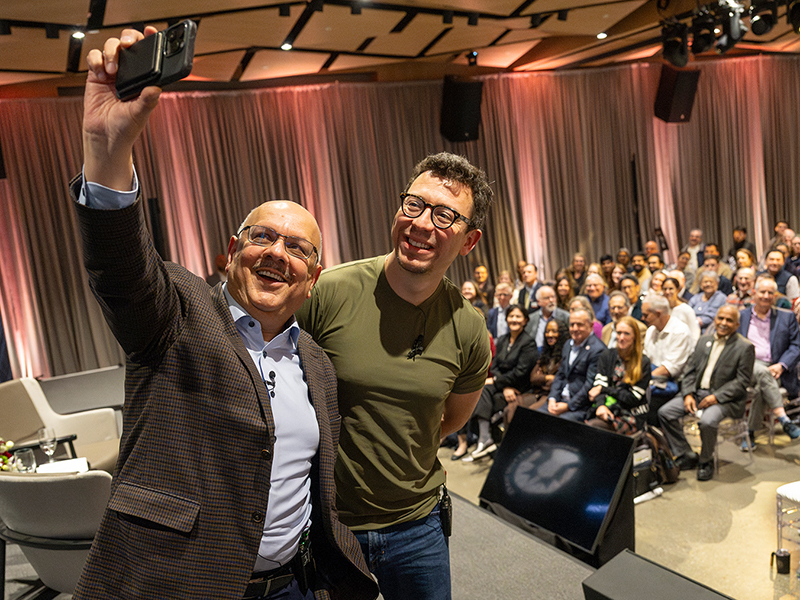
CNN and BuzzFeed became customers. Publishers paid roughly two to three cents a word. The service produced hundreds of thousands of dollars, not the durable engine a venture-backed consumer company needed. Worse, translation was drifting toward machines while learners were drifting toward phones. Duolingo shut the translation business by the end of 2013. The part designed to pay for the classroom failed first; the classroom survived.
The change of mind was not a flash of founder intuition. It arrived after mobile growth made the consumer product impossible to ignore and investors pressed a basic question: when does attention become a business? Duolingo began adding advertising after lessons, then sold a subscription whose cleanest promise was the removal of those ads. Paid convenience made more money than the clever marketplace ever had.
“Give the product away for free.”One of Duolingo's stated founding choices
Getting there was not free for the company. Duolingo raised about $173 million before going public, across rounds led or joined by Union Square Ventures, NEA, Kleiner Perkins, Google Capital, Drive Capital, CapitalG, Durable Capital and General Atlantic. Its 2021 IPO sold company shares at $102 each and brought in roughly $455 million in gross proceeds. Mission and capital were never opposites here. Capital bought the runway to discover a business model that did not put the core lesson behind a hard paywall.
The streak is the smallest useful contract
Duolingo's difference is easy to mistake for gamification. Competitors also have points, reminders and polished apps. The harder-to-copy layer is organizational: Duolingo calls its testing system the Green Machine. Teams run hundreds of experiments, watching retention, learning outcomes and monetization. A new animation or easier first lesson may barely move a metric. Enough small wins, compounded across an audience this large, change the curve.
The streak works because it is legible. “I studied for 423 days” is easier to feel than “my listening comprehension improved by an uncertain amount.” In June 2026, Duolingo let eligible learners restore their longest lost streak by opting in and doing three lessons. Some 15.4 million people did it, including nearly 8 million without an active streak when the event began. That was less a promotion than a field study in identity: people wanted their old selves back.
One app, several kinds of practice
Language remains the center. The app offers short exercises in reading, writing, listening and speaking, organized along a guided path. Its largest courses now reach Duolingo Score 129, roughly the B2 level on the European framework - enough to target professional, independent use, though not a promise that an app alone makes anyone fluent.
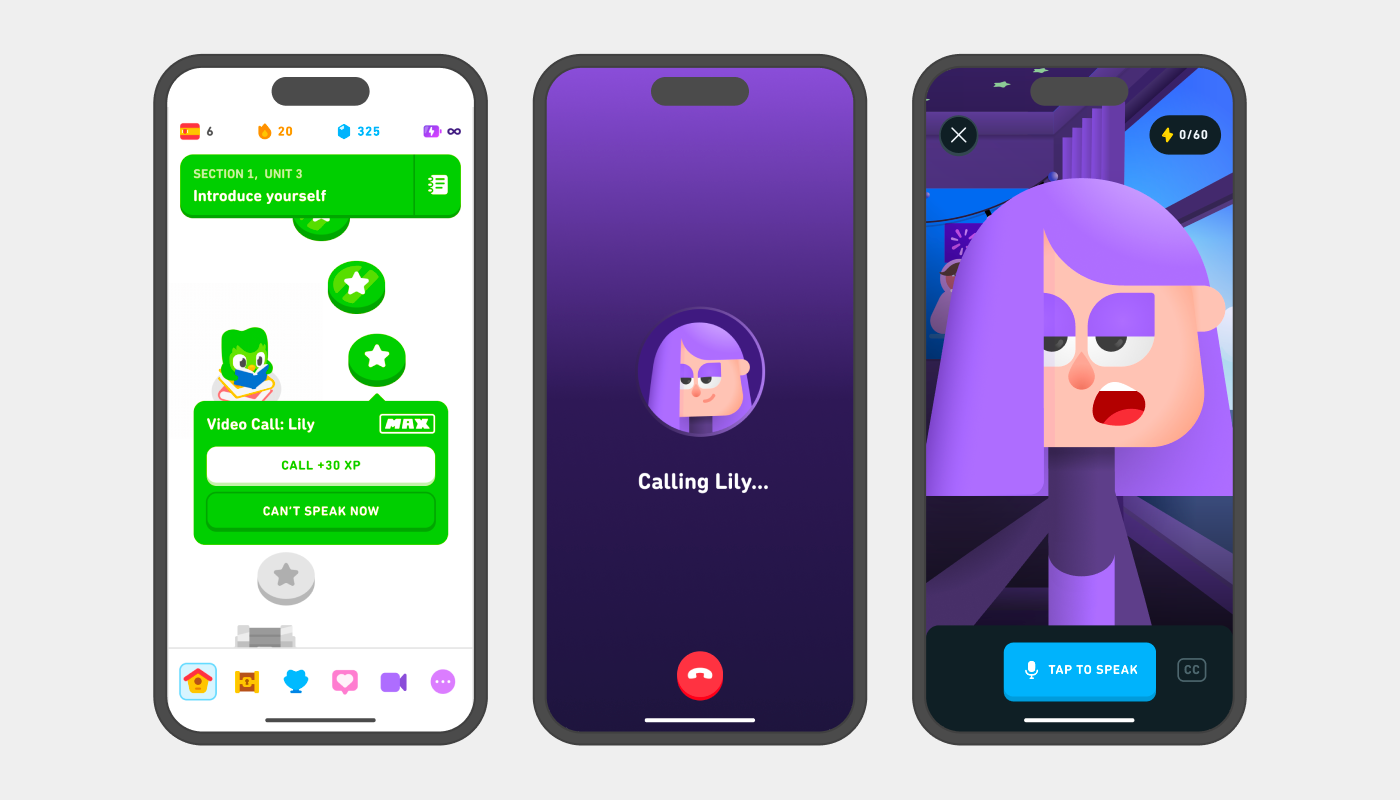
Around that core, Duolingo has built a shelf of adjacent products. Super removes ads and adds practice conveniences. Max adds AI conversation, most visibly Video Call with Lily. Duolingo for Schools gives teachers assignment and progress tools. Duolingo for Business packages lessons for teams. Duolingo ABC serves early readers. Math, music and chess ask whether the same bite-size loop can travel to other subjects.
Then there is the product that turns learning into a credential. The Duolingo English Test is a one-hour, adaptive exam taken from home for $70. More than 6,100 education programs accepted its results at the end of 2025. The contrast with a free lesson is useful: the app helps people build ability; the test charges at the moment they need to prove it.
The free classroom is paid for upstairs
Subscriptions dominate the economics. In Q2 2026, Duolingo recorded $250.3 million in subscription bookings out of $289.1 million total bookings. Advertising, English-test purchases and virtual goods filled in the rest. Prices for Super and Max vary by market and plan, while the free tier continues to carry ads. That makes Duolingo cheaper to begin than Rosetta Stone, a tutor or a scheduled class, but “free” still asks for attention and toleration of friction.
The danger is visible in that last sentence. A free product can be so aggressively monetized that it weakens the habit feeding the business. Management acknowledged the tension in 2026 and shifted attention toward learning quality, free-user growth and retention, even at the cost of slower near-term bookings growth. Longer free trials became attractive because they could raise revenue without punishing non-payers. The metric choice changed before the mission statement did.
AI is useful when it reduces the price of practice
Duolingo has used machine learning for years: lesson personalization, speech recognition, test security, ad selection and content operations. Generative AI made two expensive things cheaper. It helped the company produce course material faster, and it made open-ended conversation available without booking a human tutor. In the first quarter of 2026, Duolingo published 20,500 course units, up from 1,800 per quarter in 2024.
Scale creates its own editorial problem. A wrong example can teach millions of people the same mistake. AI conversation also trades the empathy and improvisation of a good tutor for infinite availability and a lower marginal cost. Duolingo's advantage is not that it can generate text. Anyone can. It is that generated practice lands inside a curriculum, a character world and a return habit that already exists.
What another builder can actually copy
Borrow the loop, not the owl
- Find the smallest action that creates real value, then make starting it almost effortless.
- Show progress in a unit people understand. A number is useful only when it represents something worth repeating.
- Give the free experience enough quality to drive recommendation. Treat monetization as a design constraint, not an interruption quota.
- Run small tests against a clear hierarchy of outcomes. Retention without learning is motion; learning without return has no compounding effect.
- Use a memorable voice consistently. Duolingo's characters work because product, animation and marketing inhabit the same world.
The playbook fails under predictable conditions. It struggles when progress cannot be broken into frequent actions, feedback arrives months later, mistakes carry serious consequences, or mastery depends on human judgment. A streak can support piano practice; it cannot tell you whether the performance moved an audience. It can prompt medical study; it should not certify a surgeon.
It also fails when the reward displaces the work. If learners optimize XP instead of comprehension, the game has eaten the lesson. Duolingo has tried to close that gap with mastery checks, speaking exercises, intermediate content and a Score tied to proficiency. That work matters more than another dancing chest.
Where the owl sits in the market
Babbel and Rosetta Stone sell more conventional language programs. Busuu and Memrise compete for mobile learners. Preply, italki and Lingoda sell access to humans. Chatbots can improvise a conversation on demand. Dedicated chess, music and math products go deeper in their lanes. Duolingo's defense is the combination: broad free reach, a recognized cast, a disciplined experiment engine and a credential business connected to the learning funnel.
The next test is educational, not theatrical. Duolingo has already proved it can make millions of people tap. It now has to show that the taps accumulate into speaking, understanding and transferable skill, while keeping the free product generous enough to feed the system. The owl can get someone back tomorrow. What they can do a year from now is the business that matters.