The trouble with a good classroom is the room. In Yerevan, the coding bootcamp tied to Yeva Hyusyan’s startup accelerator was doing what bootcamps promise to do: companies hired its graduates. Yet every extra student needed an instructor, a seat and time. Success made the ceiling visible. Hyusyan and co-founder Davit Kocharyan took the lesson out of the room and tried to put it in a pocket. Sololearn grew from that decision.
The story in four lines
- A useful bootcamp exposed a physical limit: classes could only grow as fast as space and staff.
- Sololearn first scattered its lessons across separate apps, then gathered them into one coding platform.
- Early praise did not mean lasting use. Shorter tasks, practice and peer help gave learners reasons to return.
- Core lessons remain free; subscriptions and team training pay for added practice, AI help and management tools.
The bootcamp with no spare chairs
Hyusyan worked on a startup accelerator at Microsoft’s innovation center in Armenia. A coding bootcamp emerged beside it, and local technology companies began asking for its graduates. The idea had evidence behind it: learners could acquire skills employers wanted. But a bootcamp is a machine with a stubbornly human throughput. The founder later described the constraint plainly: “It was hard to scale.”
A phone offered reach that a classroom could not. The company dates its founding to 2013, while Hyusyan has described launching the mobile learning effort in 2014. That distinction matters less than the choice it records. The founders were betting that a person waiting for a bus could learn a bit of Python without arranging a course schedule, a laptop and a spare evening.

The first mobile design was untidy. In one account, Hyusyan recalled separate apps for individual languages, with experiments that wandered into photography and even makeup. That spread made maintenance difficult. Combining the material into one platform simplified the work and gave learners a place to move between skills. The more interesting correction came after launch.
A five-star review is not a habit
People downloaded Sololearn, learned something, left glowing reviews - and disappeared. Praise described the first session; the business depended on the second. Hyusyan told VentureBeat that the team responded with smaller lessons, practical challenges, places to show finished work and peer-to-peer help. The product had to make the next five minutes easy to begin.
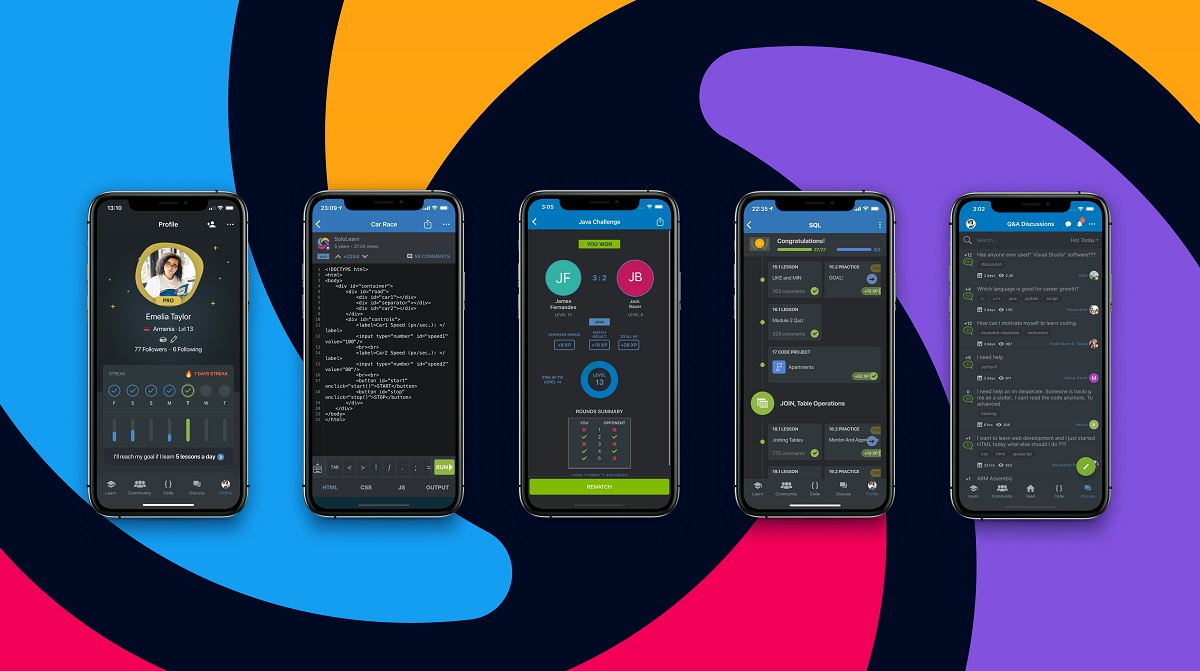
Today the company describes a fairly strict teaching loop. Learn one concept, use it immediately, get instant feedback, return for another. It does not rely on video lectures in its core courses. A learner can open an editor in the app or browser, write actual code and run it without installing a development environment. Questions can go to other learners; runnable projects can be shared. The community is part of the instruction, especially when an error message is correct but unhelpful.
This is the difference between Sololearn and a conventional video course. Watching someone write a loop can make the idea feel familiar. Writing the loop makes the missing semicolon your problem. The format also differs from a full-time bootcamp: it asks for minutes, not months away from work. Codecademy, freeCodeCamp and Mimo offer other routes through interactive learning, and longer projects remain useful once fundamentals stop being the obstacle. Sololearn’s claim is narrower and practical: begin on the device already in your hand.
The game must lead somewhere
XP, leagues, streaks and limited “Hearts” give the lessons a game’s pace. On the free plan, a wrong quiz answer spends one of five Hearts; paid plans lift that limit. The machinery can motivate a return, but the company’s founder has warned against overdoing gamification. A streak is evidence of attendance. It is not, by itself, evidence that a learner can build a program.
“Everyone was critical about the idea of learning coding on a mobile screen.”Yeva Hyusyan, speaking to TechCrunch in 2021
The counterargument was obvious: coding belongs at a desk, with room for files and a keyboard. Sololearn built an on-phone compiler and editor anyway. That decision made the company more than a collection of multiple-choice quizzes. It gave a beginner a fast way to discover whether a line of code works, and gave the platform a reason to exist in small gaps of time.
By July 2021, Sololearn said it had 21 million registered users, that active use had risen 300% over the previous year, and that it was adding up to 300,000 users a month. Drive Capital led a $24 million Series B, joined by Learn Capital and Prosus Ventures. The company’s current Teams page advertises more than 30 million registered learners. Those are sign-ups, not a count of people studying this week. Even with that caveat, the scale explains why a lesson measured in minutes can matter commercially.
A customer waiting for the next order
A 2023 pilot with delivery company Glovo put the idea under an unusually literal test. Couriers in five countries were invited to learn between orders and after shifts. Glovo says 339 signed up; over eight weeks they finished more than 24,000 lessons and earned more than 170 course certificates. Eighty percent completed at least one lesson. The pilot measured participation, not whether the couriers later got programming jobs. It did show that the spare minutes Sololearn designed for exist outside a marketing diagram.

For employers, Sololearn Teams packages short coding, data and AI training with group activity and a dashboard to track progress. The Glovo example is a partnership, and also an unusually clear picture of the target customer: an organization with people who need technical confidence but cannot disappear into a classroom. For individuals, the same course catalog covers Python, JavaScript, SQL, web development and newer AI subjects. A beginner can try fundamentals; an employee can learn enough to inspect a script or speak more fluently with a technical team.
Free lessons, paid momentum
The business model is deliberately asymmetric. Sololearn says the content of every course and its completion certificates are free. PRO charges for unlimited Hearts, more practice, extra quizzes, Code Playground access and an ad-free experience. MAX adds Kodie, an AI assistant that explains answers, points out mistakes and suggests fixes. The published pricing page lists PRO at $69.99 a year or $12.99 month to month, and MAX at $119.88 a year. Team training is sold through a demo request.
What the fee changes
The lesson is free. The shorter path through friction costs money.A free learner can study the curriculum and earn a certificate. Paid learners buy more attempts, more practice or help at the moment their code breaks.
Kodie extends the same logic into AI. If an error message drives someone away, plain-language help may keep them in the lesson. Yet a suggested solution can also end a productive struggle too quickly. The learner still has to decide whether to inspect the fix or copy it. Sololearn’s certificate is similarly modest: the company calls it proof of completion and consistency, not an accredited credential. For a hiring manager, a working project remains stronger evidence than a badge.
What fits in a pocket
There is a useful method here for anyone teaching a difficult skill. Start with one action the student can finish today. Let them test it immediately. Make a question easy to ask and an answer easy to find. Give the next visit a purpose beyond protecting a streak. Sololearn arrived at that sequence through a bootcamp’s capacity limit, too many early apps and a retention problem disguised by good reviews.
The approach has limits. Phone lessons are well suited to first contact, repetition and short exercises. A large software project still needs longer blocks of thought, a proper development environment and deliberate practice. But the first barrier in coding is often smaller than that: opening the editor at all. Sololearn’s achievement is making that first act ordinary enough to repeat tomorrow.