Sam Walder remembers violin as a source of strain before he remembers it as a startup. Music mattered during his childhood, but the lessons could feel punishing. Friends drifted away from their instruments when schedules tightened or when the culture around classical training made them feel unwelcome. Walder stayed close enough to the violin to describe himself, years later, with a perfectly tuned bit of modesty: “a… solid second violinist.”
That description contains the useful contradiction at the center of Trala. The company was not built by a prodigy designing a prettier conservatory. It was co-founded by a working violinist who knew how easily practice could turn into dread, and by a fellow computer engineer who knew how to make a phone listen. The result was software that could catch pitch and rhythm in real time, paired with teachers who could do what software cannot: interpret, encourage, and make another person care about the next note.
By the time Berlin-based Learnfield acquired the Trala app in 2025, the small Chicago experiment had become a global school. The acquisition announcement counted 800,000 downloads. Walder later put the larger arc at more than one million people taught across 193 countries. The figures are tidy. The route to them was not. It ran through a college hackathon, a ramshackle campus house, hundreds of phone calls, a pandemic, professional violinists, and nine years of trying to make an unforgiving instrument feel less forbidding.
A house with bad coffee and good counsel
The origin story begins at the University of Illinois Urbana-Champaign, where Walder studied computer engineering from 2013 to 2017. It also begins at Honors House, a wooden building on Oregon Street known to its regulars as the HoHo. Walder’s memories of it are architectural. There was the director’s office, where he sometimes tapped on Kim Graber’s window during late-night study sessions and received chocolate and dating advice. There was a living-room couch where he read, talked, and made friends he credits with helping him graduate. There was endless Folgers, a wonderfully credible detail in any college entrepreneurship story.
A visiting professor, Paul Magelli, once told the students gathered on the floor to conduct business as if every decision might appear on the front page of The New York Times. Walder carried that test into a company that, by his account, would raise $20 million and grow beyond 100 team members. Upstairs, in a small classroom, Professor Joe White offered another turn. Walder entered White’s course, Business as a Force in American Society, believing business was “evil and soul-sucking.” He left believing that a company was a group of people pursuing a shared purpose, with the values of its staff written into its behavior.
By the end of the course, Walder wanted to start one. The following semester he and his friend Vishnu Indukuri did exactly that. They brainstormed at the HoHo, drinking the coffee and imagining the future.
“At Trala, we have ‘students,’ not ‘users.’”Sam Walder
When the phone learned to listen
Walder and Indukuri had met at a college hackathon. Both were studying computer engineering; Walder brought a violinist’s experience. Their first collaboration involved an artificial-intelligence composer. From there came a more practical question: if learning an instrument was so difficult, could technology soften the frustrating interval between lessons?
Together they devised a signal-processing algorithm that could analyze the sound of a violin and respond to pitch and tempo. A learner could play into a phone, see where a note went wrong, and try again. The app also tracked practice and scores over time. Yet Trala did not make the common technology mistake of treating feedback as education in full. It added video tutorials, interactive sheet music, a community, and one-to-one lessons matched to a student’s age, experience, and musical interests.
The target student was unusually broad: an adult beginner, someone with a crowded calendar, a rural learner without a local teacher, or a player curious about genres outside the Western classical canon. Walder spoke about a designer in upstate New York and a 61-year-old librarian in Austin. Forbes later described Trala’s students as truck drivers, grandmothers, NFL players, surgeons, and construction workers. The common qualification was not pedigree. It was wanting to play.
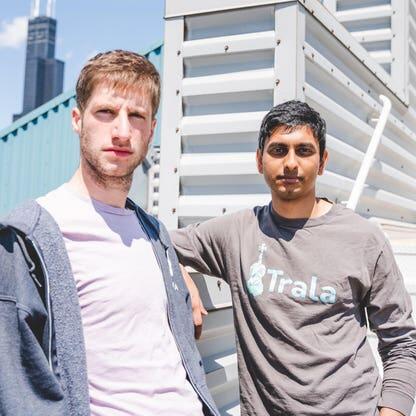
The product was co-founded 500 more times
Early on, Trala sent an interview request to every student. The team completed more than 500 phone calls, asking how people practiced and what they needed. Walder’s line that the company was “co-founded by its students” was not merely charming copy. It described an operating method. Calling people students rather than users forced a different standard. A user can click, retain, convert, or churn. A student is supposed to learn.
That standard shaped the mix of machine and musician. Professional performers including Joshua Bell, Katie Jacoby, Kiana June Weber and others contributed instruction. Bell joined a partnership intended to set a high curricular bar while opening that knowledge to beginners with a phone. Trala’s ambition was not to diminish expertise. It was to unbolt the door.
The same principle later appeared behind the scenes. Trala teachers were spending roughly 15 hours each week preparing custom lesson plans. After adviser Jeff Weiner suggested tracking teacher administrative hours as a core metric, Indukuri built an AI teaching assistant to draft plans, notes, and action items. Walder reported that administrative time fell and teacher NPS rose 20 points. The machine took paperwork. The teacher got attention back. For an education company, that division of labor is the whole score.
“You can say that Trala was co-founded by its students.”Sam Walder
A difficult year finds an available instrument
The pandemic accelerated Trala because people were at home and searching for what was missing. Walder’s explanation was less commercial than existential: music could fill a gap. Local schools closed, teachers stopped in-person lessons, and remote instruction changed from an eccentric option to the available one. But he resisted treating the pandemic as the whole demand story. A beginner in rural Michigan had faced the same access problem before lockdown and would face it afterward.
By October 2021, Trala had passed 400,000 downloads and was adding about 500 sign-ups a day. In 2022, according to Forbes, it grew fourteenfold. Walder and Indukuri were named to the Forbes 2024 30 Under 30 Education list, recognition that arrived seven years into their work. The company’s progress can be read as a staircase, but each landing changed what Trala was responsible for.
The exit, played as an ensemble
Learnfield, the Berlin company behind piano-learning platform Skoove, announced its acquisition of Trala in April 2025. The plan was to keep Trala’s violin curriculum and tools, add licensed music, pursue new partnerships, and use Learnfield’s experience in music learning and customer growth. Walder said the combination created new possibilities for violin learners and gave the old mission a chance to travel farther.
His own announcement sounded like the credits after a concert. He thanked Indukuri, the team, advisers Logan LaHive, Bob Meese, Cristina Apple Georgoulakis and Jennifer Kim-Matsuzawa, then named the investors who had backed the company. Over nine years, he wrote, Trala had provided employment for hundreds of musicians. “We created beauty together,” he told the people he called llamas.
Then came one boundary. People were welcome to reach out about almost anything, except the ritual founder question: what’s next? Walder planned to backpack and play lots of music. It was a neat return. The boy for whom violin had been stressful had built a company around making practice more welcoming, handed the app into its next movement, and made time to become a student again.
There is a founder lesson here, although Walder’s story is more pleasant if not squeezed too hard for one. The technology mattered. So did capital, distribution, celebrity instruction, and a well-timed shift toward remote lessons. Yet the thread tying the company together was attention: a phone listening to a note, a team listening through 500 calls, software giving teachers back their hours, and a founder remembering the mentors who listened to him before there was a company at all.
A violin produces no music simply because it is expensive, difficult, or revered. Someone must pick it up. Trala spent nine years making that first gesture a little easier.