Nobody puts “take the required course” on a vision board. They put a car there, or a house, or a career with a little more freedom. Aceable has built its business in the awkward space between that picture and the permission slip. Its customers arrive with a destination. The company’s job is to make the compulsory journey bearable enough to finish.
- The product: online courses for driving, real estate, insurance, and mortgage licenses.
- The bet: short, interactive lessons fit lives that have no room for another classroom.
- The business: course sales, richer study packages, bulk seats, and referrals.
01 / Five dollars a day was a clue
In a 2021 interview, founder Blake Garrett recalled that his early book-trivia apps brought in about $5 daily. By July 2013, roughly $75,000 raised had dwindled to $2,000 in the bank, alongside about $50,000 in credit-card debt. An investor rejected the business, then suggested applying its mobile and game mechanics to things people had to learn. Garrett took the advice.
The resulting driver’s-ed course launched in Texas in 2014. That choice gave the product something trivia lacked: a customer who needed a specific result. The teenager wanted the keys. The parent wanted a manageable process. A lesson about road signs could serve both.

02 / A robot with a paperwork problem
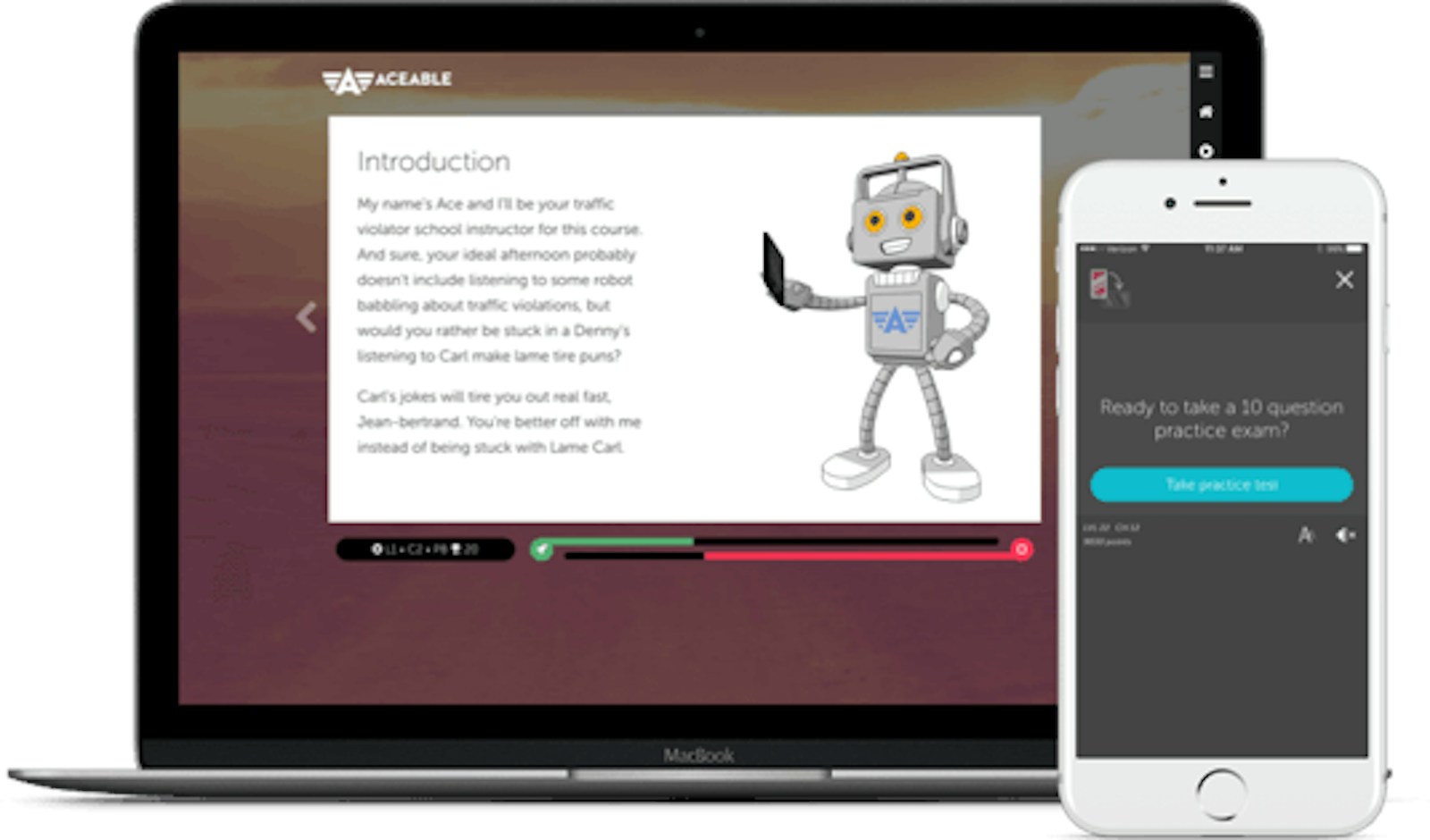
Early designer Kai Tran’s account makes the work sound pleasingly unromantic. She studied DMV documents, mapped the permit process, and worked with a state curriculum expert. The team also tested a humorous advertising approach against a more conventional one. Humor won. Ace, the robot instructor, emerged from that effort.
The combination explains much of Aceable’s appeal. A state-approved syllabus supplies the seriousness; a conversational voice supplies a reason to keep reading. The company describes lessons broken into small chunks, with questions appearing during instruction. Videos and pictures interrupt the wall of words. Its learning-science article even mentions student fan art of Ace, an unusual reward for teaching traffic law.
There is a practical point beneath the personality. A quiz lets learners discover a misunderstanding while the topic is still fresh. Saved progress makes it easier to return. The phone becomes useful study equipment during the small intervals a formal timetable tends to ignore.
03 / The price of permission
Aceable sells a course, not a license. Its Texas parent-taught driving page lists an online course, a permit test, progress tracking, and study tools. Families still need an eligible instructor, driving practice, paperwork, and the required in-person steps. The app can explain an intersection. It cannot watch a nervous teenager enter one.
At research time, that course was advertised at $74 on sale, against a $115 regular price. Texas real estate Basic was $449; higher packages added services such as tutoring and advanced preparation. Prices vary with promotions and packages. State application and examination costs belong to a different part of the budget.
- 01ChooseRight state, right credential
- 02LearnLessons, quizzes, required practice
- 03QualifyExams, application, state requirements
The important distinction is between flexible scheduling and unrestricted eligibility. Approval depends on the course and jurisdiction. Learners who need constant live instruction may prefer a classroom. Those who cannot arrange required driving practice still have a problem after the last quiz.
04 / The first expansion did not behave
Real estate initially disappointed. Garrett said the March 2017 Texas continuing-education launch flopped. Aceable then pursued pre-licensing; he reported that March 2018 sales exceeded the prior year’s continuing-education sales. Renewal and entry into a profession were different buying moments. Finding one did not guarantee the other.
That distinction is worth borrowing. A prospective agent is purchasing a route into work. An established agent is maintaining permission to do work already familiar. Both need education, but the urgency, questions, and willingness to pay can differ. “Education” is too broad a customer description to explain either purchase.
AceableAgent now competes with approved real estate schools such as Kaplan. Its emphasis is study that follows the learner across devices, with additional help available in richer packages. Competitors also offer digital instruction and exam preparation. Convenience must earn its price through the actual course experience.
05 / Expansion came with a checkbook
The funding grew with the ambition: a $47 million Series B led by Sageview Capital in 2018, followed by a $50 million HGGC-led growth investment in December 2020. The latter announcement put cumulative fundraising above $100 million and described plans for geographic expansion and more certifications.
Round sizes, not revenue or acquisition prices.
Acquisitions supplied another route into adjacent markets. Real Estate Institute joined in 2024, bringing professional-education experience that helped Aceable enter insurance and mortgage. Aceable Insurance launched in March 2025. Mortgage courses now operate under an NMLS-approved provider. Buying an established operation can bring expertise that an attractive interface alone cannot supply.
That work puts Aceable in a particular corner of the education market: preparation for a defined permission to act. The expertise must include instructional design and the rules surrounding each credential. A useful course has to hold someone’s attention while delivering the right material for the right approval. Content maintenance is part of the product, even when the learner never sees it.
The company’s 2025 recap reports nearly 30 major releases, including an Illinois real estate catalog and 26 new mortgage courses in midyear. These are Aceable’s own figures. They describe a business maintaining multiple regulated catalogs, rather than simply publishing the same lessons under different names.
06 / Sell the next step
Individual enrollments are only part of the model. Organizations can buy seats in bulk; affiliates can earn referral commissions. Brokerages need new agents, driving schools need classroom partners, and professionals return for continuing education. Distribution can follow the institutions already close to the learner.
In June 2026, AceableAgent announced Fast Track with real estate coach Tom Ferry, extending into the work after licensure. The useful lesson for other businesses is precise: identify the next obstacle your customer encounters, then decide whether you can remove it credibly.
“We help people get licensed. And it changes lives.”
Aceable’s stated mission
For a buyer, the lesson is equally practical. Start with the license you need and the state where you need it. Compare the approved coursework before comparing package names. Then decide whether you will use the extra tutoring, practice tools, or coaching. A bundle earns its keep when it solves your particular sticking point; buying more material does not manufacture more study time.
Copy the attention to the whole process: the form, the confusing prerequisite, the missed question, the point at which someone stops. This approach needs a recognized credential, approved content, and customers able to finish the remaining steps. A charming robot helps. Permission to move forward does the selling.