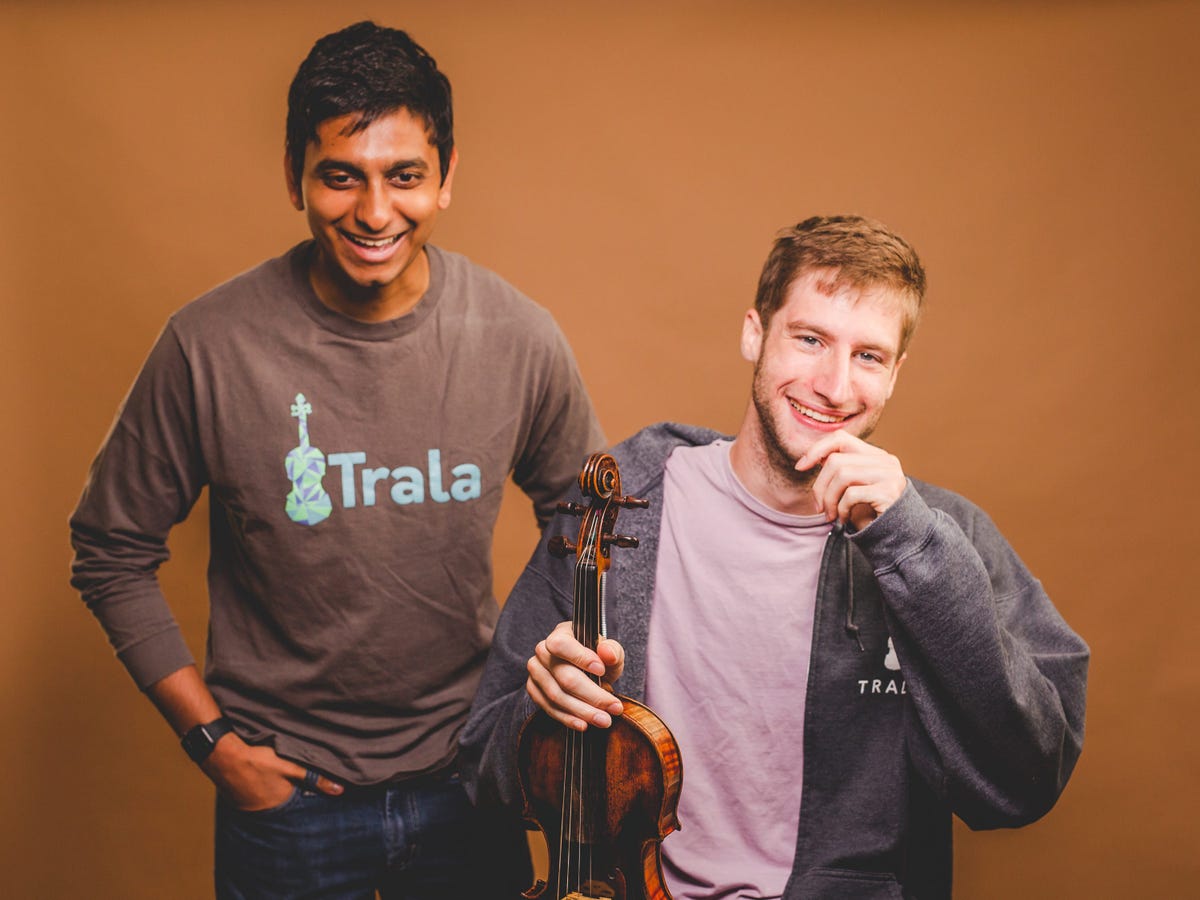
A violin is a rude instrument for a beginner. There are no frets to tell a finger where to land, and a note can be wrong by a millimeter. The bow has its own opinions. In 2016, two University of Illinois engineers looked at this beautifully unstable object and decided a phone should judge it. Trala began as an audio-feedback tool for people who already played. The software listened through the microphone, analyzed pitch and tempo, and pointed out mistakes. Technically clever. Commercially quiet.
The people who did download it kept asking a question the founders had not designed for: Can you teach us from scratch?
Sam Walder, a violinist and computer engineer, and Vishnu Indukuri, a computer scientist steeped in signal processing, first thought the request was unrealistic. Teaching violin was physical, fussy, and traditionally personal. Then Indukuri became the guinea pig. Trala stopped acting like a meter for musicians and started becoming a school for people who wanted permission to call themselves musicians.
01 / The first missThe feature worked. The customer did not care.
That is the first useful thing about Trala: what failed was not the algorithm. It was the assumption wrapped around it. Existing violinists could already hear many of their errors, had teachers, or had established ways to practice. The product's novel capability was not automatically an urgent need. Beginners had the opposite problem. They could not reliably tell whether a note was sharp, flat, early, or late, and they often had nobody nearby to ask.
The pivot demanded more than changing a landing page. The founders had spent roughly six months in a basement filtering and tuning their audio system for violin. Now they needed curriculum, video, notation, repertoire, motivation, and a progression gentle enough for somebody who had never held a bow. Their first 40 lessons were meant to occupy learners for weeks. According to Indukuri, the average user finished them in about 14 hours. The flattering interpretation was extraordinary engagement. The practical interpretation was an empty shelf.
So Trala made content part of the product, not decoration around the technology. The current app pairs short lessons with an interactive library of more than 500 songs and exercises, a built-in tuner, progress tracking, and real-time feedback on pitch and rhythm. Its teachers and curriculum experts have ranged from Suzuki specialists and concertmasters to Kiana June Weber, a Celtic fiddler, and Katie Jacoby, electric violinist for The Who. Bach can sit beside Britney Spears because an adult's reason to practice is more valuable than a purist's opinion about repertoire.
“Everyone should have access to the gift of making music.”Sam Walder, co-founder
02 / The productA practice loop with a human escape hatch
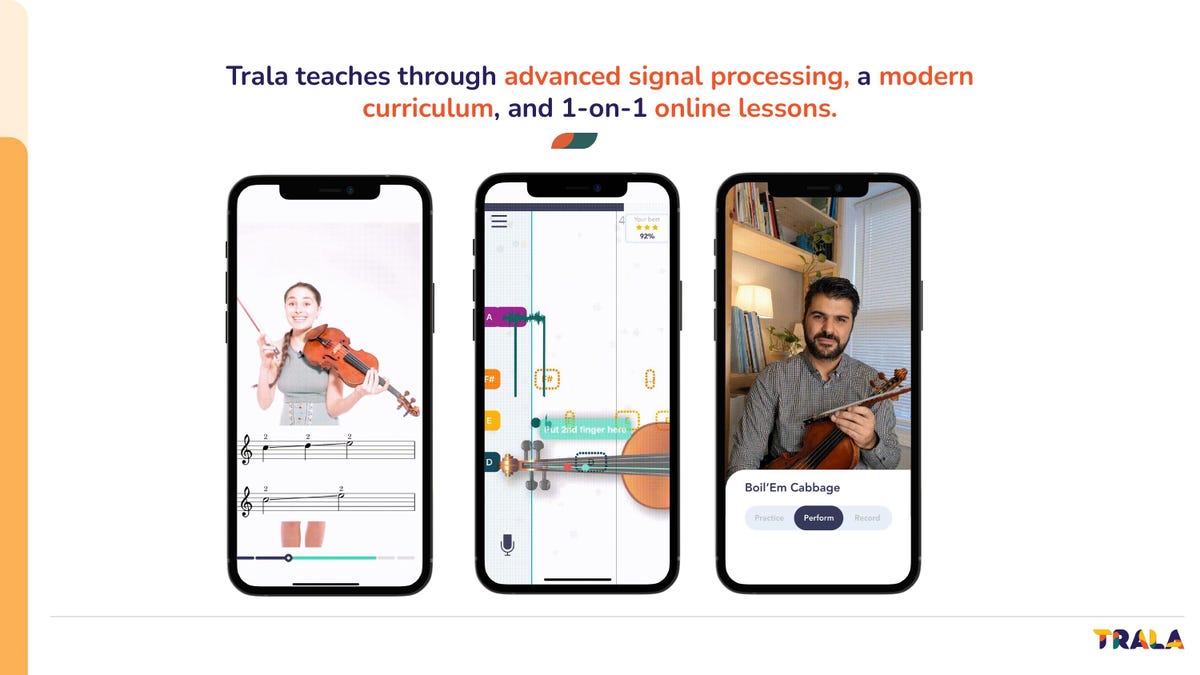
The app's central move is simple to describe. Watch an expert demonstrate a technique. Play into the phone. Let the software compare the incoming sound with the score. See where pitch or rhythm slipped. Try again. This turns the lonely interval between lessons into a scored loop. It is more responsive than a book and more specific than a generic video, because the lesson reacts to the student's own instrument.
But pitch and rhythm are only part of violin playing. A microphone cannot reliably see a stiff thumb, a collapsed wrist, excess shoulder tension, or a bow wandering toward the fingerboard. It can reward a correct note produced with an ugly habit. Trala's answer, especially before its acquisition, was a hybrid online school: the app handled repeatable practice while live teachers handled diagnosis, interpretation, and morale. Students could buy recurring one-to-one video lessons and use the software between calls.
Software is good at
- Repeatable pitch checks
- Rhythm and tempo scoring
- Sequencing daily practice
- Remembering progress
Humans are good at
- Posture and setup
- Tone diagnosis
- Interpretation and taste
- Knowing when frustration is the real problem
03 / The customerThe adult who has been “meaning to” for 20 years
Trala's most revealing customer was not a child being marched to Saturday lessons. The company said most users were adults, and its website reported that two-thirds were touching the instrument for the first time. In a 2023 announcement, Trala described an online school of 1,000 students that included truck drivers, firefighters, politicians, surgeons, construction workers, and grandmothers. These people were buying flexibility and privacy as much as instruction. An app never raises an eyebrow when a 47-year-old plays “Happy Birthday” badly at midnight.
That audience explains the company's difference from a local teacher and from free YouTube. A private teacher offers rich feedback but requires matching location, schedule, personality, and price. YouTube offers infinite supply but no sequence and no response. Trala sells a path: the next exercise is waiting, the tuner is in the same place, the score remembers yesterday, and the catalog gives the learner something recognizable to chase.
The app is free to download, while premium curriculum and progress features sit behind an auto-renewing subscription. A June 2026 Google Play review cited $19.99 a month or $119.99 a year, though store prices can vary by region. Earlier live-lesson plans cost more because they paid for a teacher's time. This is a consumer subscription business with an old edtech tension: the free alternative is enormous, and the expensive alternative is personal. Trala has to be more useful than random videos while staying easier to buy than a standing private lesson.
04 / The moneyCredibility, capital, and a larger music shelf
Trala won the University of Illinois Cozad New Venture Challenge in 2017, joined Techstars Chicago in 2018, and raised a $1.29 million seed round later that year. A $3.5 million round followed in 2020. By late 2021, total funding had reached $6.9 million, with support from executives connected to companies such as LinkedIn, Airbnb, Coinbase, DoorDash, and VMware. In 2023, Seven Seven Six led an $8 million Series A with Lachy Groom Fund, Altman Capital, Next Play Ventures, and Concrete Rose Ventures. Trala said that brought announced funding to $15 million.
Famous names were not only on the cap table. In 2021, Grammy-winning violinist Joshua Bell became an adviser and curriculum partner, recording videos and lending the authority of a concert career to a product aimed mostly at non-conservatory learners. It was a neat reversal: elite expertise became useful precisely because Trala chopped it into moments a beginner could reach.
The capital also exposed the cost structure. This was not a lightweight library of prerecorded clips. Trala needed instrument-specific engineering, a deepening content catalog, music licensing, mobile development, customer acquisition, support, and - for the school - working teachers. The company reported 14-fold growth in 2022 and 30 new teachers, then talked about creating hundreds more musician jobs. Scale promised access, but every new human lesson also carried human economics.
05 / The exitThe violin app joins the piano app
In March 2025, Berlin-based Learnfield GmbH acquired the Trala apps. Learnfield already operated Skoove, a piano-learning platform. Its announcement said Trala had passed 800,000 worldwide downloads and that the combined portfolio reached more than four million learners. The strategic logic is legible: content production, subscriptions, audio technology, and mobile learning infrastructure can travel across instruments even when the pedagogy cannot simply be copied and pasted.
After the acquisition, Learnfield became the app-store developer, introduced its terms, and placed premium content and progress tracking behind a subscription paywall. Trala remained available and continued receiving updates. The outcome was not the universal multi-instrument school Trala once sketched on its own. It was a specialized violin product inside a larger music-learning operator - a narrower ending, and perhaps the more durable one.
What another founder can steal
- Start with one measurable pain. Trala did not attempt “music” first. It tackled pitch and rhythm on one fretless instrument.
- Listen for the embarrassing request. “Teach me from scratch” contradicted the original thesis and revealed the larger market.
- Treat fast completion as inventory data. When users finished 40 lessons in 14 hours, the curriculum - not demand - was the bottleneck.
- Automate the loop, not the whole profession. Software graded repetition; teachers supplied physical diagnosis and judgment.
- Borrow authority carefully. Working violinists made the curriculum credible, but their expertise was tied to specific lessons and outcomes.
06 / The limitWhen this model stops working
The Trala approach is weakest when the microphone cannot capture clean sound, the instrument is badly set up, or the learner needs immediate physical correction. It also struggles when a customer wants a free reference rather than a structured habit, or when subscription fatigue arrives before musical progress. An adult with self-direction and a tuned violin can get enormous value from short feedback loops. A young child with a tense setup and no nearby adult may simply practice the wrong movement more efficiently.
Do not copy this under these conditions
If the skill has no reliable machine-readable signal, if experts cannot break it into a sequence, if content costs rise faster than retention, or if human intervention is required on every attempt, the hybrid economics fall apart. The lesson is not to build “Trala for everything.” It is to know exactly which part of expertise can become feedback.
Trala's cleanest achievement was not removing the teacher. It was making the minutes between teachers less blind. The company found a neglected learner, gave that learner a private place to sound terrible, and kept enough of the old craft around to know why. In a category full of claims about democratizing expertise, that boundary is the interesting bit: the phone can hear the note. The student still has to make music.