A school project can have a remarkably short public life. It gets submitted, graded and pushed down a screen by the next assignment. Bulb is built around a more useful possibility: that the work might matter again when its creator applies to college, seeks an internship or tries to explain what they can actually do.
The company sells digital portfolios and resumes to students, educators and institutions, with room for professionals too. Users assemble writing, photographs, video and other material into pages and collections. A project can sit beside an explanation of the decisions behind it. The finished object gets a history. The student gets something to show.
That is a modest proposition with demanding consequences. Someone must choose the work, describe it, review it and decide who should see it. Bulb can supply the publishing tools. Its customer stories reveal how much of the job still belongs to people.
The work gets a forwarding address
Bulb’s origin predates today’s rush to attach a personal brand to every achievement. A 2014 company announcement names five founders: brothers John and David Runkles, Eric Goldreyer, Bob Bush and Erik Petrik. They started the business in 2011. Goldreyer brought a background in travel businesses, including founding BedandBreakfast.com; Petrik brought experience in education.
In June 2014, Bulb announced more than $1 million in additional Series A financing from angels while launching its first major portfolio product. Development and marketing were the stated uses for the money. The pitch already extended beyond pupils: teachers, artists, writers and filmmakers could publish work without learning web design.
The school connection gave that general publishing idea a particular purpose. Eanes Independent School District in Texas piloted bulbSchool, seeking a way to show academic and creative work that would follow students when they moved or graduated. Continuity became a selling point: the portfolio belonged in the learner’s life, beyond any particular class.
Bulb’s graduation instructions make the promise pleasantly practical. Before leaving, users should add a personal email address and a Bulb password. The portfolio may be designed to travel, but the login needs packing too. It is a small administrative detail with more immediate value than another speech about lifelong learning.
A resume with something behind it
The product’s basic vocabulary is pages, collections and subcollections. A page holds multimedia content; collections give those pages an order. Templates reduce the work of getting started, while sharing settings let users choose an audience for particular material. A portfolio can be an ongoing notebook, a carefully edited showcase or a mixture of both.
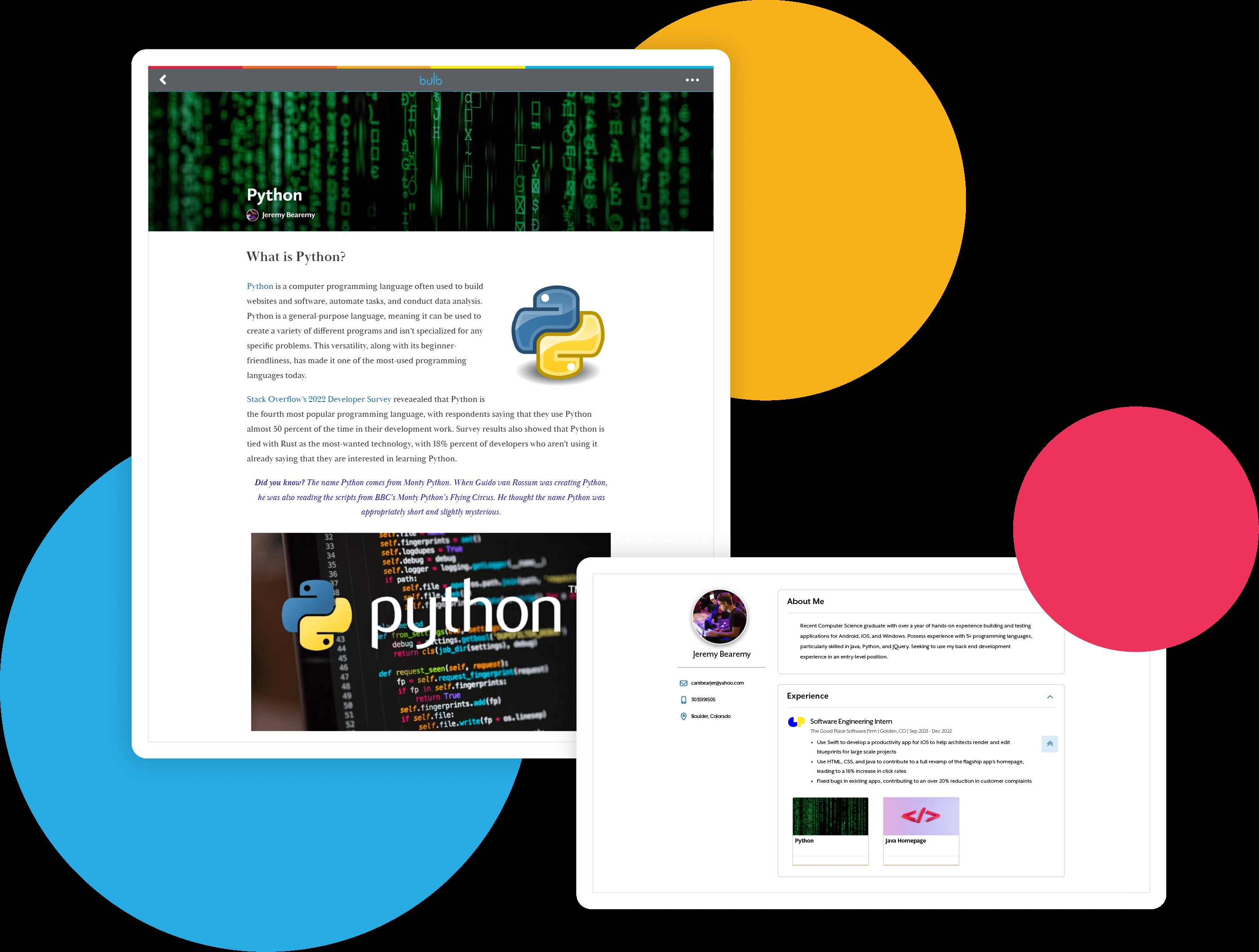
The resume feature gives that collection a second entrance. Users fill in sections such as experience and education, then attach relevant portfolio pages or collections. A student can connect coursework, volunteering or an internship to concrete examples. A professional can organize evidence around a role or a skill. The claim and its supporting material occupy the same place.
There is an easily missed distinction in Bulb’s help documentation: sharing a portfolio address does not automatically share the resume. The resume has a separate link. Generating a replacement link revokes access through the old one. That makes audience management part of the product, rather than an afterthought once a document has escaped into email.
The distinction matters in a classroom as well. Bulb’s remote learning examples include children photographing handwriting or recording themselves reading across a school year. Older students can gather notes, research and final projects. The point is comparison over time. A single polished page might impress a visitor; several well-chosen stages can help a teacher understand progress.
The first hard lesson was procurement
Building a tool that teachers like does not settle who can purchase it. In a 2018 interview, then-CEO Goldreyer described long budget cycles, requests for proposals and the number of people involved in approving school technology. The early obstacle he identified was getting through institutional buying processes.
“our first few years felt like a crash course in learning how districts procure technology.”
Eric Goldreyer / The Silicon Review, 2018
He said Bulb used that period to invest in research and development, refine its school offering and listen to customers. The experience offers a useful correction to the familiar software launch story: early attention does not necessarily turn into a fast purchasing decision.
Coppell ISD’s rollout shows the work on the other side of the sale. In the district’s account published by Bulb in 2020, individual devices had helped move learning online, but parents had fewer physical assignments arriving home. Teachers also used different tools. The district wanted a more coherent record of student growth.
A committee representing different grades and subjects compared six portfolio tools. Its requirements included parent engagement, usability for kindergarteners, documenting growth and teacher feedback. Bulb emerged from that process. Implementation then involved a three-day training experience for more than 1,000 educators, plus templates tailored to grade levels.
The sequence is worth copying: define the purpose, compare against real classroom requirements and give teachers a usable starting point. Purchasing a subscription does not create a portfolio habit. Coppell’s account describes continuing discussion of examples and classroom use, making the rollout an instructional effort with software inside it.
The internship starts in the classroom
At San Antonio’s CAST Tech High School, portfolios had a concrete destination. Bulb’s April 2020 account described students documenting school projects for internship applications in their senior year. Teacher Belinda Medellin and two UX design students discussed how they used the platform when learning moved remotely.
The school used Google Classroom alongside Bulb. Assignments and grades could remain in the learning management system while portfolio pages held the work and feedback. That division explains Bulb’s place in the market: a presentation and reflection space can sit beside the machinery that runs a course.
Another company account featured CAST Tech student Noah Wong, whose portfolio documented project processes, struggles and learning, with audio and visuals adding context. The example is useful because it includes unfinished understanding. Employers and teachers may learn something from how a problem was approached, even when the first attempt was untidy.
Partnerships extend that classroom-to-career ambition. In February 2023, Siemens announced a K-12 STEM collection pilot with Bulb, including primary and secondary resources. Younger learners could record experiments and reflections with templates. Siemens put Bulb’s reach at more than one million users across 153 countries and all 50 states at that time. It is a dated measure of reach, not a count of today’s active classrooms.
The subscription is the smaller calculation
Bulb’s posted personal pricing provides a low-cost entry: free creation with one shared page and 2GB of storage, or $2 a month, with a $20 annual option, for unlimited page sharing and storage plus resume sharing. The distinction is access to publishing and sharing capacity, not simply whether someone can begin collecting work.
1 shared page
2GB storage
Unlimited page sharing
Resume sharing
Posted personal plans checked September 8, 2026. Monthly paid option: $2.
The main K-12 institutional price card lists $6 per student per year for U.S. customers, including assignment workflow, LMS integration, an administrator dashboard and customer success support. Educator access is advertised as free. Institutions should obtain their own quote, since deployment and plan terms need to match the intended use.
The more revealing cost is time. Teachers need to decide what evidence belongs, students need to reflect and someone needs to review the result. If a portfolio becomes another compulsory upload destination, its pages can multiply without becoming more useful. The software’s value depends on making selection and explanation part of ordinary learning.
Wakelet buys a more specific kind of story
Wakelet acquired Bulb in 2024. Its October announcement said the platforms would continue independently and distinguished their jobs: Bulb concentrated on professional portfolios and resumes for students and educators, while Wakelet served a broader range of classroom curation, learning activities and collaboration.
That positioning is more useful than treating every education platform as interchangeable. Coppell educators had used Google Sites and Seesaw as well as Bulb before the district’s selection. The right alternative depends on the task. A school choosing a portfolio system needs to test its own ages, audiences and workflows, rather than assuming one district’s decision settles another’s.
For an individual, the useful practice is simpler: save a project worth discussing, explain your contribution, show a revision and choose who needs to see it. Bulb provides a place to put those pieces together. A portfolio cannot make weak evidence convincing, or make a busy reviewer click. It can make good work easier to inspect when the opportunity arrives.
Consider a group project. A useful portfolio entry would identify the shared objective, separate the author’s contribution from the team’s and show a decision that changed the outcome. That is an illustrative use of the format, not a promised result from the software. It also suggests a sensible limit: when work is confidential, or collaborators have not agreed to publication, the audience and the evidence need careful selection. A public showcase is only one possible destination for a collection.
That is the appeal of letting schoolwork travel. The assignment may be over. The person who made it still has places to go.