A student has a question. The classroom is closed. This is the small scheduling disaster around which TutorMe built a company: confusion rarely arrives at a convenient hour. Its answer was to put a human tutor online, ready to share a whiteboard, inspect the troublesome step, and help the student try again.
- Schools and other institutions funded access; eligible students could ask for help without opening their wallets.
- Live tutoring and a Writing Lab covered different kinds of academic friction.
- A $55 million sale and a 2024 rebrand preceded documented service wind-down plans in 2025.
The founding impulse was personal. Myles Hunter had moved between several kinds of schools and struggled to keep pace without the private tutoring available to some classmates. He co-founded TutorMe in 2015 with Alex Convery and technical co-founder Victor Kotseruba. The ambition was to make that extra person available beyond families who could arrange one themselves.
The school picks up the tab
TutorMe’s institutional model separated the person asking the question from the person buying the service. Districts, colleges, employers and nonprofits could sponsor access. Students received academic help through an existing relationship with an institution. The company occupied a practical corner of education technology: a tutoring service delivered through software, with human labor on the other end.
“Free” described the student’s experience. A district still needed a budget. A November 2024 Sayreville school-board agenda addendum recommended a $43,400 contract through CDW-Government for TutorMe services covering grades six through twelve, beginning January 2025. That is one purchasing proposal, with its own scope, rather than a universal price. It makes the mechanism tangible: move the payment decision away from the moment a child needs help.
Recommended district contract for grades 6-12. A scope-specific example, not a student subscription price.
Distribution mattered as much as payment. Lancaster’s student instructions began with ClassLink, the school’s existing launch pad. Choose the tutoring icon, describe the problem, request a tutor. A district bookmark or familiar login shortened the route between being confused and admitting it. For other service businesses, there is something useful to copy here: put help inside a routine people already have.
A workspace for getting stuck
The Lesson Space gave tutor and student shared working material. Audio, video, text chat, screen sharing, a whiteboard and a calculator supported different ways of communicating. A code editor extended the idea beyond worksheets. Students could work on the actual obstacle while another person watched their reasoning. The useful unit was the next step in a problem.
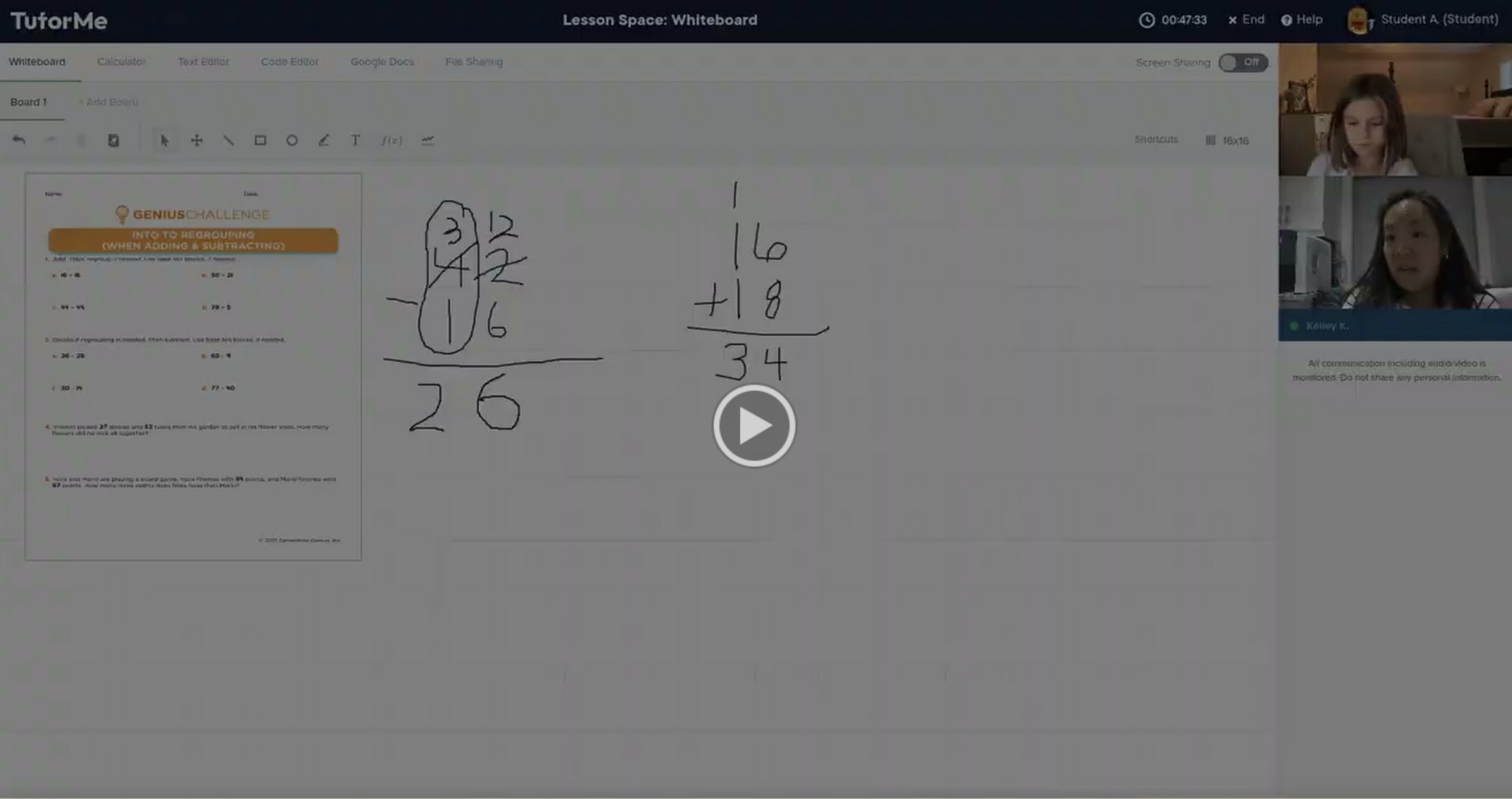
In a public session showcase, tutor Kelley helped a first-grade student identified as “Emma” work on regrouping. The company described its RAISE approach: establish rapport, assess prior knowledge, individualize instruction, summarize learning, and encourage the learner. Letting the student attempt a problem first gave the tutor something more informative than a request for the answer: evidence of where understanding stopped.
Writing required a different rhythm. Through the Writing Lab, a student uploaded an assignment and received feedback later. Lancaster’s instructions specified a Word document and directed students back to their tutoring history to retrieve comments. Separating essay review from live sessions meant the student and reviewer did not have to be available together.
“it’s about connection.”Myles Hunter, reflecting on tutoring in 2022
A bigger audience. A different owner.
Early partnerships centered on colleges and universities. The pandemic prompted greater attention to K-12. Schools were trying to support students beyond disrupted classrooms; TutorMe offered a way to extend individual help beyond the timetable. Snowline Joint Unified School District used California A-G Completion Improvement Grant funding for high-school support tied to university-entry coursework.
The ownership story changed, too. Zovio acquired TutorMe in April 2019. On May 23, 2022, it sold substantially all the tutoring business’s assets for $55 million in cash, with certain liabilities assumed. GoGuardian publicly announced the acquisition in June. The purchase placed tutoring alongside a broader collection of classroom and student-support tools.
In January 2024, TutorMe became Pear Deck Tutor. It joined Pear Deck, Pear Assessment and Pear Practice under Pear Deck Learning. The portfolio’s logic was straightforward: assess a student, teach the lesson, offer practice, provide help. Those functions could reinforce one another. Their presence in a shared portfolio did not, by itself, establish that students would use every piece.
This was a market with several plausible substitutes. A campus learning center could offer familiarity and continuity. A separately hired tutor could offer a relationship chosen by a family. TutorMe emphasized breadth and access: a single online destination for many subjects, with help available outside conventional hours. Its value depended on whether those conveniences matched the learner’s actual difficulty.
Count the right thing
By the 2024 launch, GoGuardian reported more than 1.1 million cumulative live tutoring sessions and 778,000 hours of live tutoring. Earlier announcements said more than 1.5 million students had access. These numbers describe different things. Eligibility measures a door being available. Sessions measure people walking through it. Learning gains require another kind of evidence.
Company-reported activity, not a measurement of learning gains.
The Stanford National Student Support Accelerator directory lists neither a randomized controlled trial nor a quasi-experimental study for TutorMe. That places a useful boundary around the claims. A school buying access still needs to ask who participates, how regularly, for which subjects, and with what academic results. An always-open service also depends on devices, connectivity and students actually seeking help.
The distinction also changes implementation. A school seeking occasional homework assistance can value fast access. A school seeking sustained intervention must organize repeated participation and follow progress. Buying an on-demand platform does not automatically produce that schedule. Teachers and support staff still have work to do between announcing the service and making it a habit.
The college still needed a tutor
By March 2025, Alvin Community College’s board materials reported that Pear Deck Tutor had notified the college of its intent to cease services in December. Staff investigated Brainfuse, Tutor.com and Upswing as replacements. The document records a customer preparing for a provider’s departure; it does not establish the provider’s internal reasons.
For institutions, continuity belongs in the purchasing decision alongside features and price. For builders, TutorMe leaves a practical idea to examine: remove the payment hurdle, make the invitation familiar, and let a learner show the unfinished work. The institution’s responsibility continues beyond any product name. Tomorrow’s student will still have a question.