In most American classrooms, the report card answers a strange question. Not "what can this student do?" but "how did they behave, and for how long?" A grade is a blend of attendance, effort, deadlines met, and the occasional test - a single letter standing in for a messy human being. Two former Vermont teachers spent about twenty years watching that letter flatten their students, and then they did the thing most burned-out educators only fantasize about. They left the classroom and built the tool.
The company is LiFT Learning, based in Bristol, a town of fewer than 4,000 people in Vermont's Addison County. Its founders, David Lipkin and Josie Jordan, are married. They met teaching in the same rural public school roughly two decades ago, raised three children, and along the way kept circling the same problem: school was rewarding compliance, and the working world was rewarding ability. LiFT is their attempt to close that gap - a platform that helps schools run project-based learning and then grade students on demonstrated skills, banked as verifiable evidence, rather than on time spent in a seat.

01What LiFT actually does
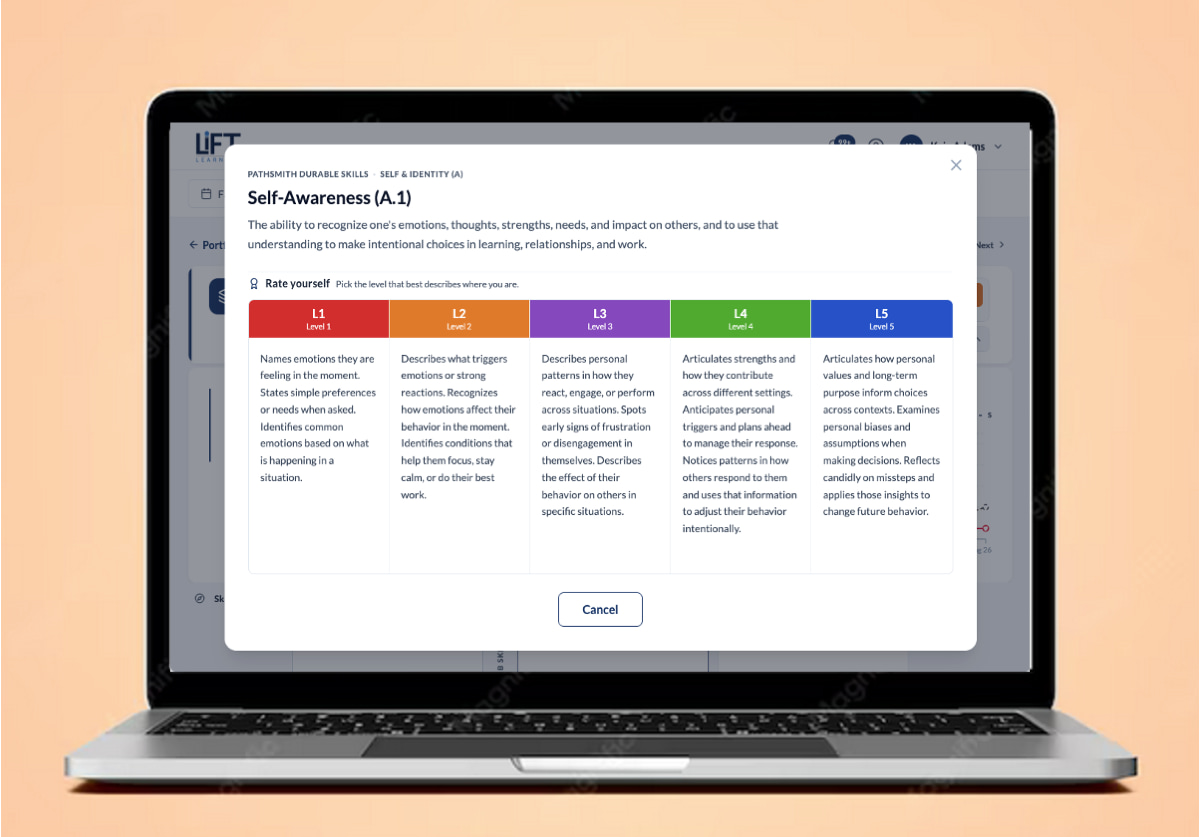
Strip away the education jargon and LiFT is two connected ideas. First, teachers and students co-design real-world projects - a welding job, a robotics build, a research piece, a community project. Second, every project is mapped to a custom skills framework, so the work a student produces becomes evidence against named competencies. Instead of a 78% that no employer can decode, a learner ends up with a portfolio: this is the project, this is the standard, and here is the proof I met it.
The platform is deliberately customizable. A public high school, a charter, a private school, and a Career and Technical Education center all define "skilled" differently, so LiFT lets each build its own frameworks and rubrics rather than forcing one national standard. As the company puts it, the goal is to create a space "where the teacher is right next to them with structure and guidance, supporting and measuring competency, not time on task."
02The shift it is selling
LiFT's pitch is best understood as a swap. The old gradebook converts a student into a number tied to time. LiFT converts a student into a body of evidence tied to skills. That sounds academic until you sit with the consequence: a competency-based portfolio is something a 17-year-old can actually hand to an employer or an admissions officer and say, "here is what I can do." A letter grade travels badly. A demonstrated skill travels.
The old report card
- One letter for a whole human
- Rewards attendance and compliance
- Scores decay the day after the test
- Bias baked into subjective grading
- Nothing an employer can read
The LiFT portfolio
- Evidence mapped to named skills
- Rewards demonstrated ability
- Proof that outlives the semester
- Rubric-based, evidence-first
- Portable into work and college
The company argues this also chips away at grading bias. When assessment is anchored to concrete evidence against a rubric rather than a teacher's holistic gut-read, the score has to point at something you can see. That is the theory, at least, and it is the reason educators describe LiFT less as a gradebook and more as an assessment philosophy with software attached.
03Who it is for
LiFT sells into schools and, increasingly, whole districts. Its customers span public, private, and charter schools plus CTE centers - the trade-and-technical programs where "can you actually do this?" has always mattered more than a transcript. As of 2024, roughly 5,000 learners were on the platform. The company has floated far larger projections - north of 200,000 students - in states that grant waivers from traditional grading requirements, which is where competency-based models have the most room to run.

04From "SchoolHack" to load-bearing infrastructure
The company was founded in 2014 as SchoolHack Solutions and shipped the first LiFT prototype in 2015. The original name is still fossilized in its Twitter handle, @SchoolHackNews. The rebrand to LiFT Learning is quietly telling: "hack" suggests a clever workaround, while "LiFT" suggests the boring, load-bearing thing a building actually needs. Over a decade, the company moved from the former to the latter - from a neat idea to the skills layer schools build on.
That decade matters. LiFT is not a viral consumer app; it is a slow sell into an institution that changes cautiously and buys on annual budgets. The founders' credibility as former classroom teachers is part of the product. David Lipkin's early career was as a clinician providing mental-health services to youth who had experienced trauma, work built on restoring trust and self-confidence. That same principle - give a learner ownership and evidence rather than judgment - runs straight through the software.
05Products and how the money works
The core is the LiFT platform itself - project design, skills frameworks, rubrics, and the competency-based portfolio that assembles from student work. A dedicated student-centered portfolio assessment tool launched in 2022, and a learner portal gives students a view where skills, not scores, are the focus, with tools to track project steps and pace themselves. Around the software sits a services layer: professional development, teacher training, virtual coaching, and change-management support for districts making the leap to learner-centered assessment.
The business model is straightforward B2B SaaS - schools and districts license the platform, usually bundled with the coaching that makes the transition stick. That services attachment is not incidental. Competency-based grading is a culture change as much as a software install, and the schools that succeed with it tend to be the ones that bought the help along with the tool.
06Backing, and building far from the Valley
LiFT has raised modestly and locally. In 2016 the State of Vermont awarded the company $350,000, and its backers have included the Vermont Economic Development Authority and the Boston edtech fund LearnLaunch, whose 2017 Boost accelerator cohort LiFT joined. Reported total funding sits around $1.1 million - a rounding error by consumer-tech standards, and a reminder that plenty of durable edtech gets built on grants, patience, and revenue rather than mega-rounds.
The recognition has outpaced the fundraising. LiFT was named a 2022 Yass Prize semifinalist, was profiled as an innovation by HundrED, and in 2024 partnered with Edlink to plug into Google Classroom and more than 100 learning-management and student-information systems through a single integration - a build-versus-buy decision the company credited with saving hundreds of development hours. It has also folded NextGen Learning's MyWays framework into the platform to strengthen project outcomes.
07Where it fits
LiFT sits in a crowded corner of edtech alongside tools like Empower, Otus, Kiddom, Project Foundry, Summit Learning, and the Mastery Transcript Consortium, plus the assessment features baked into giants like PowerSchool. But its most stubborn competitor is not another app - it is the traditional letter-grade gradebook and the century of habit behind it. That is the hardest incumbent to unseat, and it is the one LiFT has spent ten years arguing with.
The honest caveat: competency-based assessment does not work everywhere on day one. It leans on state waivers, on faculty willing to rethink grading, and on a college-admissions system that still speaks GPA. Where those conditions are absent, the swap stalls. Where they are present - the waiver states, the CTE programs, the districts that already decided the report card was broken - LiFT has a real shot at becoming the plumbing.
Ten years in, LiFT Learning is still small - about five people in a small Vermont town, chipping at one of education's most entrenched habits. What it has that the flashier startups often lack is a clear answer to the question its whole category dances around: if a grade is not the point, what is? LiFT's answer is a portfolio a student can carry out the door and prove.