Personalized learning, built for schools - a tutor for every student.
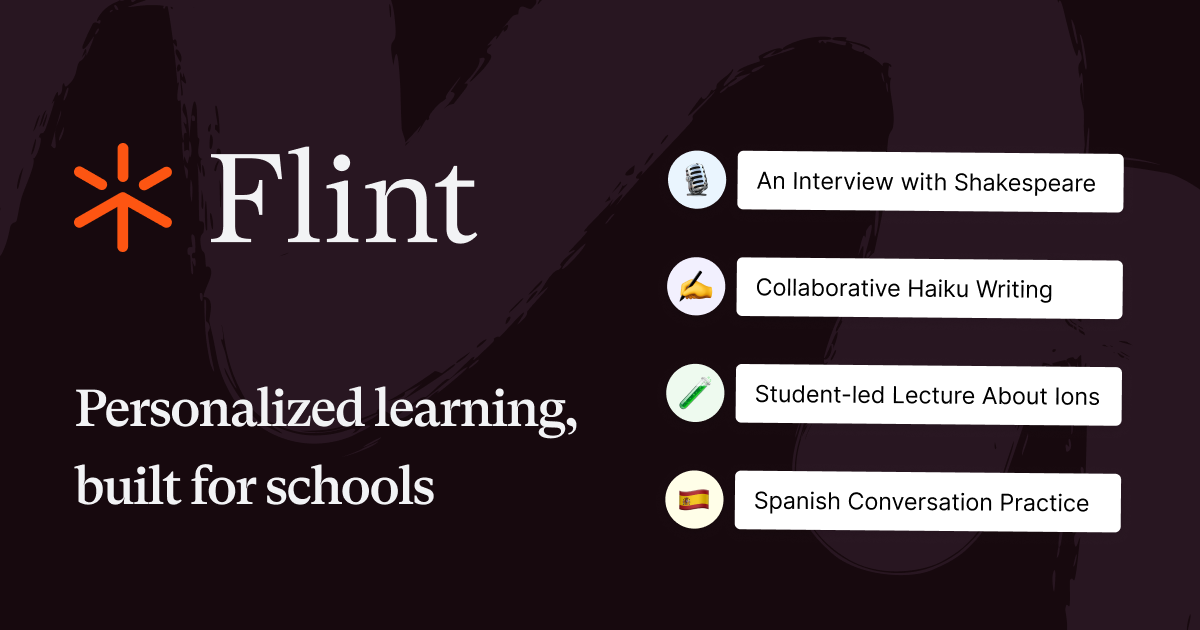
The spark and the sample set. Flint's brand card frames its pitch in four activities - an interview with Shakespeare, collaborative haiku, a student-led lecture on ions, Spanish conversation - each one an AI lesson a teacher designed.
Flint is an AI-native learning platform for K-12 schools. Teachers design their own adaptive tutors and activities; students get one-on-one guidance across any subject; and no one works a longer day for it.
Every teacher has faced the same impossible arithmetic: thirty students, one lesson plan, and no way to be in thirty places at once. The advanced learners drift; the struggling ones fall behind; the lesson aims at a median that fits almost no one exactly. Founded in New York in 2023 by CEO Sohan Choudhury and CTO Jinseo Park, Flint set out to change that equation - not by replacing the teacher, but by giving each one a room full of tutors they build themselves.
On Flint, a teacher can spin up an AI tutor for any subject in minutes, then watch the conversations happen live. A student can interview Shakespeare, practice speaking one of hundreds of languages, work through a guided science lab, or get feedback on a hand-drawn graph. The platform generates worksheets, quizzes, and handouts on demand, and turns raw activity into real-time analytics that show a teacher exactly how each student is doing. The company launched through Y Combinator as a "copilot for K-12 teachers," and has been iterating alongside educators ever since.
Traditional classrooms teach to the middle. Early classroom AI often did the opposite of learning - it handed students the answer. Flint aims at the gap between those two failures.
The problem Flint tackles is old, but its shape shifted the moment generative AI arrived in schools. One-size-fits-all instruction leaves advanced learners unchallenged and struggling students unsupported. Meanwhile the first wave of AI tools quietly did homework for kids rather than teaching them to think. Flint's stated design choice is to make students think harder, not less - keeping the teacher-student relationship at the center while AI amplifies a teacher's reach.
Its differentiation claim is that it is AI-native rather than adapted from a legacy product. Flint was built collaboratively with teachers from the start, which is why its most-used feature was not designed by the company at all - it was an AP exam prep activity created by a student and shared across the platform. That detail says as much about the product as any metric: give young people tools instead of answers, and they build things the roadmap never imagined.
"Flint's mission is to personalize learning for students - empowering educators to teach beyond median proficiency levels."
One platform, many classrooms - each activity type is an AI lesson a teacher can shape and a student can explore.
Teachers design custom tutors for any subject. Students get help, review, or an intro to new topics - and teachers can watch every transparent conversation in real time.
Generate classroom activities, worksheets, quizzes, and handouts in seconds, with custom rubrics and subject-specific tools.
Conversational practice across hundreds of languages with real-time AI feedback that listens and responds.
Interview Shakespeare or run a historical simulation - immersive scenarios that make a subject come alive.
Guided experiments plus diagram annotation and graph drawing with automated, specific feedback.
Real-time visibility into how every student is progressing across activities - the teacher's X-ray view.
A free tier for individual teachers and pilots; paid school and district licenses that unlock rostering, analytics, support, and scale.
Flint sells B2B2C into schools and districts. Individual teachers and small pilots start free; paid licenses add roster integrations, deeper analytics, dedicated support, and the features needed to run at scale, with pricing aligned to user count and usage. In a sector famous for pilots that never convert, Flint's revenue doubling in six months is the number that caught investors' attention. Its largest deployment, with the global schools group Cognita, reaches 95,000 students across 110 schools.
In November 2025, Flint announced a $15M Series A co-led by Basis Set Ventures and Patron, with participation from USC Viterbi, AME Cloud Ventures, and Blackboard co-founder Matt Pittinsky, plus follow-on from earlier backers Y Combinator and Afore Capital. Total funding sits at roughly $16.7M.
Flint sits in the fast-growing lane of AI-native classroom tools - alongside a crowded field of teacher copilots and legacy incumbents adding AI.
The competitive set includes AI teaching assistants such as Khanmigo from Khan Academy, MagicSchool AI, Brisk Teaching, and School AI, as well as established learning-management incumbents bolting AI onto existing products. Flint's wager is that a platform designed with educators from day one - and disciplined about building critical thinking rather than shortcutting it - earns the trust that turns a classroom pilot into a district contract.
That thesis has a notable endorsement. When Matt Pittinsky, who helped define the last era of edtech with Blackboard, backs a K-12 AI startup, the signal is less about the check and more about who is sending it. The AI-native generation is already in elementary school; the open question is whether the tools around them make them sharper or lazier. Flint is betting the classroom on the former.
Sohan Choudhury and Jinseo Park start Flint to personalize K-12 learning, launching through Y Combinator as a copilot for teachers.
Flint iterates closely with teachers, expanding to language practice, science labs, historical role-play, and classroom analytics.
Reaches 400,000+ users and hundreds of schools, launches AI video generation, and raises a $15M Series A in November.
Flint's single most-used feature - an AP exam prep activity - was created by a student, not the company.
Students can interview Shakespeare or hold a Spanish conversation with an AI that actually listens.
The name evokes the spark of learning; the logo is an orange spark drawn as an asterisk.
CTO Jinseo Park was a software engineer at Google before co-founding Flint.
Flint is an AI-powered personalized learning platform for K-12 schools. Teachers design AI tutors, activities, and assessments that adapt to each student across any subject, with real-time insight into progress.
Flint was founded in 2023 by CEO Sohan Choudhury and CTO Jinseo Park, and launched through Y Combinator.
Flint raised a $15M Series A in November 2025 (co-led by Basis Set Ventures and Patron), bringing total funding to roughly $16.7M including earlier backing from Y Combinator and Afore Capital.
Flint serves hundreds of schools in the US and internationally, with 400,000+ users - including a deployment with Cognita reaching 95,000 students across 110 schools.
Flint describes itself as AI-native rather than retrofitted - built collaboratively with educators from the start, designed to keep the teacher-student relationship central and to build critical thinking rather than hand students direct answers.
Website, socials, and the places Flint shows up.