It is 4:17 p.m. in Saratoga.
A seventh grader signs in at a small Afficient Academy learning center on De Anza Boulevard, opens a Chromebook, and is handed not a worksheet but a problem set the software built three seconds ago, just for her. The teacher in the corner is real. The curriculum is accredited. The algorithm is patented. The promise the company makes - one most tutoring outfits would never put on a flyer - is that she will finish her grade with an A or A+, and she will get there faster than her classmates who are doing it the old way.
This is the part of education people forget to write about. Not the apps that hum in venture pitches. Not the AI that grades essays in three seconds and gets the tone wrong. Just a tidy room of kids working through math, with a quiet machine deciding which problem each one needs next.
Tutoring, as practiced, is a polite waste of time.
Most after-school programs do roughly what school does, with smaller class sizes and a snack. A child who already knows fractions practices fractions. A child who doesn't, practices fractions next to them. Everyone goes home a little tired. Parents pay $200 a week for the privilege.
Dr. Jiayuan Fang noticed this with the particular irritation of a man who had three school-aged children and a PhD in electrical engineering. He had spent twelve years teaching at universities, built a chip-design company called Sigrity, sold it to Cadence in 2012, and now had time on his hands and a hypothesis in his head: if you can route signals through a circuit board, you can route problems to a student.
Less practice, better aimed.
Fang's bet, made in August 2014 from an office in Silicon Valley, was that the bottleneck in K-12 learning was not the volume of practice but the wastefulness of it. Most students drill the wrong things at the wrong moments, and the teachers responsible for them - through no fault of their own - cannot custom-tailor twenty-seven distinct assignments every night.
An algorithm can. Afficient Academy's claim, patented and quietly defended, is that its software watches each student long enough to know exactly which gap to attack next. The student does fewer problems. The right problems. They master one skill, and the system stops asking. They miss another, and the system politely refuses to move on.
It is, in a sense, the opposite of how tutoring usually works. Tutoring is generous. The Afficient engine is stingy. It dispenses only what is necessary.
One engine. Four programs. A great many parents.
The Afficient platform spans Math (K-12), English Language Arts (K-9), SAT prep, and ISEE/SSAT prep. The interface is unsentimental: a problem appears, the student solves it, the engine adjusts. There is no streak counter, no gamified mascot, no AI tutor pretending to be a friendly otter. The product respects the kid by not pretending to be a toy.
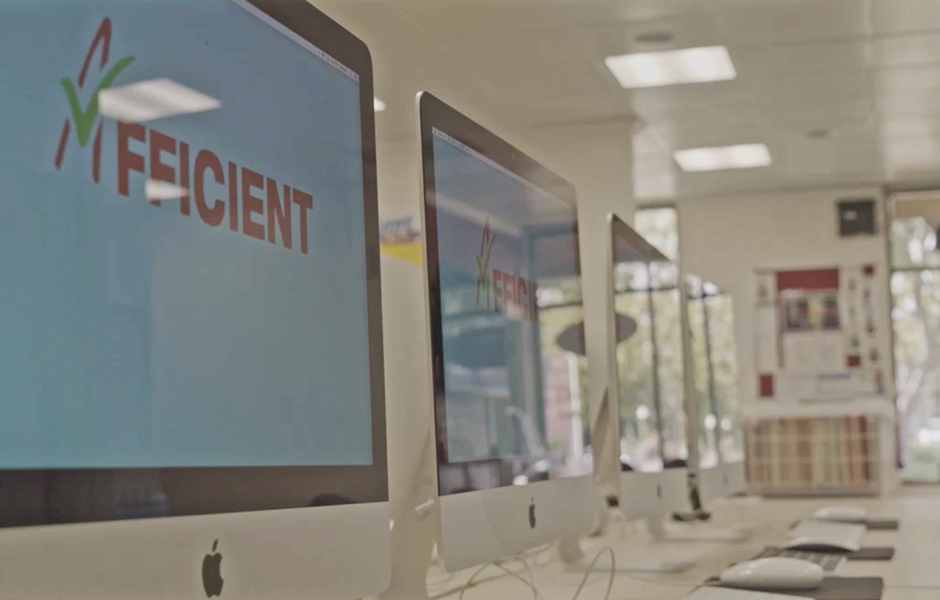
What is unusual is the delivery. Afficient runs an online-only program for families who want it, and a network of learning centers - some company-owned in San Jose, some franchised in Pleasanton, Danville, San Ramon, Dublin, Fremont, Irvine, Las Vegas, and Morrisville, North Carolina - for families who don't. At a center, a credentialed teacher watches over a roomful of students, each on a personal learning path, each working at their own pace. The software does the routing. The adult does the rest.
A Quiet Decade in Cupertino-Adjacent
- 2012Dr. Fang sells Sigrity to Cadence. Wins Silicon Valley Entrepreneur of the Year.
- 2014Afficient Academy is founded in San Jose with the bet that adaptive AI can replace worksheet drill.
- 2016Seed round closes (~$350K). The company stays deliberately small.
- 2018First wave of physical learning centers opens across the South Bay.
- 2019-22Curriculum receives WASC accreditation. Franchise model takes off.
- 2023Locations expand to Las Vegas and Morrisville, North Carolina.
- 2024First San Francisco center launches under a franchise operator.
- 2026The platform now claims more than 90% of students advance a grade level in 2-5 months.
Timeline assembled from press releases and the company's own breadcrumbs. The years are exact; the bragging is theirs.
Numbers the company is willing to be quoted on.
Afficient publishes one statistic so often it functions as a thesis: over ninety percent of its students advance a grade level in two to five months, with an A or A+ to show for it. Plenty of edtech companies publish self-reported results. Few of them stake their entire brand on a single, falsifiable line.
The 2-to-5-Month Promise
Source: Afficient Academy (top row) and indicative ranges from public education research literature (others). Treat with healthy skepticism, as you would any company-reported figure.
An A in every grade. That is the entire pitch.
It would be easy to dress up Afficient's mission in larger words. They have chosen not to. The company exists so that K-12 students fill their knowledge gaps and finish each grade with an A or A+. There is no second clause. No mention of the future of work. No reference to "unlocking human potential," which is the phrase ed-tech founders reach for when they have nothing concrete to say.
Fang built the company because the after-school programs available to his own children were, by his measurement, inefficient. He built a tool that measured inefficiency and removed it. The mission is, in this sense, autobiographical.
The rest of edtech is loud. Afficient is patient.
A generation of AI tutors has shipped in the last two years. Most of them are chatbots in school colors. They generate problems, they generate explanations, they generate confidence in their own correctness. They are, often, wrong.
Afficient took a slower road. It built a narrow engine for a narrow job, accredited the curriculum, and put real teachers in real rooms to handle what software still cannot - the puzzled face, the bored slump, the kid who needs a sandwich. The hybrid is unglamorous. It also works.
If American K-12 keeps tilting toward personalized, mastery-based learning - and the policy wind suggests it will - the companies that win will not be the ones with the cleverest demo. They will be the ones with the longest archive of student-outcome data and the calmest classroom on Tuesday afternoon. Afficient has both.
It is now 5:02 p.m.
The seventh grader closes her laptop. Her session is over because the engine decided she had nothing left to learn today, not because the clock ran out. She has done forty-one problems. She got thirty-eight right. The other three are queued for tomorrow.
Her mother arrives, hands her a string-cheese, and asks the question every parent asks: "How did it go?" The girl shrugs, the way every seventh grader shrugs. The teacher, signing her out, says it went well. The software, if you asked, would say the same thing in more detail.
None of this looks revolutionary. That is, more or less, the point. Afficient Academy is a quiet company doing a quiet thing in a strip mall in San Jose, and somewhere in a server room a model is updating, and tomorrow afternoon the seventh grader will sit down and be handed exactly the problems she needs. Multiply that by a few thousand kids. Multiply that by a decade. That is what a company looks like when it refuses to be a fad.
Where to find Afficient Academy
- Website: afficienta.com
- LinkedIn: /company/afficient-academy-inc
- Facebook: /afficientacademy
- YouTube: Afficient Academy channel
- Blog: blog.afficienta.com
- HQ: 1054 S De Anza Blvd, San Jose, CA 95129
- Phone: +1 408-726-2245