From Signal Integrity
to Learning Gaps
Here is the thing about Dr. Jiayuan Fang that matters before anything else: he already won. He built Sigrity Inc. from scratch, turned it into the go-to software for high-speed electronics signal and power integrity analysis, sold it to Cadence Design Systems for approximately $80 million in 2012, and then sat in the VP of R&D chair at one of the world's most respected EDA companies. He was, by any reasonable measure, done.
He was not done.
The thing that pulled him back into the arena was not another market gap or a pitch deck. It was his three kids sitting in an after-school tutoring program in Silicon Valley, making barely measurable progress, while no one in the room could explain exactly why. Fang was an electrical engineer - he had spent his career finding hidden root causes of failure in complex systems. Watching a tutoring model that couldn't locate the source of a student's confusion struck him the same way a faulty circuit board would: not as a tragedy, but as a solvable problem.
"The AI doesn't just identify what students got wrong - it identifies WHY they got it wrong, and fixes the root cause."
In August 2014, Fang founded Afficient Academy in Silicon Valley. The name itself carries the mission: efficient learning that works. The company built what it describes as a patented AI-driven adaptive learning flow - software that traces student errors back to their origin, then constructs a remediation path specific to that student's gaps. Not a general lesson. Not a re-read of the textbook. A precisely targeted intervention.
The results Afficient reports are striking enough to deserve scrutiny: over 90% of students advance a full grade level in 2 to 5 months, with A or A+ performance. The company backs this with data-driven progress reports, regular assessments, and what they describe as an adaptive feedback system that improves with every interaction. Enrollment is available 24/7. The programs are accredited by WASC - the same accrediting body that signs off on traditional K-12 schools.
"It is an honor to be recognized during a month celebrating the contributions of Asian Americans. It is an even greater honor to be helping the next generation succeed through innovative education."
- Dr. Jiayuan Fang, May 2024Fang arrived at this problem with credentials that few education founders carry. His undergraduate degree is from Tsinghua University, one of China's most selective engineering schools. His PhD is from the University of California, Berkeley. He spent more than a decade as an electrical engineering professor - first at SUNY Binghamton from 1990 to 1998, then at UC Santa Cruz from 1999 to 2002. He earned the NSF Young Investigator Award and the IEEE Region 1 Technical Excellence Award. He is the inventor or co-inventor of seven U.S. patents in signal and power integrity analysis, plus the U.S. patent covering Afficient's AI learning flow itself.
The translation from high-speed electronics to adaptive education is less strange than it sounds. Both fields require understanding what went wrong inside a system that looks fine from the outside. Both require algorithms that can locate the precise point of failure among thousands of interacting variables. Fang applied the same diagnostic logic he used at Sigrity - trace backward from the symptom, find the root, fix it there - to the problem of why students hit walls in math and reading.
Afficient Academy has expanded from its original San Jose location across Silicon Valley - Saratoga, Pleasanton, Dublin, Palo Alto, Cupertino, Sunnyvale - and into Hong Kong. The curriculum covers Math and English from kindergarten through 12th grade, plus targeted test prep for the ISEE, SSAT, SAT, ACT, and AMC math competitions. In March 2025, the company launched a new AI-driven SAT Preparation Suite with more than 3,000 exercises, its most ambitious single curriculum release to date.
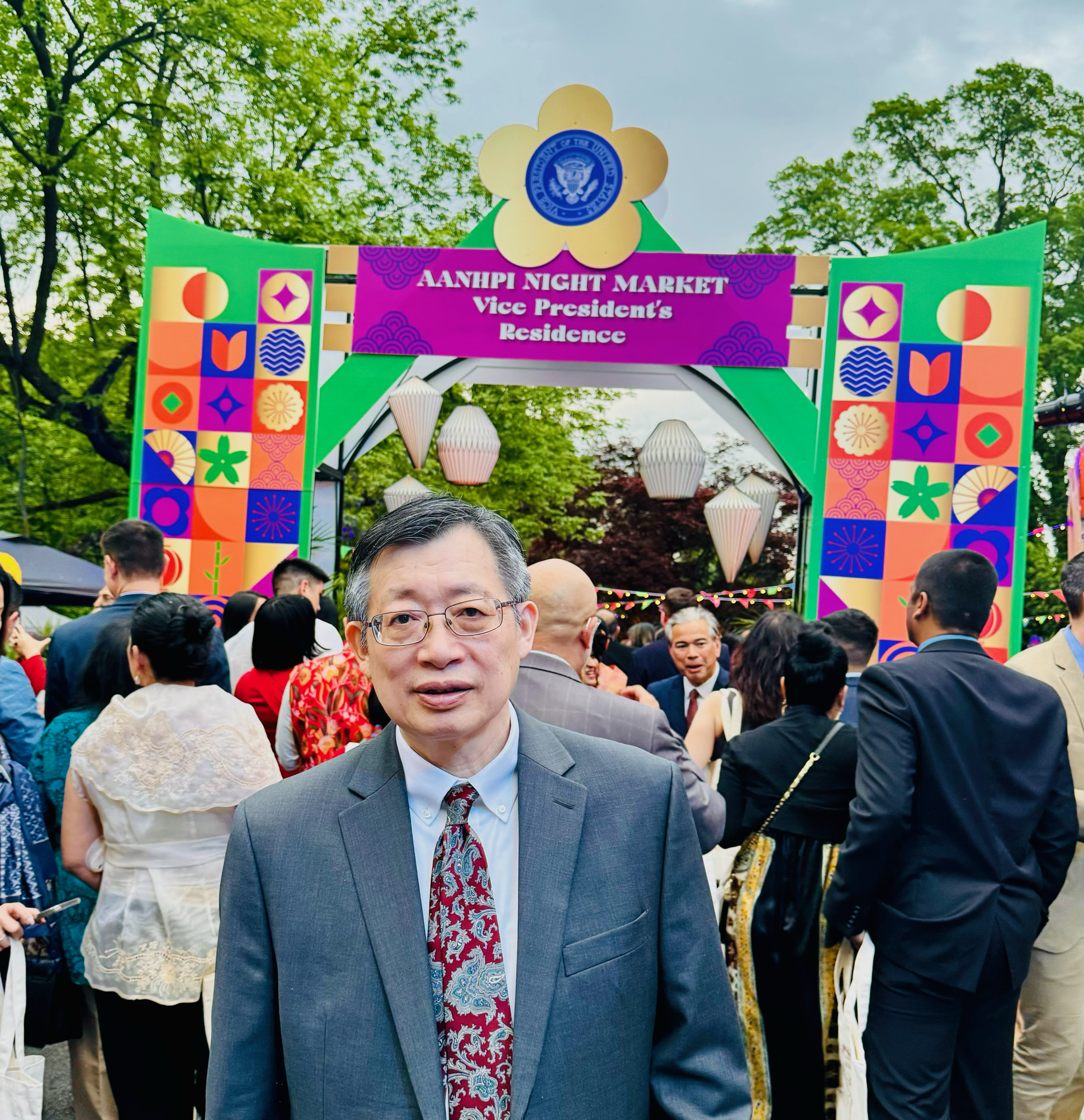
The political footprint of Afficient's work has grown alongside its academic one. In May 2024, Fang was invited to Vice President Kamala Harris's residence for the AANHPI Heritage Month celebration - a recognition of the company's work in educational access and innovation. Days later, he met with Congressman Ro Khanna to discuss AI-powered education programs and their potential impact at scale. For a man who spent much of his career in the highly specialized world of signal integrity software, Fang has arrived at a surprisingly public-facing moment in his career.
At Education 2.0 Conference in Las Vegas in December 2022, Fang delivered a keynote titled "Leveraging AI To Overcome Challenges In Classroom Education: How Schools Can Efficiently Fill Students' Skill Gaps." He received the Outstanding Leadership Award at that same event. The talk addressed a question that has defined his second career: not how to teach better, but how to build systems that know, precisely and in real time, what each individual student needs next.
Afficient operates on a B2C and D2C model, with about 55 employees and learning centers that blend AI-driven solo practice with qualified teacher support. The platform generates personalized study plans, performance analytics, and progress reports that parents can actually read. Fang describes this as "parental peace of mind" baked into the product - a feedback loop that his children's original tutoring program never offered him.
The company raised a seed round of $350,000 in 2016. By Silicon Valley standards, Afficient Academy is not a venture-scale rocket ship. It is something rarer: a sustainable, mission-led education business built by someone who has already had the rocket-ship experience, knows exactly what he is building, and is building it deliberately.
Fang lives in Saratoga, California - the same Silicon Valley suburb where many of his students are working their way through Afficient's adaptive problem sets. He is, by origin and by design, one of them.