Page County, Virginia, had three school psychologists and roughly 3,200 to 3,300 students. The arithmetic was unforgiving. Every evaluation required time that could otherwise go toward helping a child. An unfilled position made the problem harder. Before the pandemic, special education director Ellen Biller asked a neighboring district about a company called Presence.
- Schools buy remote clinicians, software, or both.
- Kanga puts assessments, activities, and notes in one workspace.
- A 2026 acquisition extends the business into student support plans.
Three psychologists, thousands of students
During the 2020-2021 school year, Page County brought in a remote psychologist through Presence. She handled evaluations across an elementary, middle, and high school. Local psychologists gained time for direct student care. The district also received training and equipment, including document cameras that let an examiner watch a student work on paper.
The revealing detail is the camera. Remote assessment still required a view of the pencil and booklet. Someone had to understand the task well enough to know that. In Presence’s published account, Biller credited training and equipment: “Our skepticism for using an online platform to serve students quickly turned into appreciation.”
That is a useful entry into this company. Presence connects PreK-12 schools with speech-language pathologists, occupational therapists, psychologists, and mental health professionals. Its business addresses a practical mismatch: a school needs specialist time, while a qualified specialist may live somewhere else.

The work around the call
Founded in 2009 by Clay Whitehead and Jack Lynch, the company began with remote speech-language therapy. It expanded into other clinical disciplines and assessments. Today, schools can hire its clinicians or license Kanga, its therapy and assessment platform, for their own teams.
Kanga’s job extends beyond carrying a conversation. Providers can prepare activities, administer licensed assessments, document sessions, and track goals. An Individualized Education Program, or IEP, turns a student’s needs into a plan; software helps clinicians keep the session connected to that plan.
The details range from formal tests to clickable dice. Presence lists assessment content from Pearson and Riverside Insights alongside therapy materials from creators including Hasbro. A clinician can use an interactive whiteboard or digital reward while retaining control of the session. Games are tools in a professional’s hands.
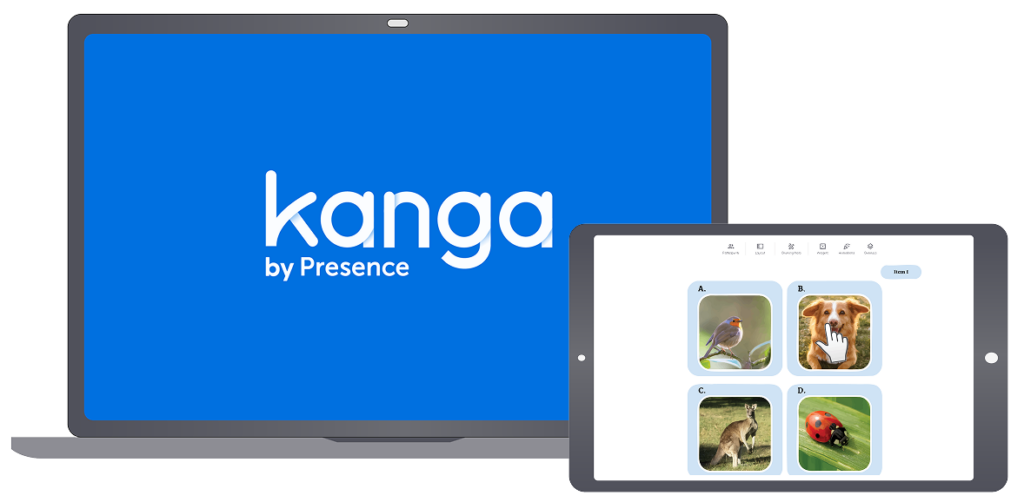
Presence says its technology has powered more than eight million sessions across approximately 11,000 schools. Those figures describe reach. They do not tell us whether a particular child will benefit. The consequential question remains the same in any therapy room: is this student getting appropriate help?
A business that had to learn to scale
The early service had an operational problem of its own. When Kate Eberle Walker became CEO in 2019, national expansion required changes behind the scenes. In a 2020 EdSurge interview, she described reducing manual operations, controlling costs, and building a national sales team. A working clinical service still needed a repeatable business around it.
Capital followed: a $27 million Series D led by Bain Capital Double Impact in May 2020. Earlier announced rounds included $8 million in 2013 and $25 million in 2015. In late 2021, Spectrum Equity and TPG’s Rise Fund agreed to acquire a majority stake, while Presence acquired Global Teletherapy, a provider serving virtual schools.
The sequence matters. Presence had spent a decade delivering remote services before school closures made the format urgent. The pandemic expanded demand for an existing capability. Subsequent investment and acquisitions increased its resources and clinical reach.
The price of a better-organized day
For districts, Presence offers dedicated service hours for predictable needs and flexible hours for changing caseloads or temporary gaps. Quotes depend on the services, coverage, timing, and location. Schools can also buy remote assessment support or license the platform for existing employees.
A single clinician can start with Kanga’s free plan: 240 therapy-room minutes per calendar month, plus planning and administrative tools. That is a limited software allowance, separate from purchasing clinician services. Paid monthly and annual subscriptions provide another route. The purchasing decision starts with the missing resource: people, tools, or both.
The purchasing decision starts with the missing resource: people, tools, or both.
Presence operates where education staffing, clinical services, and software overlap. Parallel Learning offers overlapping virtual services and assessments. District hiring and local practices remain alternatives. Presence’s distinguishing combination is its established clinician network, assessment relationships, and separately licensable workspace.
The next bottleneck is the binder
In May 2026, Presence acquired Education Modified, which organizes student support information, accommodations, interventions, and collaboration. The move suggests a broader ambition: helping teams carry a plan into everyday schoolwork. A completed therapy session is only one event in that process.
Consider GOAL High School, a Colorado virtual public charter serving more than 6,000 students. An August 2026 company case study reports more than 5,000 student support plans centralized through Education Modified. Teachers receive relevant information through role-based access; data connects with existing school systems. This is coordination work, with consequences for how consistently adults support a student.
Start with one job that needs doing
Page County offers a sensible method to copy: identify a specific shortage, assign remote work deliberately, and prepare the local team. That means equipment, training, schedules, and parent communication. Presence’s remote-first employment model extends the same geographic flexibility to clinicians, supported by clinical resources and technical help.
The conditions matter. Schools need reliable internet, appropriate devices, a private space, and onsite help where required. Assessments need suitable administration procedures and test security. Individual sensory, behavioral, or hands-on needs can change the appropriate format. The strongest use of remote capacity gives a school more ways to organize care around the child.
In Page County, the remote psychologist’s contribution was specific: take on evaluations so colleagues could spend more time helping students directly. For all the software and investment in this story, that remains a persuasive measure of usefulness: what can the school team finally get done?