An hour is a perfectly respectable unit of time. You can deliver several dinners in one, earn some money and go home. Sten Saar and Harry Franks, working at Deliveroo, noticed that insurance had other ideas. A person looking for a few hours of delivery work could face the cost of an annual policy before earning anything. The job had become flexible. The bill had kept its old office hours.
That mismatch became Zego, founded in London in 2016 by Saar, Franks and Stuart Kelly. But Saar had been practising this sort of observation for years. Before he examined the awkward relationship between working time and insurance, he had examined the inside cover of a school notebook. There was room for something useful there. For a teenager in Estonia, that was enough of a beginning.
The useful bit was inside the cover
Saar started his notebook business at 17. Its products put useful school formulas inside the covers, giving pupils a reference alongside the pages where they worked. Mathematics, physics and chemistry supplied the material. The idea came through the Junior Achievement student-company programme, which gave the enterprise a place to begin before it became a business operating across borders.
It is an appealingly practical first product. The notebook was already in the schoolbag. The formulas belonged with the subject. Nobody needed to be persuaded to adopt an entirely new habit. There is a particular satisfaction in a business that makes an existing object slightly more considerate.
The Latvian operation began in 2006 after Saar met Eiko Kivisik, then president of the student association at the Stockholm School of Economics in Riga. Evita Medne and fellow students helped find advertising partners. The notebook travelled through relationships as well as shops: people who could recognise a useful idea, find a local team and make it work in another market.
By 21, Saar was trading in four countries with a team of 22. The scale matters less than the experience it implies. He had to sell, organise people and negotiate beyond the comfort of his own language. School stationery had provided a rather thorough business education alongside his studies in business and management at Tallinn University of Technology.
London, with a few lessons already paid for
His early ventures also included a free newspaper for Estonian schools. It reached break-even in its third month, then lost its advertising revenue when the financial crash arrived. Another project consumed borrowed money and disappeared within six months. Saar has spoken candidly about those failures. A promising beginning, he learned, could still end with the money gone.
He moved to England in 2009, stepped away from the notebook business and sold it in 2013. In London he worked in sales and marketing at Quickstart Global, then in operations at onefinestay, the home-rental business. Deliveroo came later. The route into insurance passed through selling, hospitality and the detailed business of getting a service delivered.
Read that sequence as an apprenticeship in promises. A rented home has to be ready. An order has to reach the customer. Someone must arrange what happens between the attractive proposition and the actual experience. Saar's later interest in the machinery behind an insurance policy makes sense against those jobs.
“I’m a builder, a fixer, and I always question why.”
Sten Saar, describing his approach to business
The delivery shift that became an insurance policy
At Deliveroo, Saar and Franks encountered a problem close enough to touch. Costly annual insurance could prevent people from taking up delivery work. A rider's willingness to work was only one part of the calculation; the cost of getting started could settle the matter before the first shift.
Zego's answer was pay-as-you-go cover. Its early model allowed insurance to follow the working shift, switching on when a delivery driver started and off when the work finished. Customers could buy time in smaller pieces. An annual purchase no longer had to be the opening move in a modest attempt to earn money.
The ingenuity lay in taking that ordinary frustration seriously. A food order could be placed through an app, and a rider could choose when to log on. Insurance still needed to fit around that arrangement. The founders had found the problem through their work, which gave their starting point a useful specificity: an identifiable customer, an identifiable expense and an identifiable moment when the two collided.
Saar initially served as chief operating officer, taking over as chief executive in 2018 after exchanging roles with Franks. He also worked across customer service, finance and technology testing. In a young company, a title can be a useful description of the person who will eventually answer the question. For a while, several questions led to Saar.
The business widened beyond its initial delivery audience. By March 2020, Saar described products for fleets and mobility services as well as individual workers, with options ranging from hourly to annual cover. Flexibility had become a broader product principle. A customer who needed a full year could still buy one; the annual policy simply had some company.
A billion-dollar valuation, followed by the plumbing
In November 2019, Zego obtained its own insurance licence. In March 2021, it raised $150 million in a funding round led by DST Global, with General Catalyst and existing investors including Balderton participating. The round valued the company at $1.1 billion. Zego had joined the category of private businesses known as unicorns, a word considerably more picturesque than most insurance vocabulary.
That announcement described a company which had issued more than 17 million policies and covered more than 200,000 vehicles in five countries. It also followed Zego's acquisition of telematics company Drivit. Technology for understanding driving was becoming central to the business Saar was building.
A valuation is a moment in a company's financing history. Running the company requires attention on less photogenic days. In July 2023, Saar described bringing most new claims into an internal operation in less than a year. Zego had assembled more than 40 claims specialists and worked with Sharedo on a system connecting policy information, suppliers, payments and telematics.
Claims are where a promise becomes expensive and immediate. A policyholder needs an answer; the company needs to understand the event and arrange the payment. Saar's account of weekly software releases put the work in the language of continuing repair. Each release offered another chance to improve what happened after a customer needed help.
By the 2025 National Insurance Awards, that effort had grown into a 74-person team built over 18 months. Zego won Claims Initiative of the Year. Its award account described real-time payments, customer contact through WhatsApp and the Sense app, and a reduction of 6,000 open claims with suppliers. The operating work had acquired numbers of its own.
The return visit, with mistakes included
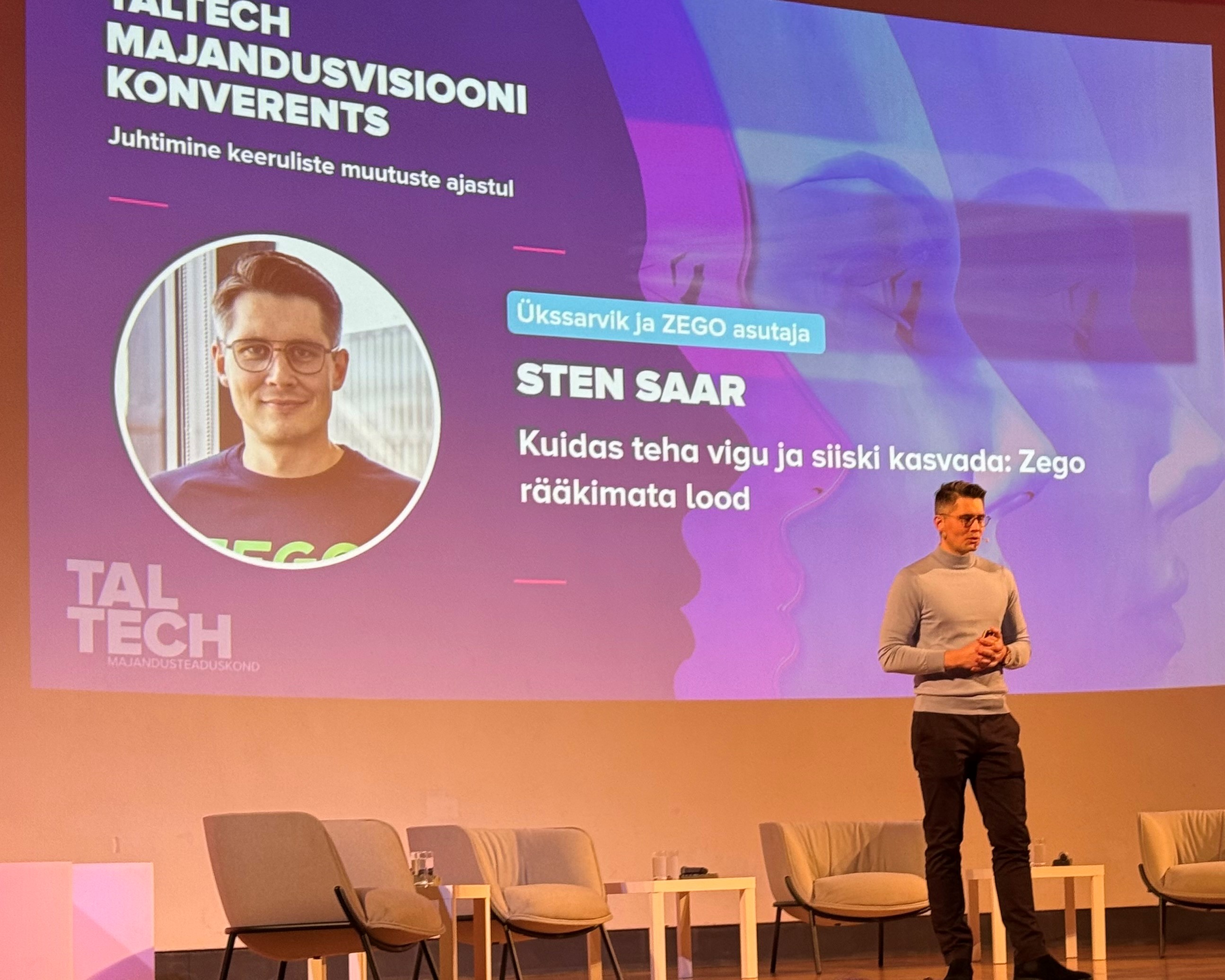
When Saar spoke at TalTech in January 2025, he brought a less polished subject than a funding celebration: mistakes. He acknowledged decisions at Zego that had cost tens of millions. His message to the audience was to learn, move quickly and get back up after a fall. Returning to his university gave that advice a setting beyond the startup conference circuit.
There is useful distance between the teenager with notebooks and the executive discussing those sums. Both had found that a business can grow faster than its founder's certainty. Saar's willingness to discuss the expensive parts gives his story some weight. The failures belong in the account beside the international expansion and the investment rounds.
His working habits have remained unexpectedly faithful to stationery. He has described keeping notes and Post-its to remind himself about focus and speed of execution. For someone whose first business put helpful information inside notebook covers, the method has a pleasing consistency. Paper continues to have a job, even in a company built around software.
The more interesting number has a pound sign
The financial picture changed materially after the funding years. Zego's net loss fell from £34 million in 2023 to £4 million in 2024. It reached monthly profitability in December 2024. Those are separate facts: a profitable month at the end of the year still left a loss across the full twelve months.
In September 2026, its reported 2025 results supplied the next figure: a £4.6 million profit. Gross written premium rose to £158.5 million, from £137.9 million in 2024, and policy count increased 55%. Premium measures the insurance business written, rather than being interchangeable with company revenue. The improvement gave Saar something firmer to discuss than a fundraising valuation.
Meanwhile, the customer changed again. Zego launched personal car insurance in February 2025, extending its driving-data approach to motorists beyond the commercial audience that had given the company its start. Saar's ambition is to build a household insurance name. Moving into personal motor gave that ambition a concrete product to be judged on.
There will be traffic in the future, too
Saar also looks further ahead, to roads shared by human drivers and autonomous vehicles. Speaking in March 2025, he called the transition the “messy middle”. The established insurance industry had decades of experience with people driving cars. A changing mixture of people and automated systems would give it a different problem, without the same historical record.
In April 2026, Sompo announced a strategic investment in Zego and a partnership to develop digital insurance products for Japan using AI and telematics. The announcement set out plans for exploration and proof-of-concept work. It was a new market relationship, with development still ahead of it.
That is a fitting place to leave Saar: with another practical question awaiting an answer. The notebook needed formulas close at hand. The delivery worker needed cover that fitted a shift. The insurer now needs to understand a road whose drivers are changing. He has kept finding work in the gap between how something is sold and how someone actually uses it. It began with room inside a cover.