The first problem was wonderfully ordinary. Rohn Malhotra and his co-founder were publishing interesting things about sports technology. Then came the question that turns a publishing project into a business: would anybody pay? SportsTechX began as a Medium blog. Its subsequent history can be read as a series of increasingly precise answers to that question.
- SportsTechX organises sports startups, investors and deals so professionals can find relevant opportunities.
- Its business combines research, paid intelligence tools and hands-on advisory work.
- The next product chapter, ATLAS, separates market exploration, fundraising and investor scouting.
Consider the industry it chose. A running sensor, a ticketing platform and software for managing a league all belong somewhere inside sports technology. They have different buyers, sales cycles and competitors. Put them in one spreadsheet without a sensible structure and you have assembled a crowd. You still need a way to find your people.
A filing system with a business attached
Founded in 2017 by Benjamin Penkert and Malhotra, SportsTechX made that structure part of its work. Its SportsTech Framework organised the field around athletes, fans and sports executives. That gave reports, interviews and company research a shared vocabulary. Classification sounds like housekeeping until an investor needs to compare companies that describe themselves in entirely different ways.
The 2018 European SportsTech Report supplied an early demonstration. It combined market figures with interviews and acknowledged Dealroom as its data partner. The introduction identified two missing pieces: a reliable view of the market and an overview of its people and projects. Annual reporting was intended to reveal change rather than produce a single impressive snapshot.
“Our first goal was to find someone who would pay for all this cool content we were putting out!”Rohn Malhotra · January 2022
By September 2019, the research had become SportsTechDB. Users could search startups by location, sport, sector and other tags. The launch offered free access alongside a paid professional version. Its pitch was disarmingly practical: stop maintaining separate spreadsheets and repeating the same research. The value lay in making the accumulated work reusable.
The customer needs a shortlist
For a founder, the useful question might be which investors understand the business. For a corporate innovation team, it might be which startups could solve an operational problem. An investor wants a relevant pipeline and enough context to judge it. SportsTechX serves all three through research, company data, introductions and advisory services.
Those services make the business broader than a subscription database. The company offers competitive analysis, custom research, visibility campaigns and fundraising assistance, including investor targeting and pitch refinement. It has also co-published research with Teamworks and collaborated with Gradient Sports on the Football Tech Report 2025. Expertise becomes something a customer can commission.

There is a useful warning inside Malhotra’s own advice. In a 2021 Esade interview, he questioned the assumption that working with one or two famous football clubs proves a startup can scale. How many more customers will follow? A glamorous reference customer cannot answer that. A market map can help investigate it, provided somebody asks the awkward question.
One login, fewer loose ends
The next difficulty was partly of SportsTechX’s own making: it had built many separate resources. Reports, databases, ecosystem lists and articles needed a common home. The Intelligence Hub, officially announced in November 2025, put them behind one login, with search, watchlists, exports, alerts and analytics. Its stated rationale was that users were still stitching information together from multiple sources.
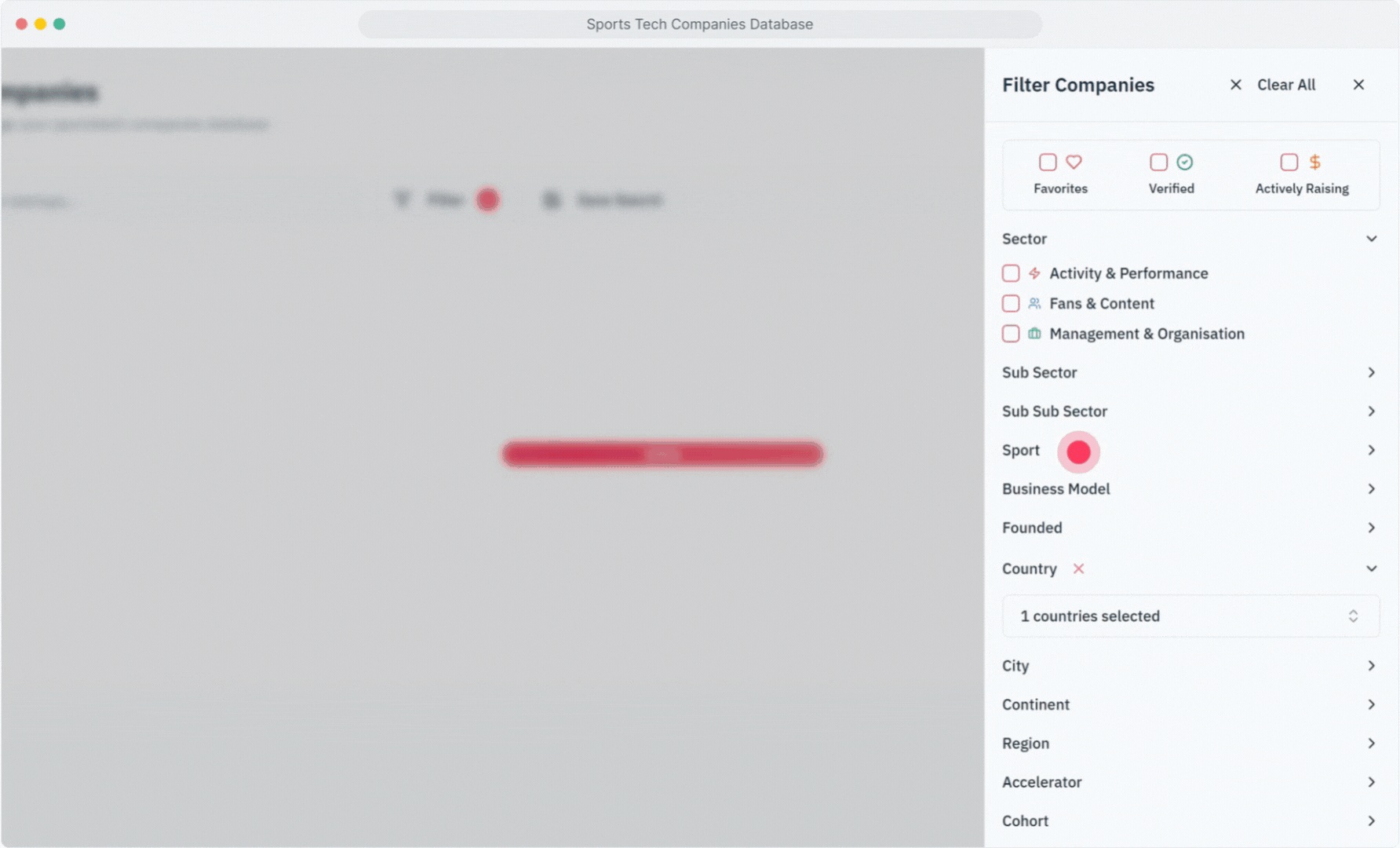
The launch newsletter described a 30-day PRO trial worth $179. That is a dated launch offer, rather than a dependable current price. More revealing than the number is the arrangement: attract users with access, charge for deeper work, and offer expert help when software alone is insufficient. The product and service businesses address different amounts of customer effort.
SportsTechX also admitted that the early Hub experience was unfinished on mobile. That small concession matters. Collecting useful information and making it pleasant to navigate are separate jobs. In March 2026, the ninth Global Sports Tech Ecosystem Report became an interactive web experience, while retaining a downloadable PDF. Readers gained another way to interrogate the research.
The map becomes a working tool
October 2026 brought a more explicit division of labour. SportsTechX announced that the Hub would relaunch as ATLAS: Explore for understanding the market, Raise for founders preparing and managing fundraising, and Scout for investors finding and evaluating opportunities. These were previews and early-access invitations. The announcement described the direction of the product.
Raise’s preview covered deck analysis, investor matching, outreach pipelines and a due-diligence data room. Selected early participants were offered free access for the first ten startups and half-price subscriptions for the next twenty. Scout’s preview emphasised thesis matching, traction checks and watchlists. The same research foundation was being adapted to two different working days.
A parallel experiment brings people together directly. Playmakers, a private founder network soft-launched in January 2026, announced 24 founding members in July, recruited as three groups of eight. Members included founders from businesses such as Playermaker, Output Sports and ScorePlay. It extends the company’s original connecting role into an organised peer community.
Copy the sequence
The transferable lesson is a sequence: define a messy field, publish useful evidence, then turn repeated questions into tools. Broad databases such as Crunchbase, Dealroom and Tracxn offer alternative starting points. SportsTechX’s proposition rests on sports-specific organisation and context. Buyers still have to decide whether that focus saves enough work to justify paying.
The limits follow naturally. A database cannot establish that a club will renew a contract, that an investor will write a cheque, or that a product has enough customers. Screening helps choose the next conversation. Someone still has to have it. SportsTechX has built a business around making that choice a little more informed.
Keep exploring
Visit SportsTechX, browse the Intelligence Hub, or read SportsTechX Weekly and the original publication.
▶Watch: Peter Moore on the digital evolution of sportsSportsTech Allstars · 16 minutes▶Watch: Computer vision, fitness and rehabilitationWith asensei founder Steven Webster · 34 minutes