Jack Kokko had a desk full of evidence and a persistent suspicion that it was incomplete. At Morgan Stanley in the late 1990s, research meant working through company documents and market information, searching, reading and searching again. A diligent analyst could spend the evening finding things and still leave with a question: what had escaped him?
His recollection comes with office supplies. Piles of paper. Highlighters. Sticky notes. The small stationery shop that grows around a large transaction. Each marked passage offered some reassurance; none could certify that the unmarked pile contained nothing important. Finance paid for judgment, then required its junior staff to spend an extraordinary amount of effort locating the ingredients.
Years later, Kokko would build AlphaSense with Raj Neervannan. Their company launched in 2011, long before generative AI became a routine item on a boardroom agenda. The original brief was already clear: help people find business information without making them repeat the young analyst’s scavenger hunt.
An engineer takes the long way round
Jaakko, known professionally as Jack, grew up in Oulu, Finland, and spent his final high-school year in the United States. His university education crossed two disciplines: electrical engineering at the University of Oulu and finance at the Helsinki School of Economics. Later came an MBA at Wharton. His qualifications amount to a useful introduction to the eventual company: understand the system, then understand the decision someone needs it to support.
He entered Morgan Stanley in London’s telecom banking business and persuaded the firm to send him to Silicon Valley. In Menlo Park, he worked in the technology team. The move put him close to companies building the future while his own research workflow remained stubbornly manual. The contrast was available every working day, without the inconvenience of attending a technology conference.
His first entrepreneurial venture took him into semiconductor materials. As founding CEO of Silecs, he raised more than $50 million and helped build a supplier whose materials improved the performance of semiconductor devices used in mass-market electronics. It was a substantial detour from financial search, and an early experience of turning a technical proposition into a business.
Finland remained part of the business he would build. In 2021, he described Helsinki as AlphaSense’s technology headquarters and linked the choice to software talent in Finland and the surrounding region. His own career had taken him abroad; the company’s engineering geography kept a connection to the country where he had studied.
AlphaSense’s origin therefore has an interval in it. The analyst experienced a problem, went away and built something else, then returned to the problem with more experience. Familiar irritations can have unusually long memories.

Two classmates, one stubborn problem
At Wharton, which he attended between 2006 and 2008, Kokko met Neervannan. A project brought them together, and Kokko’s memories of banking supplied a problem to discuss. Neervannan brought experience in software, natural language processing and machine learning. The conversation put a former user of inadequate tools next to someone equipped to consider how better ones might work.
Wharton’s account of the company begins with the hours analysts spent combing through reports, filings, transcripts and news. The variety matters. Business information arrives in different formats, from different institutions, with different vocabularies. A fact about a competitor might be sitting in an earnings call; a qualification to it might appear somewhere else entirely.
AlphaSense’s answer was a search engine built around business information and the meaning of its language. Rather than depend entirely on a researcher guessing the right keyword, the system would use machine learning and natural language processing to connect a query with relevant material. The platform launched in 2011.
Even that description contains two jobs. The software has to understand what someone is asking. It also has to have something worth searching. Kokko’s subsequent career would keep those requirements close together. A clever search across an incomplete collection could leave the analyst with a more elegant version of the original worry.
“Yes, we amplify their intelligence.”
Jack Kokko, 2016
The question travels
Investment firms and hedge funds were the initial audience. Kokko knew their work, their pressure to reach a view and the awkward distance between possessing information and being able to retrieve it. Corporate investor relations teams offered a route into another market: they read many of the same filings and transcripts, often to understand the people evaluating their own company.
From there, the uses spread across corporate strategy, competitive intelligence and M&A. The titles changed; much of the reading overlapped. A company considering an acquisition and an investor evaluating that company could be asking different questions of the same documents.
In his 2025 conversation with Ted Seides, Kokko described a deal surrounded by potential users: private equity bidders, corporate bidders, hedge funds, bankers and consultants. Each approached the transaction from a different direction. Each needed information about the businesses involved. He saw an ecosystem forming around a shared body of evidence.
That is a revealing way to describe his market. The organizing unit becomes the decision and the information around it. An analyst’s complaint can travel surprisingly far once you stop treating the analyst’s job title as the boundary of the problem.
A conceptual view of the product’s progression, from search to AI-assisted work.
Buying the conversation
In July 2024, AlphaSense completed its $930 million acquisition of Tegus. Alongside the transaction, it closed $650 million in financing at a $4 billion valuation. Those figures made an announcement. The material changing hands explains the strategic interest: expert research, private-company content, financial data and workflow tools.
For a founder concerned with gaps in the picture, expert interviews add a different kind of evidence. A filing records what a company formally discloses. An interview can address questions about how a market works. Bringing those materials together gives researchers more angles from which to examine a business, while leaving them the task of assessing the evidence.
The acquisition also illustrates how far Kokko’s responsibilities had moved from the original desk. He was now combining organizations and content collections, raising capital and making decisions about what the research platform should contain. The former analyst had become the person choosing which shelves to add to the library.
In March 2025, AlphaSense reported more than $400 million in annual recurring revenue and over 6,000 customers. Its announcement connected that growth with private-content expansion and generative AI. The business was growing along both sides of Kokko’s longstanding brief: more useful material, and better ways to work through it.
The CEO still has homework
By September 2025, Kokko was describing a further shift. AI could help construct research narratives and carry out repeated work. He discussed an AI interviewer able to speak with experts when they were available, including across time zones. He also described repeated industry checks that could build a continuing picture of pricing, demand and market changes.
There is a practical appeal to that ambition. A researcher has a calendar. A research question may remain open for months. Software that keeps working between meetings could change what it means to stay informed, provided the resulting material deserves the user’s confidence.
Kokko was candid about the work required to keep pace with the models themselves. Their capabilities change. Evaluation methods change with them. Product decisions require repeated testing, and he included the CEO among the people who needed to understand what was happening. An executive title does not make the technical homework disappear.
“Product is what adds value to users.”
Jack Kokko, 2025
His public conversations also placed him on both sides of the questions. In a discussion with Goldman Sachs research executive Eric Sheridan, Kokko explored the outlook for generative AI, including spending by major technology companies and the role of cloud providers. The former analyst was considering the infrastructure behind the tools now changing analysts’ work.
At AlphaSummit in October 2025, the company presented workflow agents for tasks such as company primers and meeting preparation, alongside AI-led expert calls and channel checks. Kokko’s ambition had moved from helping someone locate a passage toward helping them get a piece of work done. The distinction changes the promise a product makes to its customer.
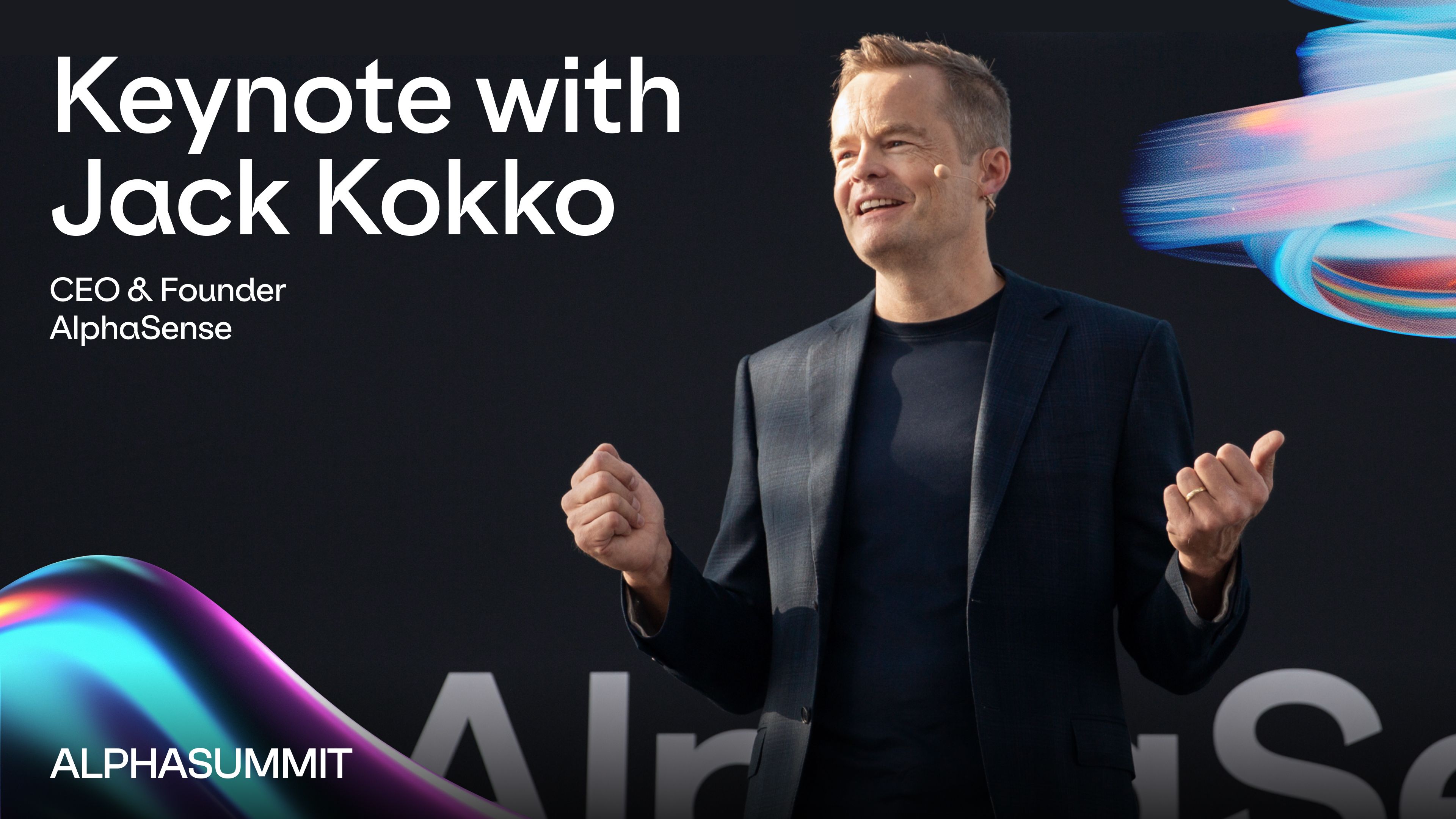
The same conference program paired Kokko with Lloyd Blankfein, the former Goldman Sachs chairman and CEO. It was a fitting encounter for a founder whose work connects finance and technology. The company that began with an analyst’s research problem was hosting a discussion with someone who had led one of the institutions defining that profession.
A bigger company, an old brief
In April 2026, AlphaSense appointed Samantha Greenberg as chief financial officer, reporting to Kokko. Her remit included financial operations, capital markets strategy and investor engagement. Building a research product at this scale also meant building the organization around it.
On June 3, the company announced $350 million in new funding at a $7.5 billion valuation. It reported more than $600 million in annual recurring revenue in the first quarter, up from $500 million in October 2025. These are company-reported subscription metrics; ARR expresses an annualized recurring revenue base rather than a year’s recognized revenue.
Two milestones, six months apart
Company-reported milestones. Bars use $600M as the reference scale; the second figure exceeds that threshold. Changes include the effects of the company’s evolving business.
The June announcement also introduced SuperAnalyst, an always-on AI agent, and a strategic partnership with Accenture to bring market intelligence and workflow automation into client organizations. Kokko’s earlier vocabulary of finding and connecting information now sat beside a broader ambition to help teams act on it.
The numbers give the story scale. The old desk gives it a human measure. A useful tool earns its place when the person using it can spend more time considering the evidence and less time wondering which document they forgot to open.
Kokko’s career has crossed countries, disciplines and industries. Its recurring question has remained remarkably portable. Somewhere in all that information is a detail that matters. He has spent years trying to make it easier for someone else to find.