Before the basketball comes the wiring. In the run-up to the 2025 NCAA Men’s Final Four, the Alamodome needed a network of screens ready for crowds moving through concourses, suites and concessions. Spectrio supplied the content management software and creative work. Computer Solutions handled installation alongside it. Together, they deployed 178 media players in a little over two weeks. Opening tip-off was April 5. Software had acquired a deadline.
- Spectrio sells the software, content and ongoing services behind customer-facing screens.
- Acquisitions built its reach; consolidating those systems took years.
- Its 2026 push puts creative production, training and proactive support on the bill.
The installation is a useful introduction to Spectrio because the visible product is so misleadingly simple. A customer sees a menu. Behind it sit players, schedules, permissions, artwork, technicians and someone responsible when the menu stops changing. Spectrio’s business occupies that backstage territory, where a marketing idea becomes a maintenance obligation.
First, there was the waiting
The family tree starts in 1986, when Mitchell Keller founded Conquest Communications. In 2002, Keller and Aaron Kleinhandler formed Audio Messaging Solutions. Digital signage joined the offering in 2007. The progression makes sense: telephone hold messages and waiting-room screens both reach people in the awkward interval between arriving and being served.
Today, Spectrio sells a wider collection under its Intelligent Engagement Suite: cloud-managed signage, interactive kiosks, licensed overhead music, on-hold messaging, guest Wi-Fi marketing, scent marketing and audience measurement. A shop can update promotions; a restaurant can change menus; a hospital can direct visitors. The product is communication attached to a place.
Spectrio says it powers more than 150,000 locations worldwide. Those are locations, not a count of individual customers. Automotive, healthcare, retail, food and beverage, and hospitality are important markets. The recurring problem is keeping a common message useful in rooms that have different audiences, hours and practical constraints.
Software connects the steps. People keep them moving.
The machinery can be quite ordinary. In one documented content-library workflow, branded material is organized into channels. An operator sets how frequently a channel plays, and future material inherits those settings. This is the small administrative bargain behind automation: make a useful decision once, then let the system repeat it. Someone still needs to review whether that decision fits the season, the location and the people standing in front of the display.
Buying companies was the opening act
Spectrio expanded through acquisitions, including Industry Weapon, ScreenScape, Enplug and Ping HD. A TJC affiliate acquired the business in December 2020; Bertram Capital retained a minority stake. Transaction terms were undisclosed. This was a consolidation strategy in a fragmented market, backed by private equity rather than a publicly priced venture round.
Acquisitions also left Spectrio with multiple content management systems. In April 2025, CEO Tamara Bebb described two years spent consolidating eleven CMS platforms into one modular offering. Customer upgrades would take time. The operational lesson is familiar to anyone who has combined teams: buying capabilities and making them behave like one product are separate jobs.
By January 2026, Bebb was describing a stronger emphasis on channel partners for new customer growth. Integrators bring installation expertise and existing relationships; Spectrio supplies the platform and services. The Alamodome illustrates that division of labor. It also explains why this company belongs in the managed signage market, alongside competitors such as Mood Media and Uniguest.
The document on the television
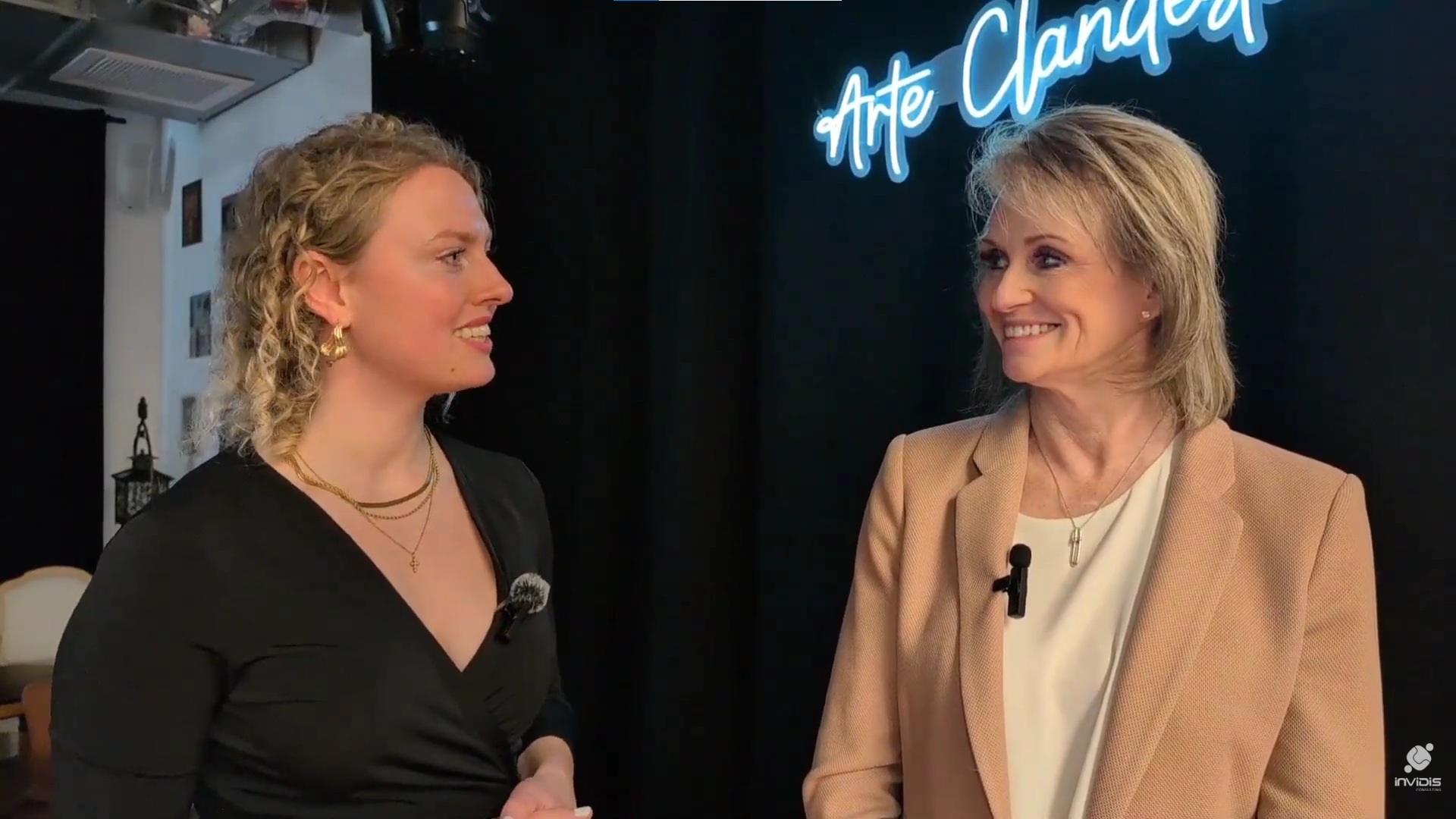
Then there is the problem that survives a perfectly functioning installation: the screen has nothing worth watching. In a May 2026 interview, production leader Shannon Baker described customers putting documents on displays without adapting them to a different audience. A person passing a counter reads differently from someone sitting at a laptop.
“Content needs to have a purpose because your digital signage should be working for you.”
Shannon Baker · invidis interview, May 2026
Spectrio’s April 2026 services launch addresses that continuing workload. Studio formalizes creative production as Content-as-a-Service. Academy provides continuing training. Care adds proactive monitoring and technical support. Read together, the three offerings identify what hardware leaves unfinished: someone must make the material, learn the system and keep it running.
Studio uses a credit model. Customers buy a monthly or term-based allocation, exchange credits for defined creative services, and work through a dedicated producer. Credits roll over between months but expire at the term’s end. That makes production a planned operating expense. It also gives buyers a reason to size the allocation to work they will actually commission.
What belongs on the bill
Spectrio’s core pricing page sends buyers to a demo rather than publishing dollar rates. A narrower public example comes from partner Displays2go: its Silver creative package is listed at $2,499.99, plus $360 per screen annually. For ten screens, that stated combination totals $6,099.99 before any separately required hardware, installation or taxes. It is a partner offer, not a universal Spectrio quote.
The sensible comparison is the whole assignment. A team that already makes its own content may prefer software purchased directly; Yodeck, for example, publishes per-screen plans. Spectrio’s broader proposition becomes more relevant when production, multiple locations and support consume staff time. A single screen with an occasional slide update gives those services less work to justify.
Make the next update easier
The recent deals sharpen that proposition. In June 2026, Spectrio announced agreements with General Motors and Kalahari Resorts. GM’s scope covers new dealerships and existing locations undergoing showroom upgrades. Kalahari’s agreement covers its US resort portfolio. These are deployment commitments; they should not be mistaken for measured sales gains.
Hardware partnerships tackle another practical obstacle. Velasea adds commercial media-player options; the signageOS automotive partnership connects supported operating systems and existing displays to Spectrio’s CMS. The aim is to make expansion less dependent on replacing the equipment already in the building.
Meanwhile, the Screenverse partnership offers programmatic advertising that could offset licensing costs. The economics depend on advertiser demand and suitable inventory. The copyable lesson is more modest: give each screen a specific job, assign an owner and budget for the next update. The useful screen is the one somebody keeps useful.