The street can be perfectly still. No branches whipping against a window. No dust skittering across the driveway. Yet the electricity is off, and Southern California Edison says the wind is the reason. The explanation lies somewhere beyond the street, along a power line that may travel miles through country the customer cannot see.
- SCE delivers electricity across a region of 15 million people.
- Coated wires and selective undergrounding reduce particular wildfire risks.
- Safety spending, customer bills and accountability meet at the same meter.
A utility is usually judged at the socket: does it work? SCE has to make decisions along the entire route. Its customers include households, farms, factories and public institutions. Their common requirement is simple enough. Deliver electricity reliably, safely and at a price they can manage. California’s landscape makes those requirements difficult to reconcile.
A coat for the conductor
Start with an object that looks almost disappointingly ordinary: a power line wearing a protective coat. SCE calls it covered conductor. Bare wire can arc or spark when it encounters branches, debris or another line. The covering helps prevent those contacts from becoming ignitions. It is a physical intervention in a problem that can otherwise sound abstract.
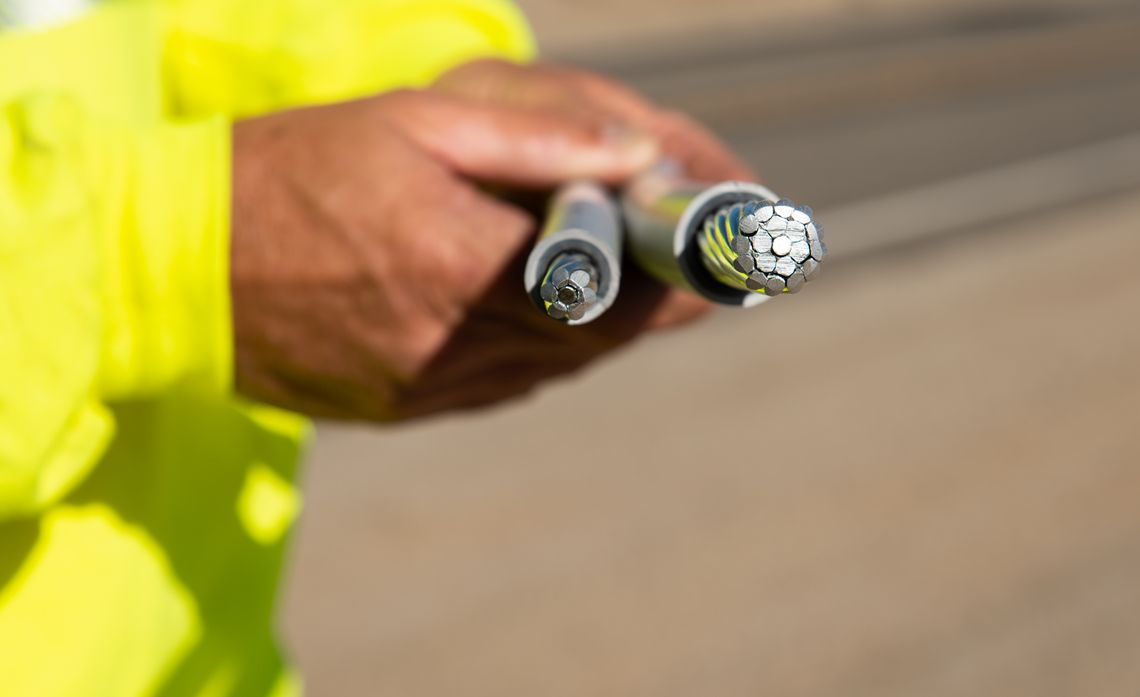
By March 31, 2026, SCE reported installing more than 7,110 miles of covered conductor since 2018. Its defenses also include vegetation clearance, equipment inspections and targeted undergrounding. Weather stations and cameras help operators see changing conditions. Fast-acting fuses interrupt faults. Each measure tackles a different part of the chain that can lead from electrical equipment to burning vegetation.
Then comes the intervention customers notice most: a Public Safety Power Shutoff. Operators temporarily cut electricity when conditions make operating affected lines too dangerous. Even an underground neighborhood can lose service if the route feeding it includes exposed overhead equipment elsewhere. Geography at the meter tells only part of the story.
overhead line
substation
street cables
What the coating cannot settle
The limit matters. Work on distribution wires cannot, by itself, resolve every risk elsewhere in a utility system. On August 4, 2026, Los Angeles County announced that investigators had concluded electrical arcing on an out-of-service SCE tower caused the January 2025 Eaton Fire. That finding concerns a particular ignition mechanism. It also makes sweeping assurances about a safer grid inadequate.
SCE’s public account had developed over time. In June 2026, the company said that, absent additional evidence, it believed its equipment likely could have been associated with the ignition. The later investigators’ conclusion belongs alongside that statement. A company’s mitigation statistics and an investigation into a catastrophic failure answer different questions; readers need both.
Recovery brings another set of distinctions. On October 20, SCE reported nearly $1.1 billion in compensation offers through its voluntary program, with more than $580 million paid. Offers are not payments. The company listed November 30, 2026, as the submission deadline for that program. The scale of the response does not erase the underlying failure.
A regulator reads the bill
SCE is an investor-owned utility subsidiary of Edison International. Its central business is operating regulated infrastructure and delivering electricity, with generation supply for bundled customers. Rates provide an opportunity to recover authorized costs and earn an allowed return on qualifying investment. For customers, the consequence is tangible: grid decisions eventually arrive on bills.
Edison reported approximately $6 billion in SCE capital investment during 2024 across the grid. That is not a wildfire-only budget. In September 2025, California regulators approved a 2025 base revenue requirement of $9.664 billion, below the $10.483 billion SCE requested. This is a regulatory funding measure, not the company’s total annual revenue.
Its market position needs equal care. PG&E and San Diego Gas & Electric are regional peers, rather than interchangeable providers for every SCE household. A community choice aggregator can purchase a customer’s electricity while SCE still delivers it. Changing the buyer of generation does not necessarily change the company maintaining the wire outside.
The car park is part of the grid
Electrification expands that wire’s job. An apartment parking space needs charging infrastructure before an electric car can conveniently use it. In 2020, the CPUC authorized up to $436 million for SCE’s expanded Charge Ready program, targeting approximately 37,800 chargers. The program addresses workplaces, multifamily buildings and other places where access depends on more than a driver buying a vehicle.
Storage adds another practical constraint: delivery dates. SCE hired Ameresco in 2021 for three battery projects totaling 537.5 megawatts. Ameresco’s 2024 annual report describes missing the August 2022 completion deadline amid supply-chain delays, weather and other events. Two projects reached an agreed substantial-completion milestone in August 2024; commercial disputes remained. A clean energy plan still has to survive procurement.
Even the name contains an easily missed distinction. Thomas Edison did not found this consolidated utility. Its lineage runs through local power companies, including the partnership that lit Visalia’s Independence Day festivities in 1886. Edison International’s history distinguishes those roots from SCE’s formal establishment in 1901. The familiar surname ties into historical arrangements for using Edison’s patents and name. The institution grew by joining systems together, a useful detail for understanding its present.
Start with your own meter
For a customer, the useful response begins smaller. Compare rate plans against actual consumption. Check income-qualified CARE or FERA assistance. Consider Medical Baseline if a household member has qualifying medical needs. Its additional energy allowance can help with costs; it does not guarantee uninterrupted service. Alerts and a workable outage plan remain relevant.
“We live safety”SCE’s published enterprise values
The transferable lesson is to inspect dependencies before trusting the local picture. A buried cable can depend on an exposed line. A charger can depend on a connection project. A cheaper tariff can depend on when appliances run. SCE’s history reaches back to lights switched on in 1886. Today, the meaningful test is whether every connection behind the switch can bear what customers ask of it.