In the 1920s, Georgia Power’s predecessors encountered a problem no board meeting could fix: the rain stopped cooperating. A fleet dependent on hydroelectricity could not produce enough power during a severe drought. Preston Arkwright, the company’s leader, concluded that the business could no longer lean so heavily on water. Steam plants followed. The lesson was physical before it was financial. A growing state needed electricity even when the weather declined to help.
- Georgia Power generates and delivers electricity to roughly 2.8 million customer accounts.
- Its Vogtle expansion delivered new nuclear power after a contractor bankruptcy and years of delays.
- Customers have practical tools for using less electricity, while regulators decide how infrastructure gets paid for.
A century later, the machinery has changed, but the assignment sounds familiar. Georgia Power must keep electricity available while Georgia changes around it. A household wants air conditioning. A factory wants predictable production. A data center wants a vast quantity of power without interruption. All three meet inside the same planning problem.
The switch hides the business
Georgia Power is Southern Company’s regulated electric utility in Georgia. Its work runs from generating stations through transmission lines and local distribution wires to customer meters. It sells electricity to homes, businesses, industrial facilities and public services. Its expertise includes plant operation, power-system planning, line maintenance and storm restoration. Reliability depends on the connections between those jobs.
This is an infrastructure business with a public referee. The Georgia Public Service Commission oversees retail rates and investment recovery. Most households cannot shop among electricity suppliers the way they choose a phone plan. Electric cooperatives and municipal utilities provide alternative ownership models in other territories; they generally are not rival buttons on a Georgia Power customer’s checkout screen.
That arrangement gives the company a durable customer base and makes regulatory decisions unusually consequential. Its audited statements report $12.631 billion in operating revenue for 2025. What distinguishes it in the American utility market is partly the scale of its nuclear commitment: Georgia Power and its partners finished reactors when new American nuclear construction had become rare.
First the schedule. Then the contractor.
Vogtle Units 3 and 4 were supposed to arrive years earlier. Before either produced commercial electricity, the project had already demonstrated how difficult a construction promise could be to keep. Then, in March 2017, Westinghouse, the principal contractor, filed for bankruptcy. The equipment was unfinished; the organization responsible for delivering it had broken down.
Georgia Power reassessed the cost of finishing against the cost of cancellation. It recommended continuing, with Southern Nuclear managing the project and Bechtel serving as the primary construction contractor. Regulators approved that course. Federal financing support mattered, too: in 2019, the Department of Energy brought project-wide loan guarantees to as much as $12 billion. Those guarantees were financing support, not a gift covering the construction bill.
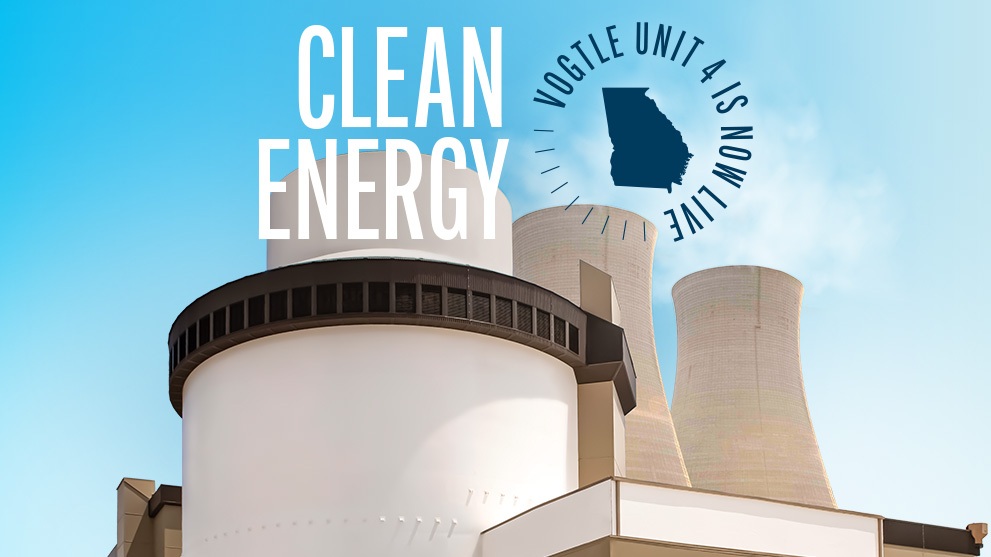
Unit 3 entered commercial operation on July 31, 2023. Unit 4 followed on April 29, 2024. The first newly built American nuclear units in more than three decades were finally selling electricity. They joined an existing plant, with Southern Nuclear operating for Georgia Power, Oglethorpe Power, MEAG Power and Dalton Utilities.
Completion-era estimates, April 2024. The final line counts $3.7bn in contractor settlement payments. These are different accounting scopes, not three invoices.
The uncomfortable number is the price. At completion, Associated Press calculations put the owners’ costs at about $31 billion. Counting $3.7 billion in payments from the departing contractor brought the total near $35 billion, against an original estimate of roughly $14 billion. These are whole-project figures. Calling them Georgia Power’s bill alone would misrepresent a shared undertaking.
Building the plant and deciding who pays for it are two different engineering problems.
More electricity from the plants already standing
The company’s next nuclear move has a different shape. In September 2026, Georgia Power announced an agreement with Google to support increased output at existing Vogtle and Hatch units. The proposal targets about 96 megawatts in Georgia Power’s owned portion of the plants. Rather than commission another reactor, it would upgrade equipment within the existing fleet.
Google would subscribe under a proposed tariff and receive the associated nuclear zero-emission credits. Georgia Power projects approximately $900 million in customer benefits over the units’ lives. Both the approval and the benefits deserve their conditional verbs: the announced agreement requires commission approval, and projected savings are not money already returned to households.
This offers a useful idea to copy: connect a large customer’s specific demand to a specific investment and an explicit payment structure. It depends on customers willing to commit, equipment that can safely produce more and regulators satisfied that other customers are protected. Forecast demand that disappears would make the bargain harder to defend.
The household version of the problem
For customers, the immediate options are smaller and more useful than a reactor tour. Georgia Power offers energy audits, usage tracking, efficiency rebates and assistance programs. My Power Usage helps customers inspect consumption and set alerts. EASE offers qualifying households free efficiency improvements. Commercial customers can explore incentives, lighting services and electric transportation programs.
The sensible sequence is to examine consumption, identify waste, then compare eligible improvements and rate plans. A time-sensitive tariff only helps if a household can move enough consumption into cheaper hours. A rebate is useful only when the purchase qualifies. An efficiency measure’s value depends on the building, its equipment and how people use it.
The same attention belongs on the bill. Regulators approved a base-rate freeze through at least the end of 2028, but fuel and separately treated storm costs can still matter, as can consumption. The company’s 2025 resource plan also retained coal generation alongside investments elsewhere. Completing nuclear plants did not turn the entire fleet carbon-free.
Trust extends beyond the wires. In October 2026, the company confirmed unauthorized access to limited information associated with about 300,000 Georgia Power accounts and said affected customers would receive notifications and free credit monitoring. Electricity service now includes responsibility for the account portal, too.
Georgia Power’s old motto is “A Citizen Wherever We Serve.” Its modern test is whether a long-lived network can serve new demand without making ordinary customers carry an unreasonable share of the experiment. The lights are on at Vogtle. The arithmetic remains public business.
Follow the wires
Explore Georgia Power, home energy programs, the resource plan, and the proposed Google agreement.
LinkedIn · X · Instagram · Facebook · News hub
Watch: the Vogtle construction story