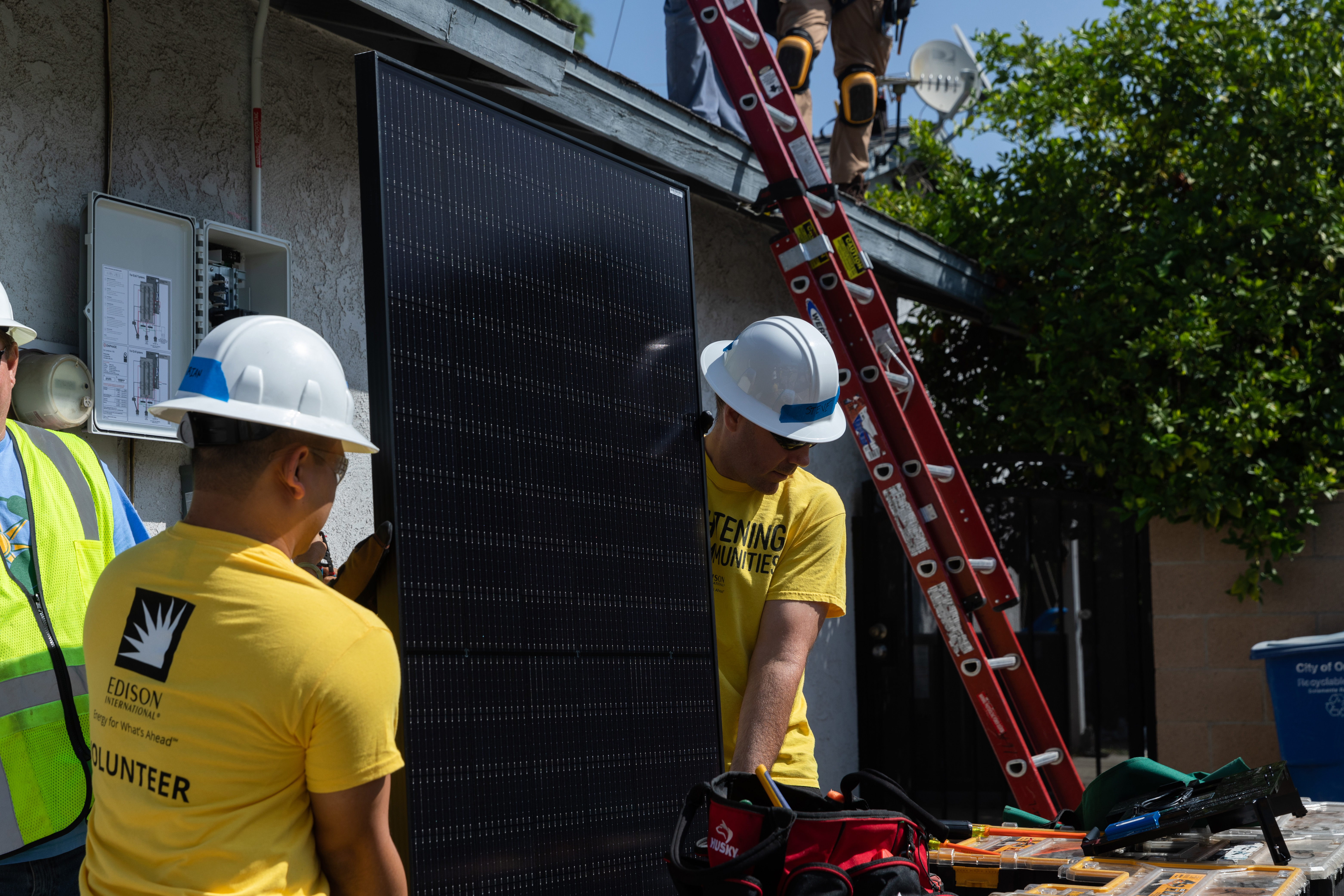
Steven Powell has one hand on a solar panel. On the other side is Brian Mauleon, a Southern California Edison project manager. Both wear white hard hats and yellow volunteer shirts. A ladder reaches toward the roof behind them. In this corner of Ontario, California, the energy transition has acquired a pleasingly ordinary instruction: mind the other end.
The installation, documented in November 2022, was part of a GRID Alternatives project serving two families who qualified for assistance. Powell was already SCE’s president and chief executive officer. Here he was helping move a piece of the future across a yard. Electricity may travel invisibly, but someone still has to carry the equipment.
That photograph offers a useful place to begin with Powell. His working life has involved planning what electricity will do next, then confronting everything required to make it happen. Electric cars need somewhere to charge. New generation needs connections. Communities need dependable service. Every promising diagram eventually meets a street, a budget, a construction crew and a customer with questions.
Two UCLA degrees. One long apprenticeship.
Powell graduated from UCLA with a bachelor’s degree in chemical engineering in 2000 and joined Edison that year. He returned to UCLA for an MBA, completing it in 2010. The combination put engineering and business education on the same résumé, with a decade of utility experience between the two qualifications.
His subsequent responsibilities ranged across resource planning, gas and power procurement, and preparations for plug-in electric vehicles. Those jobs sit at different points along the same chain of questions. How much power will customers need? Where will it come from? What changes when a household adds a vehicle to its electricity demand?
The electric-vehicle assignment is particularly revealing. A car buyer can concentrate on range, price and the availability of a charger. A utility has to think about the system receiving that charger, and the next one, and the ones after that. Powell’s career put him on the receiving end of electrification before he became responsible for the utility as a whole.
By 2018, he was senior vice president of strategy, planning and operational performance. The portfolio included long-term planning, technology priorities and improvements to the way the business worked. In September 2019, he moved into the newly created executive vice president of operations role, bringing transmission and distribution, customer service and safety functions within his remit.
Then came the succession. Kevin Payne retired after 35 years at the company, and Powell became president and CEO on December 1, 2021. He had spent more than two decades inside Edison. The appointment followed years spent learning several of the departments he would now have to bring together.
Joins Edison
MBA
Operations
and CEO
The customer at the far end of the circuit
Consider the geography of his job. SCE serves more than 15 million people across roughly 50,000 square miles of Central, Coastal and Southern California. That is a great many different circumstances behind the single word “customer.” A neighborhood adding chargers and a remote community seeking dependable power can belong to the same system while experiencing it very differently.
At the 2023 Tribal Leaders Clean Energy Summit, Powell met leaders whose concerns made that difference concrete. The Chemehuevi Indian Tribe, on the California side of the Colorado River and Lake Havasu, had experienced outages at the end of a limited-capacity circuit. Its plans included battery backup and a solar-powered microgrid.
For tribal communities, the conversation also concerned sovereignty: the ability to shape their own energy arrangements. Powell spoke about hearing their difficulties, their clean-energy interests and the obstacles they encountered when partnering with SCE. The value of such a meeting rests partly in allowing the customer’s definition of the problem to enter the room.
He also raised employment. Building a different energy system would require people trained to build and maintain it. By July 2025, Edison International announced another 12 lineworker scholarship recipients, with awards of up to $25,000 each. Powell described the program as an investment in the next generation of talent. The future grid comes with a substantial training requirement.
“We’re going to need a big workforce that is skilled and diverse”
Steven Powell · Tribal Leaders Clean Energy Summit, 2023
A thank-you note travels up the wire
A smaller incident shows how the organization can look from the opposite direction. In 2023, Manhattan Beach resident Susan Donahoe wanted someone at SCE to know about troubleman William Voelker. He had helped identify dangerous electrical conditions at her duplex and followed through on getting the situation addressed.
Donahoe tried to give him a coffee gift card. He declined. She then searched for SCE’s chief executive and began calling, eventually reaching corporate communications. Her appreciation traveled through the company until Voelker received a note from Powell thanking him for doing the right thing.
It is an excellent little reversal of the usual corporate announcement. The customer supplied the nomination; the chief executive supplied the acknowledgment. The episode gives Powell a modest, specific place in the story. He recognized an employee whose conscientious work had mattered enough for a customer to go looking for the boss.
Read alongside the Ontario installation, it brings the discussion back to people doing physical work. The panels, poles and connections depend on judgment exercised somewhere far from an executive office. Powell’s public role includes explaining the system. These episodes show him participating in it and acknowledging the people who operate it.
Fire puts every promise under pressure
Wildfire is an unavoidable part of Powell’s responsibilities. In July 2022, he stood beside Orange County Fire Authority Chief Brian Fennessy at a briefing about firefighting helitankers. SCE funded the Quick Reaction Force, supporting aircraft capable of fighting fires at night. The equipment was striking; the underlying purpose was immediate and practical.

The January 2025 wildfires made the stakes devastatingly clear. After the Eaton Fire, SCE faced questions about its equipment and the origin of the blaze. On August 4, 2026, Los Angeles County released the findings of an investigation conducted jointly with CAL FIRE: electrical arcing on an out-of-service SCE tower caused the fire.
That finding belongs in any account of the utility Powell leads. His work includes rebuilding infrastructure while the company faces litigation and demands for accountability. An origin-and-cause finding and the resolution of legal claims proceed through different processes. Neither a construction plan nor an executive’s promise settles the questions residents bring to them.
In April 2025, Powell committed SCE to rebuilding a more resilient grid in affected areas, increasing electrical capacity and keeping community views involved in the work. The company’s initial plan proposed underground distribution infrastructure in Altadena and Malibu. A month later, SCE submitted its wildfire mitigation plan for 2026 through 2028.
That submission anticipated $6.2 billion of investment over three years, including at least 440 additional circuit miles of covered conductor and 260 circuit miles of underground distribution lines. These were proposed measures and spending, rather than a report of completed construction. Powell’s words about safety must ultimately be assessed against what the company builds, maintains and delivers.
Anticipated investment over three years
of covered conductor
distribution lines
Tomorrow has to arrive at an acceptable price
The safety challenge sits alongside another difficult assignment: expanding and modernizing electricity service while keeping it affordable. Powell’s leadership positions extend beyond SCE. He serves on the Electric Power Research Institute’s board and chairs its Climate READi Committee. He also co-chairs the Edison Electric Institute’s Wildfire Task Force and serves as a California Science Center Foundation trustee.
These connections put him among researchers, other utility leaders and institutions concerned with science and public understanding. They fit a career spent moving between planning and operations. The technologies can change quickly. Translating them into utility practice involves equipment, training, regulation and decisions about which problems to address first.
His public speaking has followed that terrain. On Energy Switch, he joined Brad Jones, then ERCOT’s chief executive, to discuss how the grid works and how it could meet growing demand. The setting required an explanation for viewers who encounter electricity mainly through a switch and a bill.
A September 22, 2026 engagement at Claremont McKenna College brought those competing pressures into its title: “Energy and Leadership in the Age of Extremes.” The program framed the task as evolving faster, withstanding more and costing less. It is a compact description of why a utility chief’s calendar offers few opportunities for a simple victory lap.
For Powell, the next chapter remains tied to the region where he has built his career. His responsibilities connect the plans for more electrification with the less glamorous requirements of delivering it: workers, maintenance, customer conversations and construction. The hardest part of a future-tense strategy is the obligation to produce results in the present.
Return to the Ontario photograph. There is a panel between two people, and a roof waiting for it. Powell’s title cannot move the other end. That requires a colleague. Across the much larger system he leads, the same practical dependence remains: the plan advances when people can do the next piece of work, safely and well.
Follow the current
Conversations, field notes and further reading.
- SCE website
- Steven Powell on LinkedIn
- Watch: Understanding the Electric Grid
- Edison leadership biography
- Ontario solar installation
- Tribal energy summit
- A lineworker’s thank-you
- Altadena and Malibu rebuilding plan
- 2026-2028 wildfire plan
- Eaton Fire investigation finding
- Energy and Leadership in the Age of Extremes