Consider a company whose customer software works exactly as configured. The workflows run. The reports arrive. Yet employees keep their own spreadsheets, departments disagree about the numbers, and a customer’s question travels through several screens before anyone can answer it. In a May 2026 essay, SoftClouds customer success manager Neha Kumari describes this quiet drift between a platform’s setup and the way people actually work. It is a useful place to begin understanding her employer.
- SoftClouds implements and connects Oracle, Salesforce, and other enterprise systems.
- Its work includes customer service, knowledge bases, quoting, analytics, and software delivery.
- The useful lesson: inspect the handoffs before buying another feature.
01 / The handoff is the product

Founded in 2005 by Balaji Ramachandran, SoftClouds occupies the practical middle of the enterprise technology market. A software vendor supplies the platform. A business supplies its peculiar habits, rules, and accumulated exceptions. SoftClouds supplies consultants and engineers to reconcile the two. Its menu includes cloud implementation, custom applications, and customer relationship management, usually shortened to CRM.
That sounds abstract until you look at the customers. In testimonials published by SoftClouds, Mountain America Credit Union describes a migration to Oracle Knowledge Advanced, a custom interface, and years of subsequent improvements. Spirent describes connecting Oracle knowledge management to Salesforce. OccuVAX describes adding mobile capabilities for remote flu clinics. Each assignment gives a familiar technology term a specific job to do.
Marriott’s Jeremy Reed offers a smaller, revealing detail about a Siebel Open UI project: “communication lines were always open.” In integration work, the conversation matters. Someone must decide which system owns the information, what the employee sees, and what happens when the usual sequence does not apply. The customer experiences those decisions as an answer that arrives promptly, or a wait.
The customer experiences those decisions as an answer that arrives promptly, or a wait.
THE INTEGRATION PROBLEM
02 / Fix the release, then the reporting
A utility case study published in May 2024 begins with a different frustration. Salesforce updates depended on manual steps. Concurrent development was awkward, quality assurance took time, and teams lacked consistent release practices. The bottleneck sat in the machinery used to change the software.
SoftClouds describes installing an automated release pipeline, standardized templates, integrated code checks, and tools for merge conflicts. A centralized calendar made releases easier to follow. These changes addressed the route from a developer’s work to a live system. The company reports faster deployments, but the more transferable detail is the sequence: make the process repeatable, then make it faster.
and the owner.
and workflows.
Keep watching.
By May 2026, another published case concerned automotive reporting. Financial and operational information sat across queries, spreadsheets, and flat files. Teams maintained different versions of reports. SoftClouds’ proposed answer was a unified Power BI data model, automated preparation through Power Query, shared calculations, and access controls. Agreement about the information came before the dashboard could become useful.
The company’s scope also reaches ongoing operations. An April 2026 case describes an unnamed mail-order pharmacy processing more than two million prescriptions annually. SoftClouds brought support, infrastructure, security, and quality assurance into a coordinated service model. Monitoring and clear escalation tiers addressed a reactive support environment. These are company-reported cases, but their operational details explain the work better than a parade of customer logos.
03 / A business built after go-live
SoftClouds sells professional services through fixed-bid and time-and-materials engagements, with on-site, off-site, and offshore delivery options. The distinction matters to a buyer. A defined migration lends itself to a bounded scope. A changing backlog requires decisions about priorities and engineering time. Continuing improvements give the relationship a life beyond the initial installation.
Its service range reflects that reality. Oracle work includes knowledge management, subscription management, field service, and configure-price-quote systems, which help sales teams assemble and price an offer. Salesforce services cover CRM, service operations, portals, and DevOps. Cloud and custom development sit alongside those specialties. Customers hire help for a business process; the implementation can cross several product boundaries.
2017 / 2018 / 2019
A historical growth marker, confirmed by Inc.That places SoftClouds among implementation specialists and systems integrators. A buyer can choose another consultancy, a larger integrator, or an internal applications team. Its distinctive combination is Oracle experience alongside Salesforce delivery and knowledge integration. The partner page names Oracle and AWS; SoftClouds also uses the historical Oracle Platinum Partner designation. The clearest evidence of fit remains the actual project work.
04 / The people doing the connecting
The same attention to connections appears inside the company. A September 2025 account describes SoftLearn, its group learning program, and SoftMentoring, which adds individual guidance across functions. The stated gap was simple: an organization-wide session cannot provide every private conversation a developing employee needs. The company says mentoring creates room for those exchanges.
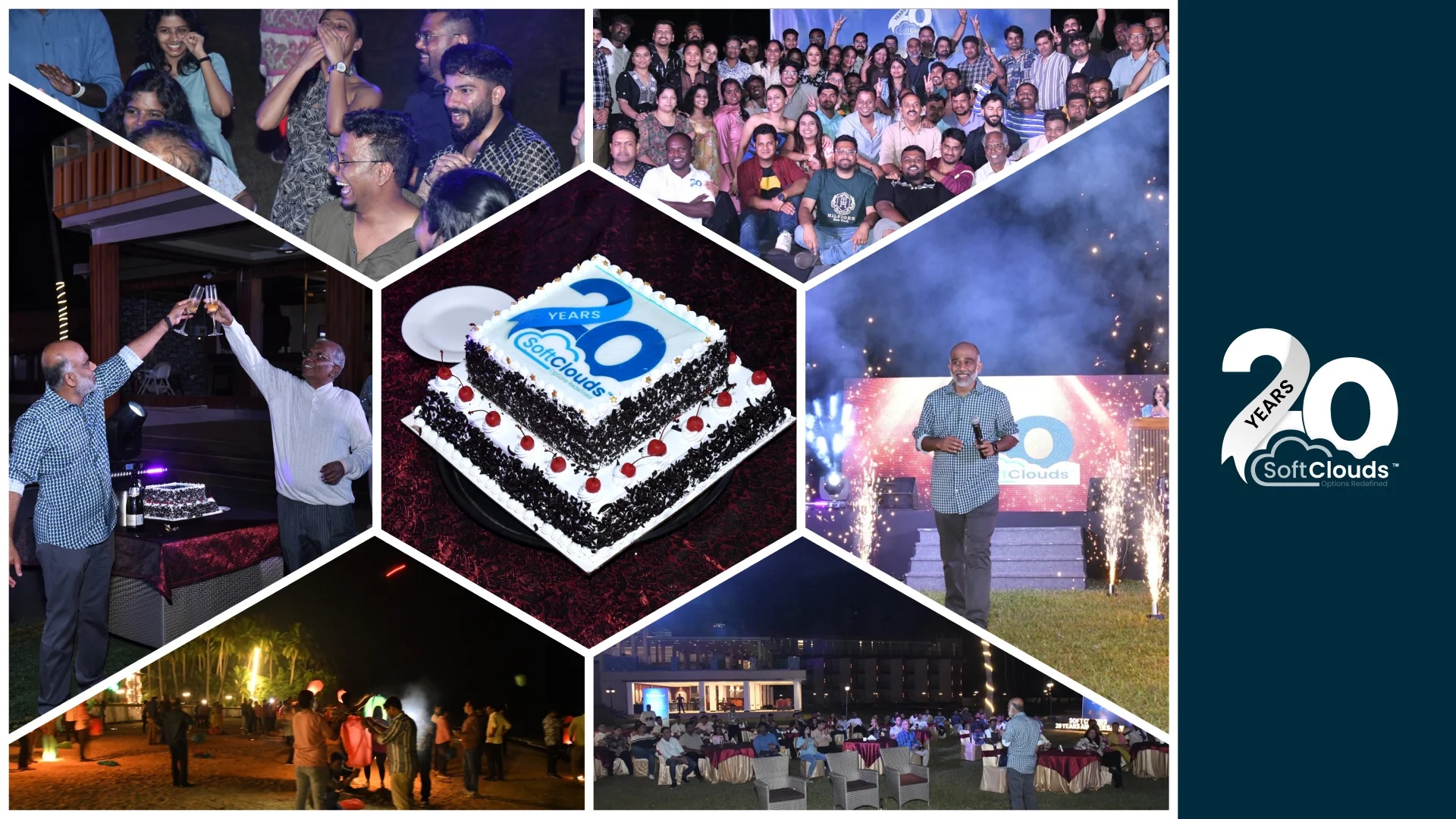
For its twentieth anniversary in 2025, colleagues spent four days in the Andaman Islands. Chief technology and innovation officer Asokan Ashok’s account includes performances, reflection, and a beach cleanup on Ross Island. Away from the implementation schedule, the company’s own portrait of its culture becomes rather literal: people spending time together, then picking up discarded plastic.
05 / Start with the detour
There is a practical way to borrow from these examples. Follow one task through your organization. Watch where an employee retypes a value, exports a spreadsheet, or asks a colleague which report to trust. Name the owner of that handoff. Agree on a definition. Automate a check. Measure whether the detour disappears.
That approach needs cooperation, access to the underlying systems, and people willing to maintain the rules. A small team with straightforward needs may get further with a standard application. For a business carrying several generations of enterprise software, however, the connections deserve attention. SoftClouds’ work makes a persuasive case for examining what happens between the systems you already own.
Keep exploring
WATCH THE WORK
Transforming Field Service with AI ↗ Oracle Field Service & ConnectedCX webinar ↗More from SoftClouds on YouTube ↗