Before Snap! Mobile had an app, it had a problem with cookie dough. Cole Morgan, a former college football player, was selling it to help high school teams raise money. He also sold discount cards. Then a former coach delivered the sort of customer feedback that never needs a slide deck: “I like you, but not what you’re selling.”
There is a whole business tucked inside that sentence. The coach wanted money for his program. The product fundraiser came with another assignment: turn players into salespeople. Morgan’s eventual answer was to move the appeal online and build a process around it. The company now reports more than $1 billion raised for school and youth programs. That figure counts fundraising through the platform, rather than Snap!’s revenue.
- The job: help schools and youth groups fund activities, then manage the work around them.
- The bargain: guided digital campaigns; programs currently keep 80% or more of funds raised.
- The ambition: turn a seasonal fundraiser into an ongoing relationship with the whole department.
A very useful rejection
Morgan co-founded Snap! Raise with Eddie Behringer in 2014. Behringer left in 2019 and went on to launch Copper Banking. Morgan’s former coach, Doug Trainor, supplied a $50,000 founding loan, according to Snap!’s account. The first campaign helped a former coach’s team buy ball brushes and raised more than $6,000. This was an unusually practical origin for a software company: a piece of equipment, a trusted relationship, and a complaint.
The useful invention was the managed campaign. Participants reach friends and family through email, text, and social media. Donations flow through a customized webpage. A representative helps the group get started and guides the campaign. The usual run is 28 days. A coach gets a defined project instead of a perpetual obligation to sell something.
“I like you, but not what you’re selling.”A former coach, in Snap!’s founding account
Snap!’s audience extends beyond football. Bands, art programs, academic clubs, cheer squads, and youth groups can use Raise. The shared problem is a leader who needs funding while already running an activity. The company’s expertise sits at the intersection of donor outreach, payments, school administration, and the peculiar logistics of getting a group of young people to complete a task together.

Twenty cents deserves a question
Snap! Raise charges for that service. Its current FAQ says there is no upfront cost and programs keep 80% or more of what they raise, with pricing tailored to the school and level of partnership. Schools running multiple campaigns may qualify for better terms. The wider Mobile One platform has tiers discussed with a representative.
At an 80% retention rate, a hypothetical $10,000 campaign leaves the program $8,000. The other $2,000 is the service portion. This arithmetic makes a better starting point than either enthusiasm or indignation. What matters is the net money delivered, alongside the work required to deliver it.
Consider two fundraisers with equal net proceeds. One takes a coach’s evening to launch; another consumes several practices and requires someone to reconcile cash and unsold goods. Their cash results match. Their costs do not. Conversely, a group with an experienced volunteer team and an effective low-fee campaign may have little reason to pay for managed outreach. The buyer should put staff hours next to dollars on the comparison sheet.
Snap! positions itself against do-it-yourself fundraising pages through support and built-in outreach. GoFundMe and RallyUp offer other fundraising routes; TeamSnap addresses team-management work. Traditional product sales remain an option too. The choice depends on which job needs doing. A group seeking a donation page has a different shopping list from an athletic director coordinating registration, spending, and a season’s calendar.
The practice that discount cards ate
Hanover High School baseball provides a concrete example. In a Snap! case study, coach John Grainger’s team had spent three years selling discount cards. The account describes difficulty motivating players, time taken away from practice, and a fundraiser that returned only half the proceeds to the team.
After switching, the team raised $12,440 in its first year with Snap! Raise and $40,046 over three fundraisers, the case study reports. Automated email and text outreach replaced in-person sales. Rewards encouraged players to add supporter contacts. These are one customer’s reported results, published by the vendor, rather than a forecast for another school.
The interesting change was the assignment given to the players. Selling a discount card requires a transaction about a product. A digital appeal invites someone already connected to a participant to support the program. The work moves toward gathering the right contacts and following up. Anyone copying the approach can start there: state a clear purpose, identify actual supporters, give the appeal a deadline, and measure the money that reaches the team.

Follow the money into the office
Once a company helps a team raise money, it gets a good view of everything that happens afterward. Somebody must budget it. Somebody must collect fees, register participants, update schedules, and tell parents when a game moves. Snap! expanded into those adjacent jobs through acquisitions and its own products.
A $90 million Series B in August 2021, led by Elysian Park Ventures, financed the broader ambition. Elysian Park is affiliated with the Los Angeles Dodgers’ ownership group. Snap! acquired Groundwork that September, bringing financial-management software into what became Spend. In April 2022 it added 8to18 and SchoolCNXT. FanX, the fan-engagement app, followed in March 2023.
- 2021Groundwork
Money management - 20228to18 + SchoolCNXT
Administration + communication - 2023FanX
Community engagement - 2025Mobile One
Integrated platform launch
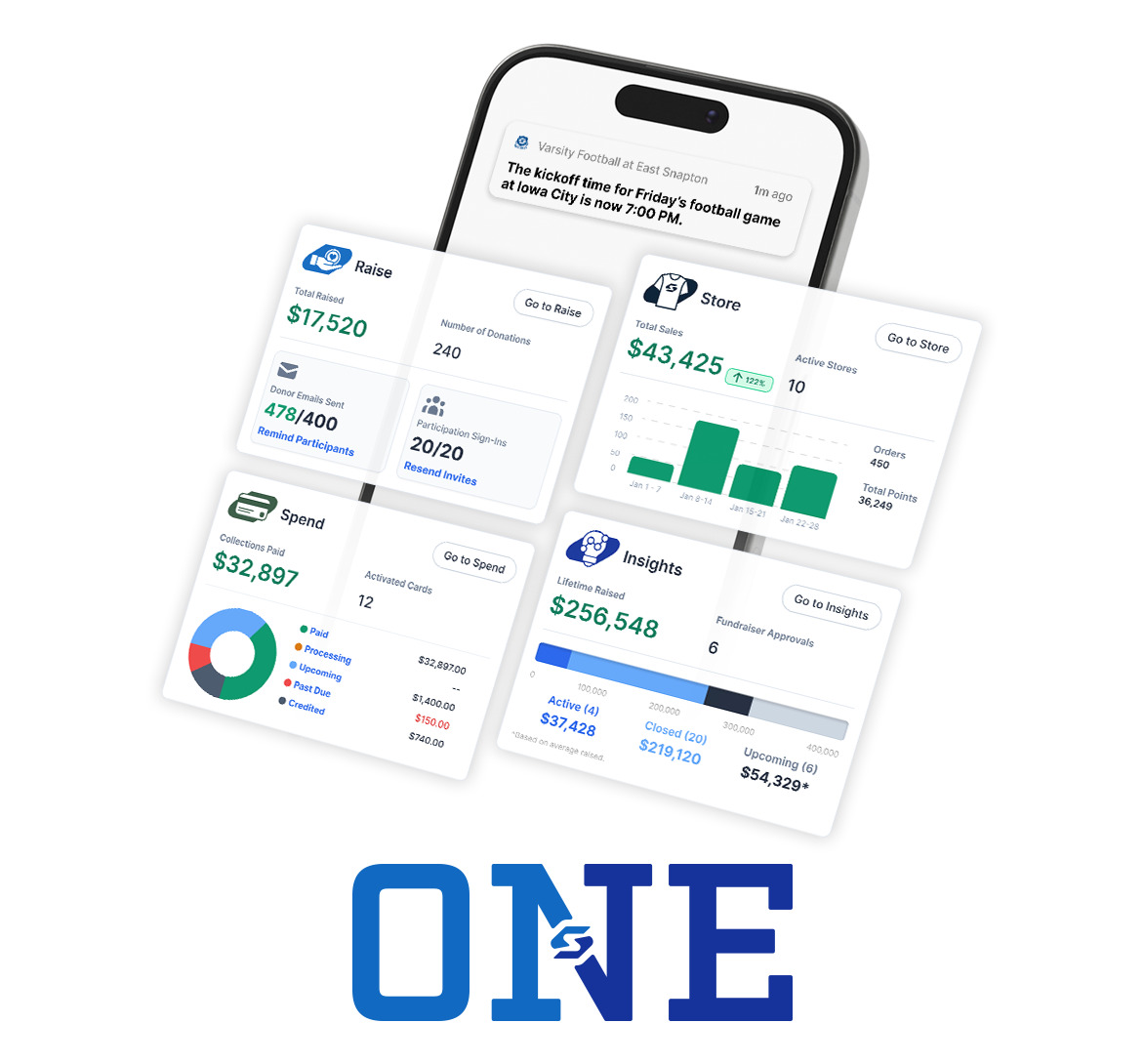
Mobile One launched in April 2025, joining fundraising, administration, and community engagement. Schedules, Sites, Registration, and Leagues handle organizational work. Spend offers budgeting, payment collection, and controlled access to finances. Insights supplies oversight dashboards. FanX puts schedules, scores, notifications, and sponsorship placements into a school-branded mobile experience.
Store, launched in 2021, adds a small retail operation without a school stockroom. Snap! handles orders, payments, and shipping. Programs earn points on purchases that can become gear or a check. A supporter can buy a shirt after the fundraising campaign has ended. For Snap!, this expands the reasons a school might keep using its system through the year.
The app still needs a community
Snap!’s history includes a period when the underlying activities stopped. The pandemic slowed school sports and the business. In 2021, Morgan told GeekWire that the interruption led the company to rethink its sales process and become more efficient; he also described schools becoming more willing to adopt technology. A difficult season changed both the seller’s habits and the customer’s willingness to try software.
The company now has institutional routes into that market. It renewed its NFHS partnership for four years in September 2024 as the organization’s exclusive fundraising platform partner. Varsity Brands announced a partnership across BSN SPORTS and Varsity Spirit in January 2025. In November 2025, Snap! and Till Financial announced a youth debit card generating 1% cash back for participating schools. Snap! announced Google for Education partner recognition in February 2026.
School software also requires care with permissions and student information. Snap! says it does not sell program, participant, or donor data. A school evaluating the platform should review the actual privacy policy and campaign agreement, including the fee, access permissions, and payout arrangements. Good intentions are easier to appreciate when the paperwork is clear.
There are limits to what this approach can accomplish. Digital outreach depends on a reachable network and people able and willing to give. Repeated appeals compete for the same attention. An integrated app needs staff and families to use it; a schedule is useful only when someone keeps it current. These are practical dependencies of the model, not promises a download can settle.
The lesson worth borrowing is to count the work surrounding the money. Define the need, give the appeal an end date, track net proceeds, and record the hours spent getting them. Morgan’s former coach supplied a remarkably economical product brief. Help the team. Stop making the team run another business first.
Website & fundraising · Mobile One & product video · Watch the coach demo · Cole Morgan podcast interview · Company blog · Newsroom · LinkedIn · X · Instagram · Facebook · TikTok