Consider the school laptop. In the purchasing meeting, it is a specification: memory, processor, price. In the classroom, it becomes something rather less tidy. Someone must configure it, connect it, locate it, fix it and eventually erase it. The purchase order has an ending. The work has a habit of continuing.
This is the territory occupied by United Data Technologies, better known as UDT. Its customers buy technology, but they also need a way to live with it. The company’s services reach from the device on the desk to the network, data center and cloud behind it. The interesting part is how much of that business depends on apparently small tasks performed consistently.
- Schools are the anchor. UDT reports serving districts representing approximately 10% of America’s students.
- The work outlasts the sale. Procurement sits beside repair, security, support and secure retirement.
- There is physical infrastructure. Integration centers prepare and repair fleets of devices.
- The arithmetic matters. Kingsport approved a UDT internet quote projecting $28,386 in annual savings.
The purchase order is the easy part
Henry Fleches and Gerard Amaro started UDT in 1995, operating from Fleches’ family home. In 1997, the company hired its first employee and secured its first contract with Miami-Dade County Public Schools. A school district makes an instructive early customer: technology has to reach many buildings, serve different users and survive an academic calendar that will not politely reschedule itself.
UDT’s account of its history describes a progression from South Florida product reseller to a national provider of technology services. That progression makes commercial sense. Selling the machine opens the door to discovering all the things its owner must do next. Each new obligation creates another possible service relationship.
By March 2025, UDT said it worked with 10 of the country’s 20 largest school districts, naming Miami-Dade, Orange County and Los Angeles Unified among them. Its customers also include government organizations and commercial businesses. Banks, healthcare providers, hospitality companies and universities appear in its description of the sectors it serves. The common problem is operating technology with finite staff and a long list of demands.
Its place in the market is therefore that of a technology integrator and operator. Hardware makers build the machines. Software companies supply applications and platforms. UDT helps customers assemble, secure and manage the resulting environment. Partnerships with companies including Microsoft, Cisco, Dell and HP give it access to the products; service delivery makes the combination useful.
A service business with a loading dock
Cloud computing sounds weightless. Device management is conspicuously heavy. There are boxes, shelves, labels and machines that need to go somewhere. UDT’s integration centers give its services a physical expression: preparation and repair have an address.
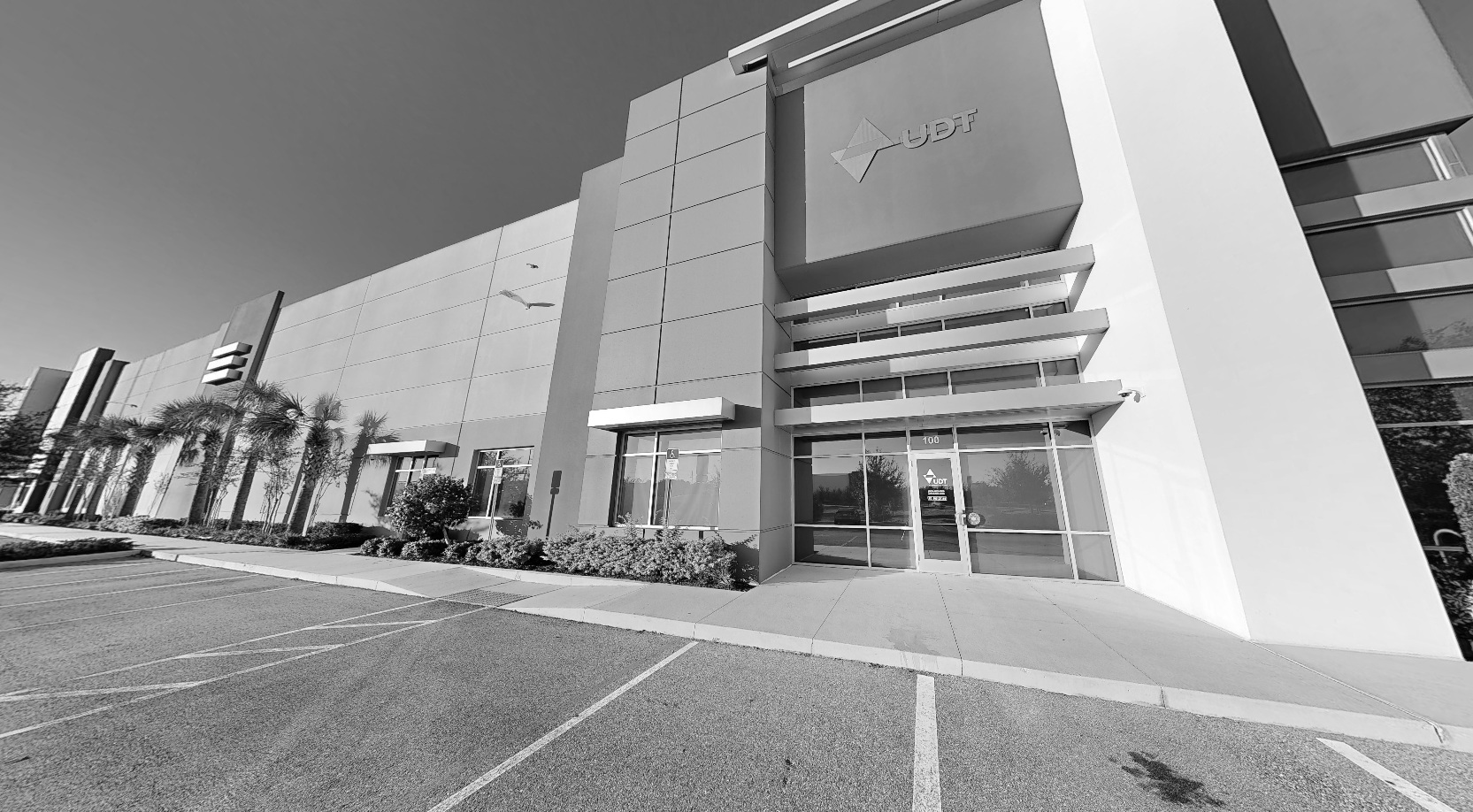
In July 2025, UDT announced its Columbia Integration and Repair Center in Irmo, South Carolina. The stated capacity was up to 30,000 devices a month. Capacity is a ceiling, not a claim that every available slot is occupied. The facility was also intended to provide redundancy when another center encounters disruption or demand spikes.
The listed duties are wonderfully practical: repair, imaging, asset tagging, etching, delivery and secure, climate-controlled storage. Fleches linked the expansion to larger device fleets and the pressure to repair and refresh them without interrupting operations after the pandemic changed how people learned and worked.
The problem is easy to recognize. A fleet can grow faster than the organization’s ability to support it. Buying more devices also buys more future repair work, more inventory records and more retirement decisions. UDT’s response has been to put facilities and workflows behind those obligations.
Its broader endpoint portfolio covers strategy, procurement, integration, deployment, adoption, support, warranty repair and recovery. The aim is to turn a succession of emergencies into work that can be planned. A useful distinction: a broken laptop is an incident; a reliable process for every broken laptop is a service.
- 01PrepareConfigure, enroll, tag
- 02DeployDeliver and support
- 03RenewRepair, swap, refurbish
- 04RecoverWipe and retire securely
The monthly bill tells a better story
UDT earns business through equipment and software procurement, licensing, professional services and ongoing managed arrangements. Its Lifecycle360 for Education offering lets schools start with particular services and expand. Lifecycle360+ packages a fully managed device lifecycle into fixed monthly payments. That is a different budget conversation from purchasing a fleet and handling each later problem separately.
For a concrete price, turn to Kingsport City Schools in Tennessee. On March 10, 2026, its board approved changing internet providers from Zayo Education to UDT. The district’s meeting notes put UDT’s estimate at $3,480 a month for the same services, with projected monthly savings of $2,365.50. Annualized, the saving was $28,386.
Projected annual difference: $28,386. Previous amount calculated from the quoted new price plus stated savings. March 2026 board figures.
A different engagement illustrates the breadth of the work. In August 2026, Canutillo Independent School District announced an approximately $4 million private fiber wide area network delivered with UDT and WANRack. The district said federal E-Rate funding would cover the project, with completion expected by summer 2027. That figure is the project budget, not a statement of UDT’s fee.
These two examples also explain why there is no single useful price for “UDT.” Internet access, a device repair program and a district-wide network are different purchases. The sensible comparison starts with the required service, its operating conditions and who is responsible when something needs attention.
Security belongs in the same conversation
UDT’s UDTSecure portfolio includes security assessments, managed detection and response, patch management, incident response and forensics. The company offers cybersecurity as a service for organizations that need specialist capacity. Device support and security overlap whenever a machine must be enrolled correctly, updated or wiped before it leaves the fleet.
Its managed IT portfolio adds remote monitoring, Microsoft 365 administration, backup and business continuity services, and a 24/7 help desk. Co-managed IT allows an existing department to use UDT engineers for escalation and administration. That can be a useful arrangement when a team has local knowledge but needs additional time or expertise.
“Get out of the PC business.”UDT’s managed services pitch
The invitation has a practical appeal, although responsibility still needs a named owner. A customer must define which systems the partner manages, which decisions remain internal and how performance will be judged. Combining services can reduce handoffs, but the contract must make those handoffs visible.
In August 2026, UDT announced ISO 9001:2015 certification from BSI for a specified scope of managed and professional technology services, including its help desk, network and security operations, connectivity and cybersecurity. It is evidence about a quality management system and repeatable processes. It is not a promise that equipment never fails or that attacks cannot succeed.
The next machine has an AI problem
UDT’s recent work extends to AI adoption. Its 2025 anniversary announcement included an AI Center of Excellence initiative. In January 2026, Chief AI Officer Daniel Rodriguez described collaboration with AMD around Ryzen AI processors and local inference, emphasizing privacy, responsiveness and practical workflows.
The development fits the company’s existing position. A new capability on the endpoint introduces decisions about deployment, data handling and support. Someone still has to make the machine useful in its actual environment. Announcing AI capabilities does not establish a customer outcome by itself; the operational questions remain worth asking.
UDT also gives those questions an internal vocabulary. Its STRIVE values cover urgency, teamwork, responsibility, integrity, versatility and excellence. Responsibility is expressed as being “100% accountable, 100% of the time.” For a services company, that principle has a very tangible test: whether the person answering the problem can see it through.
Borrow the questions before the contract
A buyer can copy the discipline without purchasing the entire portfolio. Before committing to devices, decide how they will be configured, tracked, repaired and retired. Before comparing monthly fees, compare coverage and service levels. Before outsourcing a function, establish who can authorize changes and who answers for the result.
A fully managed monthly model deserves particular scrutiny when enrollment changes, budgets fluctuate or the organization already has capable internal support. Targeted repair or deployment services may fit better. UDT’s modular education offering allows that smaller starting point. The right size of engagement follows the work that needs doing.
The company’s most useful lesson is concealed in the ordinary laptop. Its useful life stretches well beyond its moment of purchase. UDT has made that interval into a business. For the customer, the question is whether paying someone to manage the interval produces a better classroom, workplace or operating budget. Kingsport’s spreadsheet is a good place to begin.
Open the next tab
Explore UDT’s website, Lifecycle360 for Education, managed IT services and news and insights.
Follow LinkedIn, X, Instagram and Facebook. Watch UDT’s YouTube channel or take the integration center tours.