The instruction sounds like a terrible way to test a business: fly the drone toward the wind turbine blade and see whether it stops. Danny Ellis, SkySpecs’ co-founder, described that early field experiment in a 2020 interview. Collision avoidance was the product. If the aircraft could keep itself out of trouble, perhaps an operator could steer it around and collect useful pictures.
The aircraft could avoid the blade. The business still had a problem. An operator wandering around a turbine with a camera was an awkward foundation for a repeatable commercial service. In early 2016, Ellis recalled, the team decided to automate the entire inspection. All three blades. The flight and the photography. The unit of work became a turbine, rather than a pilot’s afternoon.
- SkySpecs sells inspections, asset software, and specialist services to renewable energy owners and operators.
- Its useful trick is connecting damage observations to maintenance decisions.
- The lesson travels: standardize the evidence, then help the customer act on it.
“a solution looking for a problem”
Danny Ellis, recalling the early business in 2016
A very useful disappointment
SkySpecs emerged from University of Michigan robotics work and was founded in 2012. Danny Ellis and Tom Brady are its best-known co-founders; a contemporary university account also names Sam DeBruin and Ryan Morton. They had technical ability before they had a settled commercial destination.
One possible destination was bridges. Ellis pursued a two-year, $150,000 Michigan transportation contract and lost. An adviser suggested a clean-energy competition, which required pointing the drone toward wind turbines instead. SkySpecs won $50,000. A funding constraint had supplied a customer category.
Another constraint was time. The founders initially wanted to manufacture the aircraft themselves. Looking back, Brady joked that building everything could produce the better result “given infinite time, I think that’s true.” In 2015, the company halted that early in-house production effort. It concentrated resources on the inspection problem. Today it again offers purpose-built aircraft, including Foresight, described as designed and assembled in the United States. The historical lesson is about sequencing ambition.
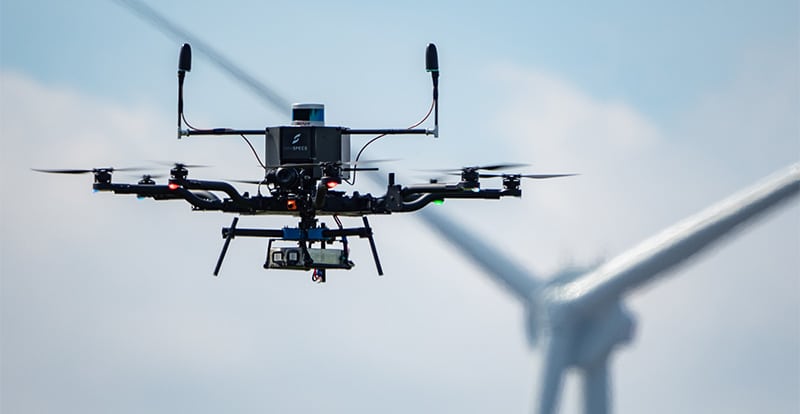
The photograph is the beginning
SkySpecs says a standard autonomous external blade inspection takes about 15 minutes per turbine. That number describes data capture. The more interesting work starts when the images become comparable records: what was damaged, where it was, how severe it appeared, and what changed since the previous visit.
Blade management software, known as Horizon and now marketed as SkySpecs-Blade, gives those observations a place to live. Internal damage requires another instrument: SkyCrawler, a rover carrying imaging equipment and LiDAR inside the blade. An external photograph cannot offer the same view. Different questions need different machines.
with rope access
with SkySpecs
EDF UK’s Teesside testimonial. A reported site result, not a universal productivity or savings guarantee.
EDF UK supplies a vivid example. Its published testimonial describes 25 turbine inspections in one day at Teesside, compared with a previous pace of one turbine per day using rope access. You can see why an operator would pay attention. You should also resist turning one field result into a universal cost ratio.
The customer problem is organizational, too. On SkySpecs’ website, MidAmerican Energy project manager Mark Jeratowski describes intermittent inspections and scattered records that made repair planning difficult. A fleet can possess plenty of photographs and still struggle to arrange a repair campaign. The missing ingredient is a usable history.
- 01InspectCapture the evidence
- 02CompareTrack the change
- 03PrioritizeAllocate the budget
- 04RepairClose the loop
Illustrative workflow, not a measured performance chart.
Follow the next repair dollar
Its acquisitions reveal where SkySpecs thinks that history should lead. In 2021 it bought Vertikal AI, bringing predictive maintenance expertise, and Fincovi, bringing financial asset management. In 2023 it added i4SEE’s turbine analytics. Each widened the view beyond the blade photograph.
Drivetrain monitoring asks about component health. Performance analysis examines operating data. Finance software follows transactions and portfolio reporting. These are related jobs for an owner trying to decide whether to spend money now, postpone work, or investigate further. SkySpecs now markets a Fleet Performance operating system, with offerings extending into solar and other asset categories.
On October 21, 2026, the company announced a Risk Management Module for its blade software. It models the probability of damage worsening over specified periods and applies configurable rules to prioritization and work orders. The commercial proposition is practical: put the forecast where someone can use it to organize work.
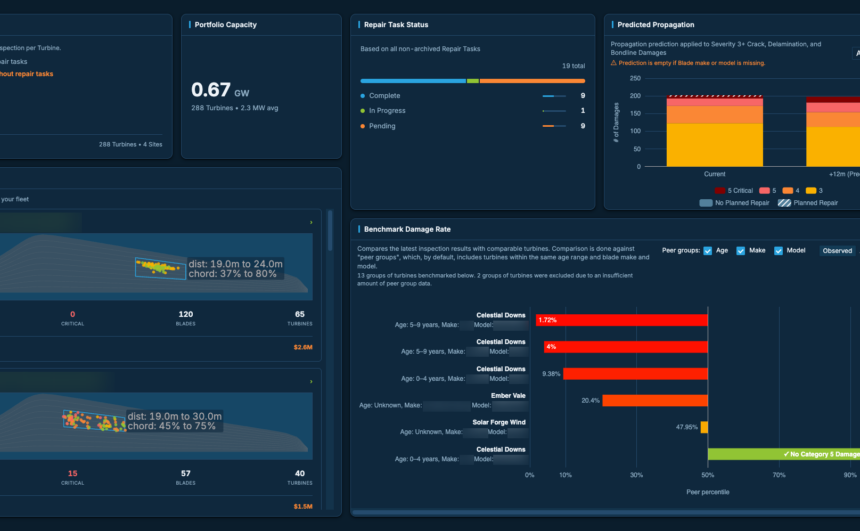
The economics need a human
The business combines software subscriptions with inspections and specialist services. Its performance terms describe recurring fleet optimization, a bounded proof of concept, and separately purchased investigations. Building that range has required capital: Goldman Sachs led an $80 million investment in 2022, followed by $20 million in growth funding in March 2025. Those are financing figures, not customer prices.
SkySpecs operates among capable alternatives. Clobotics also offers autonomous blade inspection and an analysis portal. ONYX Insight’s Cortex connects monitoring, analytics, and maintenance workflows. SkySpecs’ positioning rests on the combination of field operations, accumulated inspection records, engineering, and financial capabilities. A drone alone is an increasingly incomplete explanation of the business.
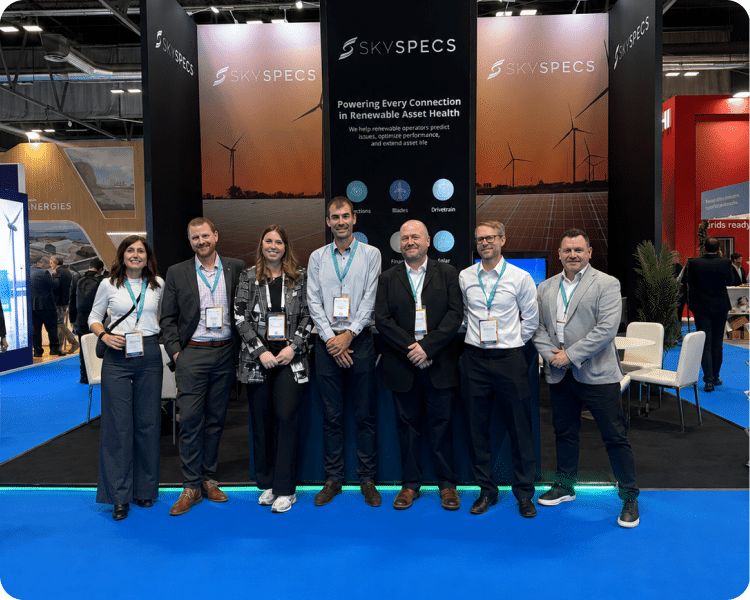
The people matter. Rich Katz became CEO in April 2025. The company’s published working principles include curiosity, generosity, and the 80/20 rule. That last principle fits its early history: spending less effort perfecting every component can leave more effort for the customer’s actual problem.
There are limits. External imagery cannot answer every internal structural question. Performance analysis needs suitable operating data; SkySpecs’ terms explicitly allow inconclusive upgrade assessments when the available operating conditions are insufficient. Repair work is outside that particular performance-services scope. A prediction still needs an owner, a budget, and execution.
That is the part another business can copy. Make observations consistent. Preserve their history. Connect them to a decision somebody owns. Then check whether the work happened. The flying robot earns its keep when somebody on the ground knows what to do next.