A stolen laptop is an expensive nuisance. A stolen laptop full of a technology company’s research is a rather more interesting problem. At Intel, Siva Narendra began wondering why a computer could not require something like a car key. Take away the key, and the machine should become useless to whoever had walked off with it. It was a neat engineering proposition. Finding the business inside it would take considerably more work.
In 2004, Narendra brought the idea to Prabhakar Tadepalli, who had already started a company. Tadepalli questioned its commercial prospects and suggested talking to someone who understood insurance. Tom Spitzer became the third founder. Their discussions carried the venture toward payment security, then mobile wallets. Tyfone had begun, although its eventual customers would help decide what, precisely, it ought to become.
That is an appealing place to begin his story: an inventor with a solution, discovering that the problem might move. Today, Narendra is Tyfone’s co-founder and CEO, based in Portland, Oregon. His working life connects silicon research, digital identity, payments and the decidedly human business of persuading people to trust a financial institution.
The artist takes an engineering degree
Before the patents came the drawings. Growing up in India, the youngest of six children, Narendra wanted to be an artist. His siblings offered a less romantic assessment of the likely income. Doodling at school earned him punishment outside the classroom, furnishing a family joke about being an outstanding student. He had, quite literally, been sent out standing.
His father, a linguistics professor and freedom fighter, continued writing and researching after retiring in his eighties. Narendra credits his mother with teaching him how to learn. Education followed him from Government College of Technology in Coimbatore to a master’s degree at Syracuse University and a doctorate in electrical engineering and computer science at MIT. MIT lists him among its 2002 alumni in the Energy-Efficient Circuits and Systems Group.
The drawings and the doctorate make an agreeable pairing. Both begin with putting an idea into a form that someone else can examine. In Narendra’s case, engineering provided a profession for that impulse, and eventually a much larger audience than a schoolteacher inspecting the wrong page of a notebook.
A career spent below the screen
His early professional world was far removed from banking interfaces. At Intel Laboratories, his research concerned low-voltage analog and digital circuits. A 2002 conference biography also records an adjunct faculty role at Oregon State University. These were questions about how computing worked underneath the applications: the electrical behavior on which a seemingly effortless digital experience depends.
He later became a senior staff scientist in Intel’s Corporate Technology Group. His contributions there led to 75 issued patents. Across his career, his published work includes more than 60 peer-reviewed papers. Those numbers give some scale to the technical background he brought into entrepreneurship. They also help explain why a discussion about a banking app can send him back to the behavior of a physical system.
“I’m a pocket protector wearing geek who learned how to wear pocket squares.”
Siva Narendra, as quoted by Josh DeTar
On the Digital Banking Podcast, Narendra recalled debugging research systems and finding, again and again, that the trouble lay with the power supply. The lesson he drew concerned assumptions: people knew power mattered, yet could proceed as though somebody else had already dealt with it. In financial services, he argued, taking a basic dependency for granted can have serious consequences for the people using the system.
It is a practical way to bring an engineering education into a boardroom. Before debating the attractive feature on the screen, ask what must keep working underneath it. The question is less glamorous than a product launch. It is also a useful defense against launching something that only works while everyone is watching.
The customer edits the invention
Tyfone’s move toward banking involved a welcome interruption. Margarete Mucker at Star One Credit Union wanted mobile banking rather than a mobile wallet. The company adjusted. Over time it moved from mobile banking toward digital banking across channels. The important decision was to let a customer’s immediate need change the shape of the product.
Star One became an enduring connection in Tyfone’s story. Community institutions offered a specific challenge: their members could value the relationship while expecting the convenience they encountered elsewhere. A credit union could know someone well and still lose their patience with an awkward digital experience. Familiarity did not excuse the extra clicks.
Narendra has served as CEO since 2011. Tyfone identifies its early work with organizations including Google, First Data and the Department of Defense, centered on securing digital identity for transactions. That range of settings makes the eventual focus on community banking more interesting. The underlying security question traveled; the customer and the everyday use changed.
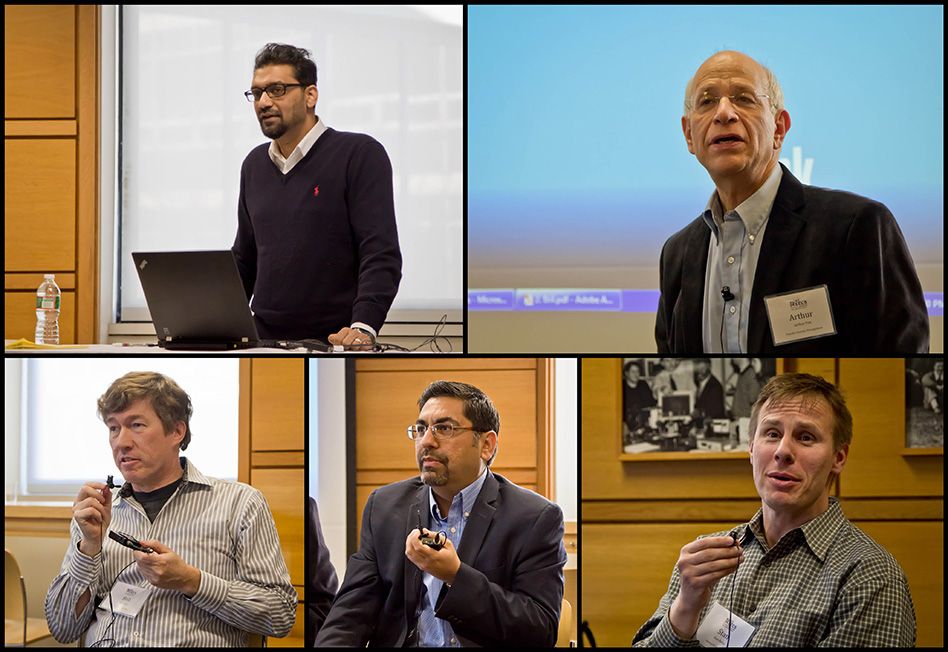
At MIT’s Start6 program in January 2014, he moderated a panel on funding strategies. The workshop taught engineering students the practical matters of starting companies, from financing to dividing equity. His panel brought together experience in venture capital, angel investment and company building. For a researcher who had entered business with a laptop-security idea, it was an apt subject to help unpack.
Seven minutes. Red shoes.
By June 2018, there was another problem to solve: being remembered. Narendra and Josh DeTar were preparing a seven-minute demonstration for American Banker’s Digital Banking conference in Austin. Tyfone had secured a major sponsorship. A roomful of similar-looking sales presentations promised ample opportunity for the audience’s attention to wander.
Erica DeTar, who worked at Nike, suggested red Air Jordans. Narendra and DeTar wore them onstage. The shoes attracted attention, and the idea stuck. Because Jordan designs changed, the company later adopted red Converse All-Stars, which were easier to keep consistent and customize. The red Chucks became a recognizable part of Tyfone’s appearance at events and client meetings.
There is something pleasing about a technology company discovering that its most visible interface is a sneaker. A seven-minute demo can contain a great deal of engineering. An audience still needs something to remember on the walk to lunch. Narendra has kept the original Jordans for special occasions; even the standardized shoe has an ancestor.
What happens after you press send?
Payments brought him back to the machinery underneath an ordinary action. On July 20, 2023, the day FedNow launched, Tyfone and Star One completed a live transaction on the service. For Narendra, the significance went beyond adding a faster button to an app. He saw an opportunity for community institutions to participate in payment infrastructure with different economics.
He described Tyfone’s approach in three layers: transaction processing, fraud controls and the account holder’s experience. The sequence matters. Moving money faster creates demands on the systems that authorize and monitor it. Only then comes the part a customer sees: paying a bill, funding an account or moving money when it is actually needed.
- 01Move the moneySend and receive transactions.
- 02Control the riskBuild fraud controls around the movement.
- 03Make it usefulConnect the infrastructure to everyday tasks.
His concern with digital trust predates the current enthusiasm for AI. In a 2013 essay, he challenged Vint Cerf’s comments about privacy. Narendra argued that technical difficulty should prompt investment in protection. Faster technological change, in his view, increased the responsibility to develop safeguards. The position fits a founder whose original business question concerned what happened when a device reached the wrong hands.
A familiar face can still lose the relationship
Talking with Jim Marous in 2024, Narendra described banking expectations as something consumers bring from other digital experiences. A financial institution does not get to set the comparison entirely for itself. Its app lives on the same device as everything else a person uses. Personalization, convenience and real-time functionality become part of the expectation.
He also raised the difficulty of change itself. An institution can replace its technology and discover that users dislike an unfamiliar experience. Progress on a supplier’s roadmap may feel like an obstacle in a customer’s morning. For someone who studies technological evolution, that is an inconveniently human constraint, and a reason to pay close attention to how a product is experienced.
Recognition followed: Narendra was an American Banker Innovator of the Year finalist in 2024, then won the Tech Leadership - Visionary CEO category at the 2025 Banking Tech Awards USA. Tyfone was also named a 2026 Best Place to Work in Fintech, its third consecutive year of recognition. The company describes a culture built around autonomy, transparency and continuous learning.
The next problem is invisibility
In 2026, Narendra’s five-part series, The Invisible Institution, sharpened the question. What happens when a person gets financial guidance from an AI platform, sees accounts through an aggregator and moves money through an outside wallet? The bank can remain involved in the transaction while becoming less central to the customer’s attention.
His argument gives community institutions work to do. He identifies lending, digital identity, instant payments and personalization as areas requiring deliberate investment. In an August 2026 conversation with Robbie Young, he again emphasized the competition between established institutional trust and the convenience of AI companies. He also discussed why underwriting judgment and physical branches could retain value.
Tyfone’s September 2026 acquisition of ATTUNE extended this thinking into account opening and loan origination. The announced goal was to connect acquiring a customer, opening and funding an account, lending and ongoing digital banking. It is an ambitious scope, rooted in the same question that interrupted the mobile-wallet plan: what does the institution actually need to serve the person?
Narendra’s responsibilities also extend to the Federal Home Loan Bank of Des Moines. Re-elected as an independent director for a term running from January 2026 through December 2029, he brings his technology background into another part of the financial system. His public conversations still leave room for gardening, coffee and the daily commute with his wife.
The problems have grown since the missing laptop. The useful habit is recognizable: examine the assumption, ask the next person, revise the design. A founder can spend years learning how to explain an invention. Narendra’s career suggests that listening carefully to the reply deserves just as much practice.