At Arrowhead Credit Union, opening an account online could require remembering where you lived seven years earlier. Some applicants struggled with the questions. Others met a desktop experience on a mobile screen. Behind the scenes, staff checked information across several systems. The arrangement managed to inconvenience honest people while still admitting fraudsters - a rather expensive form of hospitality.
Then the old provider announced it would discontinue the platform. An upgrade that had lived perpetually on next year’s list acquired a deadline. Arrowhead chose Narmi. Its story captures the company’s opportunity: the relationship with the member was worth keeping; the machinery around it needed work.
- Narmi sells software to banks and credit unions, serving consumers and businesses through those institutions.
- Account opening, daily banking and staff tools share a connected platform.
- Existing core systems stay central to the proposition.
- The useful measure is work completed: applications finished, cases reviewed, payments delivered.
A memory test at the front door
In Narmi’s Arrowhead case study, the credit union reported application completion rising from 40% to roughly 75%. Staff had previously assembled validation information from systems including Symitar, Experian and Google Maps. Narmi integrated Alloy’s identity decisioning, giving reviewers a clearer view of issues within the application workflow.
Customer results reported in Narmi’s case study. A 35-percentage-point increase; individual institutions’ outcomes vary.
The cost of the previous arrangement showed up in repeated checking and staff attention. The change also required a less visible adjustment: trusting automation enough to stop reproducing its work. In a separate customer interview, operations executive Theresa Hainsworth described that learning curve.
“We had to learn to just trust the system.”Theresa Hainsworth • Arrowhead Credit Union
This is a useful distinction for anyone buying enterprise software. A process can be technically automated while employees continue doing it twice. The second copy is often where the promised efficiency disappears.
The founders had sat on the other side
Chris Griffin and Nikhil Lakhanpal’s experience included running Georgetown University’s alumni and student credit union. Later work at large financial institutions broadened their view of the problem. They founded Narmi in 2016 to build technology for institutions whose local importance did not translate into satisfying digital tools.
The choice was unfashionable enough to make fundraising difficult. In a 2022 reflection, Griffin recalled more than 100 venture-capital rejections. Neobanks had glamour. Selling software to established community institutions had integration meetings. Narmi persisted with the latter.
A $20.4 million Series A announced in 2021 was followed by a $35 million Series B in June 2022, co-led by Greycroft, NEA and Picus Capital. That capital supported a business selling digital infrastructure to institutions that already had customers, deposits and reasons to survive.
Keep the core. Repair the journey.
A banking core records the institution’s underlying accounts and transactions. Narmi’s expertise lies in connecting that infrastructure to experiences people can use. Its integration roster includes FIS IBS and Horizon, Fiserv Premier and DNA, Jack Henry Symitar and Silverlake, COCC and Corelation Keystone.
The products follow the customer’s journey. Grow handles consumer, business and staff-led account opening. Banking provides online and mobile services. Command gives employees messaging, application information and administrative controls. Guard addresses fraud; Now brings FedNow instant payments into banking. Open supplies APIs and customization tools.
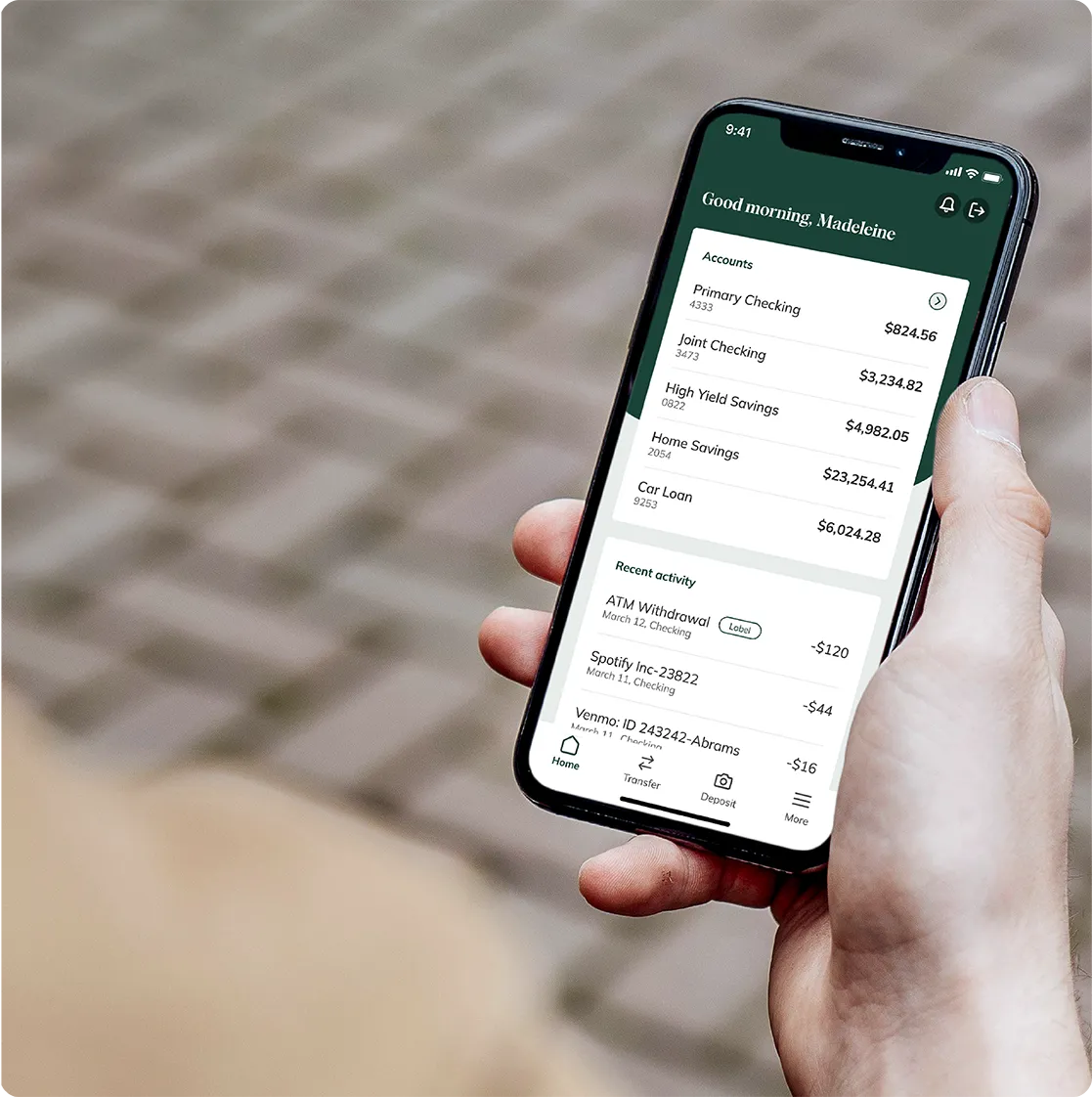
Command’s user emulation lets support staff see a read-only version of what the customer sees. That small design choice changes the conversation: fewer attempts to describe a mysterious screen, more attention to resolving the problem. Its application views also expose status and abandonment information. Managers can inspect where work stalls instead of asking the front-end team for another cosmetic improvement.
A simplified editorial view of the platform, not a technical architecture diagram.
Narmi Lend extends the proposition to embedded, pre-qualified loan offers. Its launch focused on Corelation Keystone and Symitar ELA connectivity, complementing existing loan origination systems. Compatibility remains consequential: an attractive demonstration cannot settle whether the institution’s particular infrastructure and workflows fit.
Someone must maintain the clever thing
Grasshopper Bank considered bringing digital banking development in-house. According to its Narmi case study, weighing development costs and continuing upkeep pushed it toward a partnership model. Internal teams could spend more attention on the client experience while Narmi carried platform development.
That is the commercial logic of Narmi’s B2B SaaS business. Institutions buy software and its continuing evolution. Their customers encounter the resulting banking service. Alternatives include Q2 and Alkami for digital banking, specialist onboarding providers, core-vendor products, and building internally. Narmi’s pitch combines user experience, integration and staff operations; buyers still need to examine each alternative against their own requirements.
Customization matters here. The public design-system repository includes components for building experiences with Narmi’s APIs. The institution can extend a shared platform rather than treating every feature request as a private construction project.
Delivery is another test. Narmi reported 50 solutions delivered for 24 distinct institutions in 2025, with fourth-quarter implementations spanning eight core providers. Those figures describe project activity rather than its entire customer base, but they show why repeatable integration is a commercial asset.
The unglamorous AI test
At First Citizens’ Federal Credit Union, staff receiving Portuguese or Spanish messages had relied on translation tools or bilingual colleagues. They found another use for Narmi’s AI Secure Messages: translating incoming messages and helping compose replies inside the existing workflow. Staff review remained part of the process.
Narmi’s September 2026 AI Marketplace announcement gathers tools for application review, messaging, marketing and financial analysis. Its AI product page describes human approval checkpoints and audit trails. The MCP server is read-only: assistants can analyze banking data but cannot initiate transactions. Those boundaries belong in the buying conversation as much as the demonstration.
A faster payment needs an earlier decision
In September 2026, Narmi also announced a GrailPay partnership for checking linked-account payment risk before money moves. Speed compresses the time available to catch trouble. Putting the assessment into the workflow makes the placement of the decision as important as the speed of the rail.
The practical lesson travels beyond banking. Identify the step where customers abandon the process, then follow the work into the back office. Ask who checks it, which systems they open, and what they repeat. Narmi’s case becomes persuasive when that chain grows shorter. A beautiful screen is pleasant company. A finished task gives people a reason to return.
Go inside the machinery
Explore Narmi, the developer portal, product updates and company essays. Watch Chris Griffin’s MCP interview or explore the AI product walkthroughs.