The question that helped redirect Tyfone was almost impolite in its simplicity. Why build a mobile wallet when a credit union needed mobile banking? An inventor can spend years perfecting an answer. A customer can dispose of the question in a sentence.
- Tyfone supplies digital banking software to credit unions and community banks.
- Its nFinia platform serves account holders and the employees supporting them.
- Payments and loan tools can work alongside other banking platforms.
- Its latest expansion connects account opening, lending and conversational AI.
The customer had a better problem
In 2004, Siva Narendra was thinking about stolen laptops and the corporate data inside them. He had worked at Intel. His idea was a digital equivalent of a car key: without it, the laptop would not operate. Prabhakar Tadepalli questioned its commercial viability. Tom Spitzer joined the founding effort. Their attention shifted toward physical security for payments, then mobile wallets.
Community financial institutions supplied the correction. In Tyfone’s account of its early years, Narendra recalls Star One Credit Union’s Margarete Mucker asking, “why are you doing mobile wallets? We need a mobile banking solution”. Tyfone followed the demand into mobile banking, then into banking across devices and channels. The security expertise travelled with it.
The useful detail is the continuity beneath those changes. Protecting a stolen laptop and letting someone safely move money are different commercial jobs. Both require confidence in who is using the device. Tyfone changed the application of its knowledge. That is a more interesting founder story than a procession of supposedly inevitable successes.

Today, Tyfone describes its purpose through digital banking, useful experiences and customer relationships. Its buyers are institutions with their own brands and account holders. The company supplies the machinery for the relationship: online and mobile banking, payment workflows and the tools employees need to keep those services working.
The screen has a back room
A consumer sees balances, transfers and a card that can be locked when it disappears. A business sees cash management, payment approvals and permissions. A support employee sees the person who cannot get any of it to work. All three are users of the same banking service, even if only two appear in the advertising.
nFinia’s retail offering covers ordinary banking tasks and connections to outside services. Tyfone lists more than 300 native financial functions and over 200 partner integrations. Those are company counts, useful as a description of breadth rather than a scoreboard. A feature earns its place when somebody can finish a task with it.
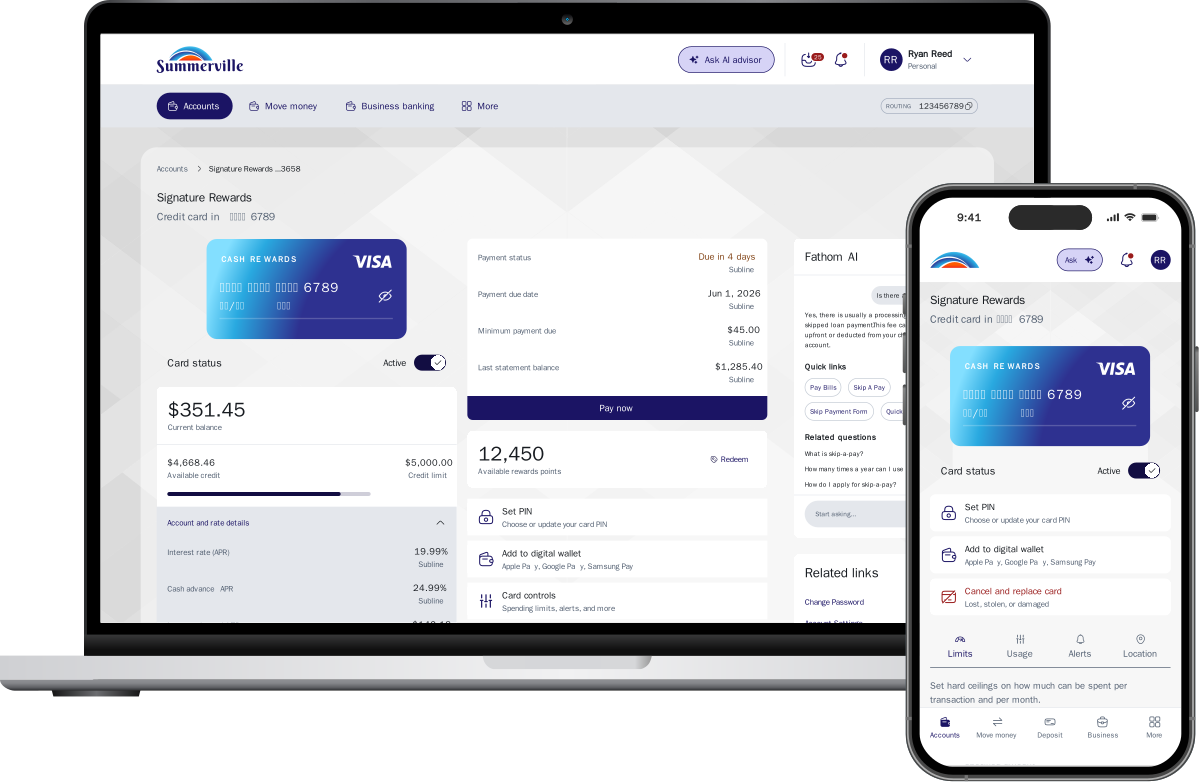
For business banking, the complexity changes. Multiple businesses may sit behind one login. Employees need different permissions. ACH and wire activity needs controls and approvals. A pleasant balance screen is only the beginning; the software must accommodate who is allowed to do what with whose money.
Harmoney, the included management console, handles the institutional side. Staff can find users, review activity and work with reporting and configuration tools. Its presence makes Tyfone’s argument more concrete: the customer experience includes the employee’s ability to solve the problem after the customer has given up trying.
Emprise Bank offers a useful example. In Tyfone’s published case study, the bank began looking for a replacement in 2021 because its existing platform limited new features. The subsequent nFinia story reports a 30% reduction in call-center volume and financial-tool engagement rising from 19.2% to 56%. These are reported results from a particular bank, with its own implementation and customers.
More use. Fewer calls.
Financial-tool engagement. Bars share a 0-100% scale.
Figures from the Emprise customer case study; outcomes depend on the institution.
There is a sensible buying lesson here. Count what customers complete and what staff no longer have to explain. A beautifully animated app that merely relocates confusion to the telephone has moved the furniture without improving the room.
A payment is also a policy
Tyfone’s payment products deal with jobs that are easy to describe and awkward to administer. Quick Pay lets someone repay a loan without a digital banking login, using methods including cards, ACH, eCheck, internal accounts and PayPal. For a borrower whose immediate intention is simply to pay, that shorter route has an obvious appeal.
Skip-A-Pay automates eligible loan-payment deferrals. The institution sets the rules; the member gets a self-service process. Skip fees can generate income for the credit union, so the product carries two perspectives at once: a borrower wants breathing room, and an institution wants a manageable service. Automating the request does not remove the need to understand its terms.
In March 2026, Tyfone announced Loanovia, a dedicated loan servicing and payments unit. Its suite includes Quick Pay, Skip-A-Pay and Collect, which organizes collections outreach, payments and reporting. The announcement described more than 80 deployed applications across credit unions. Applications are deployments, not necessarily 80 separate institutions.
Instant Payment Xchange connects institutions’ core systems to FedNow. Moving money quickly also requires deciding when movement should slow down. The gateway describes dollar and velocity limits, trusted-device initiation and cooling-off periods. A payment’s speed and its safeguards belong in the same product conversation.
Conceptual workflow, not a technical network diagram.
Star One helped co-develop an embedded instant-payment experience. Tyfone subsequently established Payfinia as a separate payments entity in October 2024. The pattern is familiar from its beginnings: work with an institution on a concrete problem, then give the resulting capability a wider commercial life.
Buying the beginning of the relationship
The expansion also has a financial history. A reported $6.6 million Series C in 2015 included RPX and In-Q-Tel. In April 2023, a Demopolis investment accompanied a merger with Cubus Solutions. The combined business retained the Tyfone name and brought Cubus’s loan-payment tools into the portfolio. CB Insights reports the Demopolis transaction at $25 million; the public deal announcement describes a significant investment.
That capital figure is financing, not the price a bank pays to install nFinia. Tyfone sells to institutions through a B2B cloud-software model. For a prospective buyer, the meaningful cost calculation includes the selected products, integration work, conversion and continuing operation. The brochure’s feature count cannot perform that calculation.
September 2026 brought another extension: the acquisition of ATTUNE, adding technology for account opening, deposit funding and loan origination. This moves Tyfone earlier in the customer journey. Before an account holder can enjoy the banking app, somebody has to become an account holder.
Tyfone says ATTUNE’s solutions can operate alongside existing core and digital banking systems. That flexibility matters to its positioning. Comparable alternatives include Q2, Alkami and Jack Henry. Tyfone’s case rests on configurable software, integration choice and close collaboration. Buyers still need to examine their particular core, commercial workflows and migration capacity.
The conversation moves inside
The latest product wager concerns where people ask financial questions. Tyfone’s August 2026 announcement of nFinia Reimagined introduced Fathom as native AI intelligence. It named iTHINK Financial as the first customer expected to launch Fathom that fall. A planned launch should be judged as a planned launch; its usefulness will become clearer in actual customer use.
Fathom’s proposed experience combines an institution’s knowledge with account information and banking actions. Users can ask questions, explore spending and move toward an action inside the conversation. The institution gets tools to supply content and monitor questions. The commercial ambition is to keep the bank present when an account holder wants an explanation, rather than merely when money moves.
This requires more than fluent answers. Tyfone describes institution-isolated data, auditable interactions and consent for transactions. Its broader security approach includes device authentication and configurable levels of assurance. Institutional content, permissions and review processes must work together. A conversation becomes consequential the moment it can touch an account.
September partnership announcements add more pieces: Array’s financial security tools and Eltropy’s authenticated support channels. Their significance is practical. Advice, assistance and banking increasingly occupy the same screen. Each added service must make that screen easier to use.
The shoes were the easy part
Tyfone has a rather visible answer to the problem of being remembered. Before a 2018 conference demo, Josh DeTar warned Narendra, “Nobody is going to remember what we said”. Erica DeTar suggested red Air Jordans. The team later adopted red Converse All-Stars because their design was consistent and they were easy to customize. The red-shoe tradition became a shared identity at customer visits and events.
Keep the expertise. Let the customer change the question.An editorial reading of Tyfone’s early pivots
The shoes make an introduction easier. The more transferable habit is less photogenic: Tyfone says it holds weekly calls with every client and quarterly group calls. That recurring contact gives its relationship language an observable practice. Another company can copy the cadence without buying a single pair of Converse.
For a community institution, the attraction is access to digital capabilities while preserving its own account-holder relationship. The fit depends on compatible systems, a workable conversion and staff prepared to govern the new tools. Tyfone’s story began when a customer improved the question. Its next chapter will depend on whether customers can keep doing so.