The most important technology in your bank is the technology you never notice. A deposit lands. A debit card clears. A suspicious transfer stops. A teller finds the right account before the line grows restless. For thousands of American community banks and credit unions, some part of that choreography runs through Jack Henry, a company born in Monett, Missouri, in 1976 and still headquartered there. The logo rarely faces consumers. The software does.
Jack Henry & Associates serves approximately 7,400 banks, credit unions, and other organizations. Its fiscal 2025 revenue reached $2.375 billion, split between $1.36 billion in services and support and $1.01 billion in processing. Those categories sound dry because they are descriptions of plumbing: host the system, maintain it, move the transaction, solve the exception, repeat tomorrow. Yet this plumbing controls whether a local financial institution can give its customers the speed of a national bank without inheriting the national bank's budget.
A borrowed computer, then a system of record
The origin story belongs to an era when “fintech” was not a category. Jack Henry managed data processing at Gillioz Bank & Trust. Jerry Hall did similar work for a shoe company. Henry had tried one of the few software packages available to banks and found it inadequate. Smaller institutions could not afford in-house computers, so many sent their processing elsewhere. The gap was obvious during drives the two men took to meetings in Springfield.
They wrote their plan on the back of a napkin, rented space above an engine repair shop for $40 a month, and borrowed a computer. The company opened on June 2, 1976. It incorporated the next year and generated $115,222 in revenue. The ingredients were modest; the problem was not. Banks needed reliable ledgers and processing systems, and those systems would become more valuable as customers accumulated history and employees built procedures around them.
“Business is about people.”Jerry Hall, co-founder
That line survives because it doubles as product strategy. Jack Henry does not mainly sell to technology companies. It sells to regulated institutions whose customers call when payroll disappears or a card stops working. Reliability, service, and the ability to answer a human being are not soft benefits in that setting. They are part of the product.
The stack beneath the banking app
A core banking platform is a financial institution's system of record. It keeps account balances, posts transactions, calculates interest, and feeds many of the other services a bank offers. Jack Henry's core families include SilverLake for banks and Symitar for credit unions, alongside Core Director and CIF 20/20. The company acquired Symitar in 2000, a move that gave it a durable position in the credit-union market.
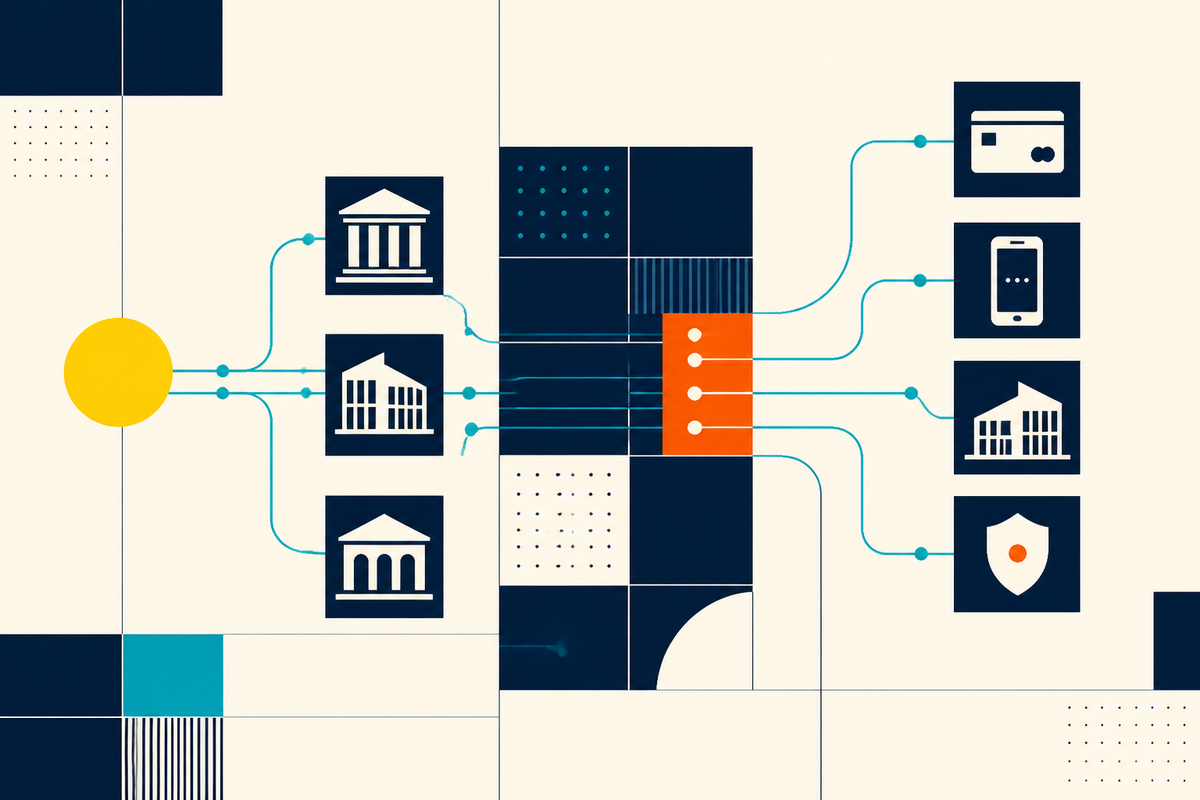
Around those cores sits a much wider catalog. Banno provides the digital front door: consumer and business banking, conversations, account opening, analytics, marketing, and card controls. Payments products handle cards, bills, ACH, wires, checks, remote deposits, and instant networks including FedNow, RTP, and Zelle. Lending and operational systems cover origination, servicing, documents, reporting, and workflow. Financial Crimes Defender brings fraud monitoring, anti-money-laundering checks, case management, and regulatory reporting into a cloud platform.
The practical effect is leverage. A credit union with a few branches can offer a polished mobile app, faster payments, fraud detection, and digital account opening without building each capability from scratch. Staff can automate repetitive back-office work. Customers can deposit checks or talk to an employee from a phone. Small businesses can accept a contactless payment and reconcile it with accounting software. The institution purchases a shared technology base, then configures the customer experience around its own market.
The moat is a migration nobody wants to botch
Jack Henry competes with Fiserv, FIS, CSI, Q2, Alkami, Corelation, and a long tail of specialized vendors. Its advantage begins with focus. Community and regional institutions are not a side market; they are the organizing idea. The company combines cores, payments, and digital banking while giving customers ways to connect outside fintech products through open APIs.
That openness matters because no vendor can build every useful financial tool. A bank may want a specialist for loan decisions, identity verification, wealth management, or payment disputes. A closed suite forces it to accept the incumbent's answer or endure a difficult integration. Jack Henry's pitch is that the core can remain dependable while the edges stay modular. Its ecosystem makes outside innovators complements instead of automatic threats.
The other advantage is less fashionable: switching costs. Replacing a core affects data, controls, integrations, staff training, customer communications, and regulatory oversight. A migration can create new capability, but it also creates risk. That makes trust cumulative. The more reliably a platform runs, the harder it is for a rival's feature list to dislodge it. Jack Henry then expands the relationship through hosting, payments, digital modules, and professional services.
Hosted core and complementary systems produce contracted, repeatable service revenue.
Cards, payments, digital activity, and processing grow as customers use the rails.
Licenses, implementation, conversions, consulting, and hardware support change.
Core relationships open the door to digital, payments, fraud, and operating tools.
Modernization without the cliff jump
The strategic tension is simple. Jack Henry benefits from systems that are difficult to replace, but its customers cannot remain on yesterday's architecture. Consumers compare every bank app with the best app on their phone. Fraud moves in real time. Fintechs pull payment activity and deposits away from primary accounts. Artificial intelligence is only as useful as the data it can safely reach.
The company is responding with a staged cloud strategy rather than a single forced migration. Its public-cloud Jack Henry Platform is designed around shared services and open connections, while established cores can continue in private-cloud or on-premise arrangements. Newer products show how the transition works at the edges. Financial Crimes Defender can monitor transactions across Jack Henry and third-party systems. Payments Orchestrator embeds ACH, instant payments, wires, and virtual accounts into outside workflows.
Tap2Local, developed with Moov, lets small businesses accept contactless payments through a phone and receive the service from their bank or credit union. Rapid Transfers uses integrations with Visa Direct and Mastercard Move so customers can pull money from eligible external accounts, brokerages, digital wallets, or crypto exchanges into their primary institution. The distribution choice is the point: Jack Henry wants the local bank to keep the relationship that a standalone payments app might otherwise capture.
The company is not asking a community bank to become a software factory. It is trying to make the bank a better assembler.The open-platform wager
Partnership is therefore part of the product roadmap. Google Cloud has worked with Jack Henry since 2022; in June 2026 the companies expanded their relationship around agentic security tools and a purpose-built AI defense platform. Moov supplies modern payment processing. Visa and Mastercard provide debit rails. Feedzai contributes fraud and anti-money-laundering technology. Each partner adds speed or specialization while Jack Henry supplies distribution, integration, and the institutional context.
A market defined by the institutions it preserves
Jack Henry sits between global financial infrastructure and local relationship banking. It is larger and broader than a point-solution fintech, but more focused on smaller U.S. institutions than the biggest processing conglomerates. Its customers occupy an awkward middle: large enough to need modern, resilient technology, yet often too small to build it alone. They must satisfy the same consumer expectations and regulatory demands as national banks while defending a business built on local knowledge.
The company's 2026 Strategy Benchmark captured that pressure. Leaders ranked operational efficiency, deposit growth, and new payment capabilities among their priorities, while planned technology investment leaned toward AI, digital banking, and data analytics. Jack Henry has products in each category, but owning the menu is not enough. It must modernize quickly, keep integrations genuinely open, and protect service quality while a nearly 50-year-old installed base changes underneath it.
There is no clean finish line. Banking infrastructure is a relay of old obligations and new expectations. The ledger still has to balance while a customer opens an account in seconds. The fraud model must get sharper without blocking legitimate money. The cloud must feel flexible to developers and boring to auditors. Jack Henry's position is strongest when it can make those contradictions ordinary.
The company will never be the name on most people's debit cards. That obscurity is almost a measure of success. If the local bank's app opens, the payment arrives, and a suspicious transfer does not, the machinery disappears. Somewhere in Monett, a business that started above an engine repair shop earns another quiet transaction.