The most expensive word in a bank transfer may be wait. A merchant can watch a customer approve a payment and still wonder whether the funds will arrive. That delay matters if the merchant must ship a $10,000 item, issue a ticket for tonight, or credit a player’s account now. Link Money, the San Francisco company founded by Eric Shoykhet and Edward Lando, built its business around this uncomfortable interval between permission and certainty.
↘
- Customers pay directly from a bank account; merchants avoid card-network interchange.
- Link Money says it guarantees eligible payments that its system authorizes, including some later returned for insufficient funds.
- The same platform now handles payment links, account checks, fraud signals and payouts.
The obvious pitch is price. Link Money markets Pay by Bank as a way to cut total payment costs, claiming savings of more than 70% against some existing arrangements. Yet price is only half a merchant’s calculation. A cheap payment that fails after fulfillment is expensive indeed. Link Money’s sharper proposition is to make a direct bank payment feel decisive at checkout: authenticate the customer, examine the risk, authorize the transfer, then stand behind qualifying approvals.
A receipt before the money
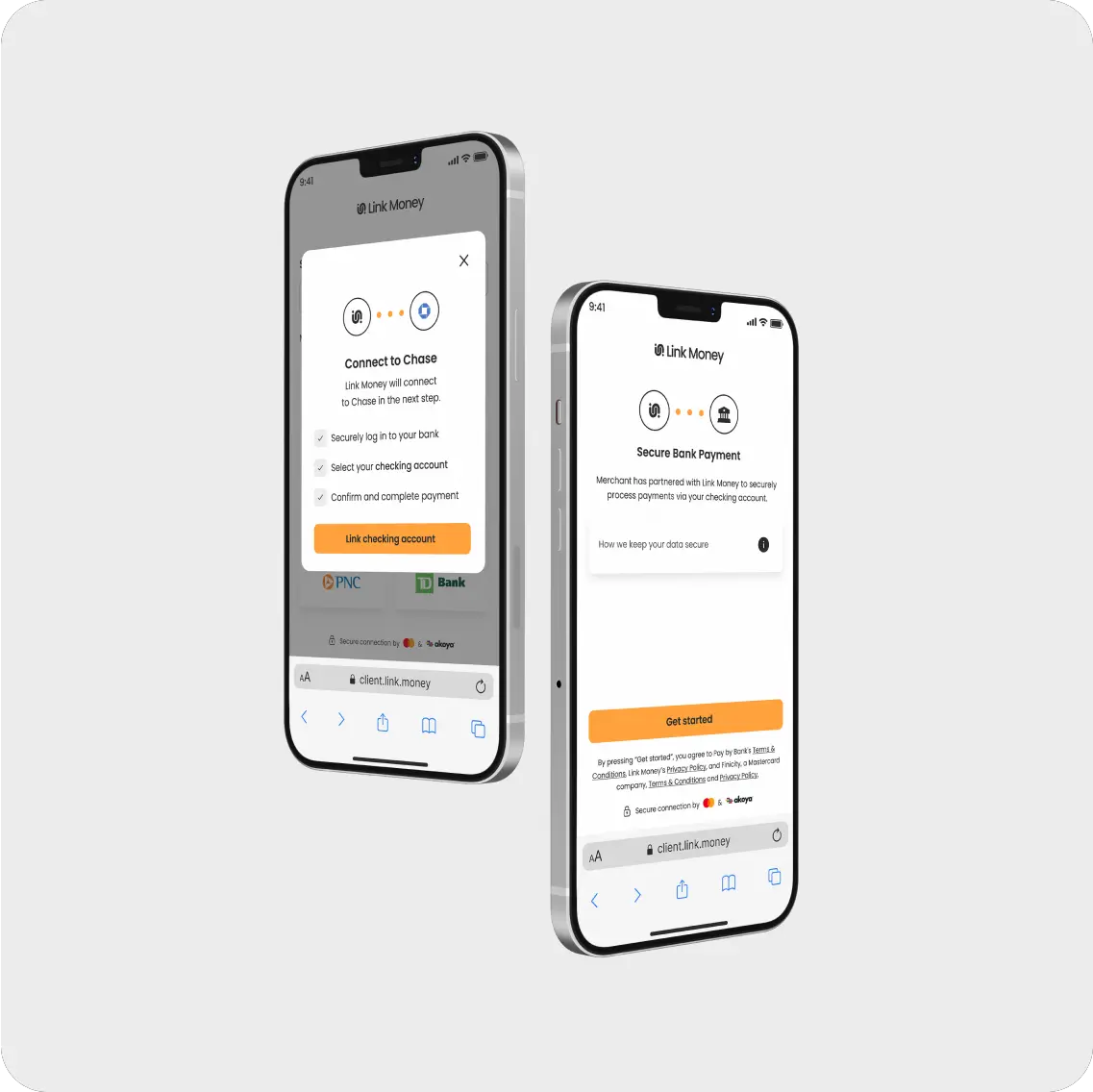
For the customer, the process is deliberately ordinary. At a participating merchant, they choose Pay by Bank, connect to their bank, select an account and approve the payment. They do not enter card numbers into the merchant’s checkout. Underneath that short journey are bank connections, account data and a decision engine judging whether the transaction should proceed. Link Money says its connections reach 95% of U.S. bank accounts through more than 4,500 banks.
The guarantee has a boundary worth reading. Link Money says that when it authorizes an eligible payment, the merchant’s funds are guaranteed even if the debit later returns for insufficient funds. That is a product promise with conditions, not a blanket statement about every transfer. It is also the reason the risk engine matters: approving more payments recklessly would make the promise costly to keep.
The first problem was easy to count
The company announced $30 million in funding in January 2023: a $10 million seed round led by Tiger Global and a $20 million Series A led by Valar Ventures. At that point it was pitching LinkPay, the earlier name for its flagship bank-payment product, as a way to save merchants as much as 70% on processing fees. Savings can be persuasive, particularly on high-value transactions, where a percentage fee grows into a conspicuous line item.

A Link Money case study of an unnamed marketplace illustrates the arithmetic. The company says the merchant saved $3.3 million after adding Pay by Bank. Its shoppers bought items averaging in the low hundreds of dollars, with some purchases above $10,000. The merchant wanted lower fees, but also a route for larger payments and fewer fraud costs. This is a company-reported outcome from a particular customer, not a universal saving to pencil into every checkout forecast.
The more surprising example happened at a physical counter. In a joint study with a Central California dental-practice operator, staff sent Dynamic Links by text or email so patients could pay from their bank accounts. After six months, the practice reported that cards, cash and Pay by Bank each accounted for roughly a third of revenue. Overall payment-processing costs fell 37.5%. A URL, in that setting, became a kind of card terminal without the card.
Then the fraud arrived
Link Money’s early focus on software subscriptions came with comparatively low fraud, according to a case study published by its risk partner Sift. Demand soon appeared in ticketing, travel, events and gaming, where individual transactions could top $20,000. A low fee could win the meeting; a convincing answer to stolen accounts and coordinated fraud had to win the contract. The company began using Sift’s network signals alongside its own payment decisions to spot patterns across bank accounts, devices, IP addresses and user behavior.
“The Sift Score API has been a game-changer for us.”Eric Shoykhet, Link Money co-founder and CEO, in Sift’s case study
Sift reports that Link Money stopped $3 million in verified fraud attempts for one ticketing merchant within a year. It also says fraud volume at another newly onboarded merchant fell 90% in six weeks after an initial wave. The second figure is especially instructive: a new merchant’s customers did not look like the old merchant’s customers. The model had to learn their patterns quickly. Link Money sells an authorization decision, so it must keep updating what an acceptable risk looks like.
That lesson appears in the product catalog. AccountVerify checks whether an account is active and owned by the customer. Indicators exposes risk and fraud signals to a merchant’s own systems. Dynamic Links lets a business request payment without an engineering integration. The merchant can use the full checkout product or select the pieces that fit its existing operations. Link Money’s published industry profile describes transaction pricing as a cents-plus-basis-points model; current contract prices are not public.
A bank connection should work both ways
In April 2025, Link Money launched Instant Payouts. Merchants could send winnings, refunds, seller proceeds or other disbursements through the same API used for incoming payments. The company says it routes eligible instant transfers over The Clearing House’s RTP network and uses same-day ACH when RTP is unavailable. Product chief Rohit Mehtani described the operating trick simply: reverse the source and destination accounts in the API while Link Money handles the routing.
That two-way design made gaming a conspicuous 2025 customer category. Sweepium announced instant bank deposits and real-time payouts; SpinQuest announced bank payments and redemptions; Epick Fantasy and Fyntek announced integrations for fantasy-sports and gaming payments. The point is practical rather than glamorous. A player who deposits instantly may reasonably expect a win to arrive just as quickly. A platform does not want a separate vendor and a second account-linking ritual for the trip home.
The underlying banking work is less visible. In 2024, Silicon Valley Bank announced that it would handle ACH processing and money movement on behalf of Link Money’s merchants. The company also partnered with ticketing platform Anchor. These relationships place Link Money between banks, merchants and customers, trying to make a fragmented set of rails appear like one clear checkout decision.
There are limits. A customer needs a supported U.S. bank account and must be willing to connect it. A merchant needs enough eligible payments for the guarantee to matter. Card rewards, credit and familiar dispute rights may still be preferable for some buyers. Those conditions do not diminish Link Money’s idea; they clarify its market. It is building payment infrastructure for merchants who can turn lower fees, better risk decisions and faster money movement into a measurable operating advantage.
The company’s cleverest move may be linguistic. “Pay by Bank” describes the action. “Guaranteed ACH with instant authorization,” its current homepage language, describes the relief. The former asks customers to try a new button. The latter tells a merchant why it can finally press ship.