Banking software is easiest to understand when the deadline cannot move. In December 2024, BNK Finance Kazakhstan was still a microfinance organization. It wanted to become a bank, and the software underneath that new institution had to be ready the moment the regulator approved its license. Colvir Software Solutions had five months to install a full core banking system, migrate data and reconcile the working habits of Kazakhstan with the requirements of BNK's South Korean parent. There was no ceremonial “phase zero” and no room for a soft opening. On June 26, 2025, the license arrived. The system went live with it.
The interesting part was what the team declined to do. Colvir and BNK kept customization to a minimum and concentrated on standard, mission-critical functions. That decision produced the fastest core launch in Colvir's history. It also makes a useful introduction to a company that has spent a quarter-century arguing that configurable banking software can absorb local complexity without turning every deployment into an archaeological dig through custom code.
The software beneath the banking app
Colvir is incorporated in London, but its center of gravity is Central Asia. It builds the systems that sit behind the polished mobile screen: customer records, ledgers, deposits, loans, payments, financial accounting, anti-money-laundering controls, regulatory reports and the innumerable permissions that determine who may approve what. The company says its core platform contains more than 100 modules and can automate up to 80 percent of manual data handling. A bank buys the pieces it needs, connects them through Colvir's service bus and configures products, reports and workflows around local rules.
The portfolio keeps expanding outward. Treasury handles foreign exchange, money markets, securities, derivatives, brokerage, custody, liquidity and limits. Separate internet and mobile products serve consumers and companies. ERP covers payroll, procurement, contracts and assets. A data warehouse holds management and regulatory information. An ISO 20022 layer translates the richer language now used for financial messages. Then there is the charming outlier: a postal system for sorting, dispatch, financial services and public-service delivery. Colvir entered that business in 2003 after winning a Kazpost tender, proving that the distance between a mailbag and a bank ledger can be shorter than it looks.
CORE
Its moat is a map of exceptions
On a global tender list, Colvir meets familiar names: Temenos, Oracle FLEXCUBE, Finastra, Infosys Finacle, Thought Machine and Mambu. Colvir's advantage is less cinematic. It knows the integrations, regulatory forms, languages and operational exceptions of markets that can look peripheral from London or New York. The company says more than half of Kazakhstan's banks run its core. Its customer roster includes Bank CenterCredit, Halyk Bank, ForteBank, Freedom Bank, Nurbank, Eurasian Development Bank, Azerpost and Kazpost, along with institutions in Uzbekistan, Turkmenistan, Azerbaijan, Tajikistan and Georgia.
That concentration creates a loop. Each implementation deepens local knowledge; that knowledge reduces risk for the next institution. In early 2025, Kazakhstan became the first Central Asian country to adopt ISO 20022 across its payment system. Thirteen institutions chose Colvir's migration solution. The work involved system changes, integration, testing, staff training and round-the-clock support. The standard was international. The migration was emphatically local.
“We chose a strategy focused on delivering standard functionality with minimal customization.”Sergey Sinelnikov, Colvir implementation project manager
The business model follows the architecture. Colvir licenses a kernel, mandatory foundations such as the general ledger, customer accounting, payments and security, and then optional modules and integration services. Most license costs depend on the number of people using the software during a calendar day. Implementation, migration, support, training and country-specific regulatory work sit around that base. There is no public current price list. One old procurement marker gives scale, not a quote: a 2017 National Bank of Pakistan evaluation listed Colvir's bid for an Afghanistan core-banking project at $1.48 million. A contemporary price could vary radically with users, modules, integrations and migration.
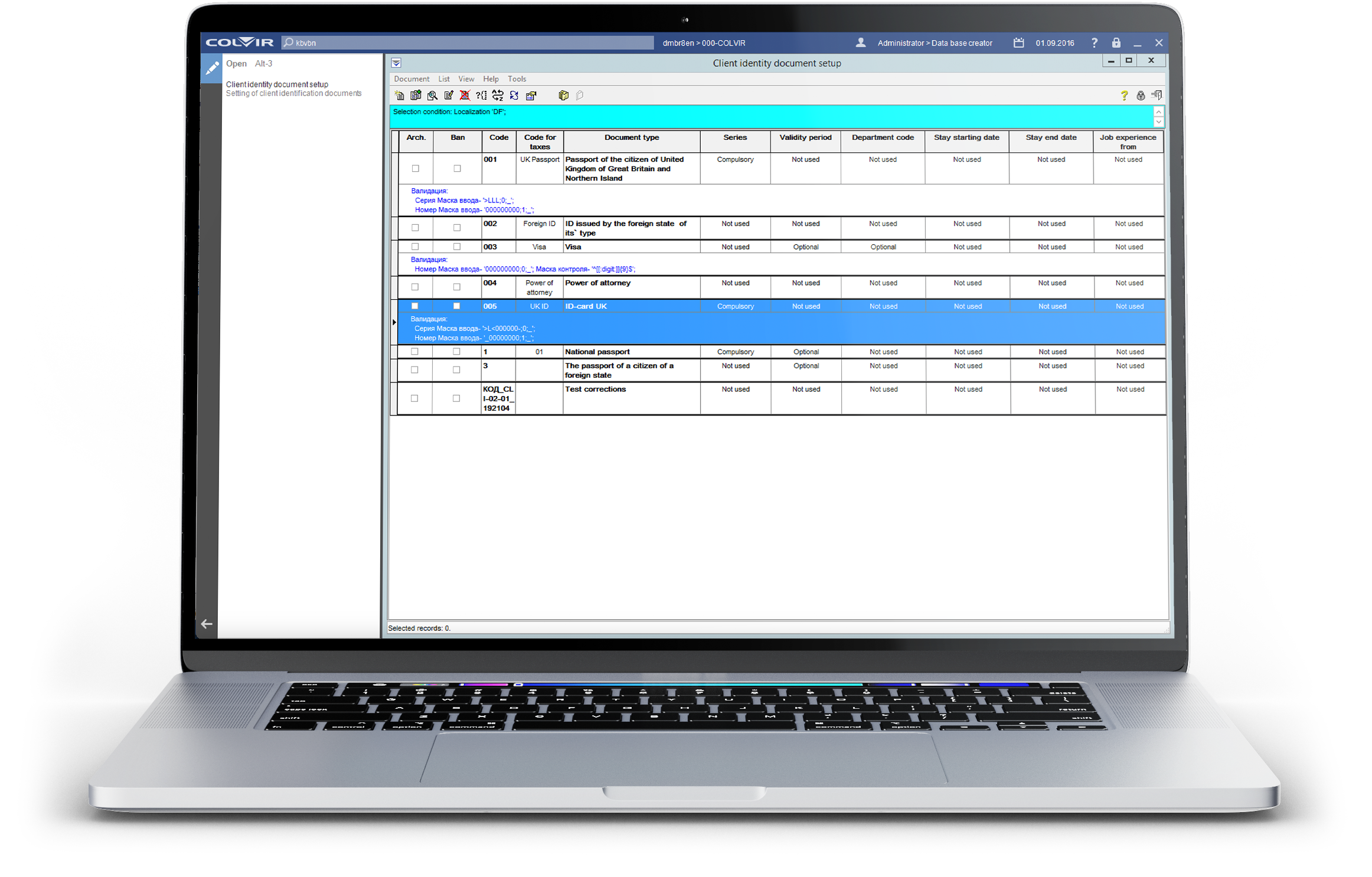
For an ordinary bank employee, “configurable” has concrete consequences. A product team can adjust the parameters of a retail deposit, create a report template or alter a workflow without waiting for a fresh software release. Treasury staff can watch correspondent-account liquidity in real time, load trades from Bloomberg, Refinitiv or an exchange, and check a proposed deal against limits before approval. Corporate customers can submit payments and inspect balances remotely; compliance teams can carry their controls through the same operating system. The attraction is not novelty. It is reducing the distance between a policy decision and a safe production change.
The service bus is important here because few banks enjoy a clean slate. Card switches, government services, payment networks and specialist products already exist, often from other vendors. Colvir's architecture is designed to connect those systems rather than demand their immediate removal. That places the company between two market poles: the large integrated suites that promise breadth, and cloud-native core vendors that promise a fresh start. Colvir offers breadth with an incremental route forward, especially for institutions whose regulatory calendar cannot pause for an architectural fashion.
What failed after the “seamless” merger
The most informative Colvir case may be the one that admits to a hangover. When Bank CenterCredit absorbed Eco Center Bank in 2022, both institutions were already on Colvir. That common foundation helped move clients and affiliated entities quickly. But the combined data, processes and staff were larger than anticipated. After the merger, routine procedures and support processes needed two to three months of performance stabilization. An online archive purchased a year earlier turned out to be especially useful for moving dormant data away from the daily workload.
This is the part of transformation brochures often crop out: migration can succeed while operations still wobble. The copyable idea is to plan for the first ordinary month, not merely the triumphant first morning. Archive cold data before it competes with live transactions. Treat capacity tests as business rehearsals, with real process volume and staff behavior. Keep a stabilization team available after cutover, when congratulatory cake has become breakfast.
A vendor that teaches clients to call less
At a 2026 industry event in Uzbekistan, Tenge Bank said its own team now implements roughly 50 to 60 percent of enhancements requested by business users. It built an on-call group and knowledge base, so some incidents never reach Colvir. The vendor continues to handle regulatory tasks, where the cost of a mistake is higher. For enterprise software, this is an unusually healthy definition of success: the customer gains autonomy while the supplier remains accountable for the dangerous edge.
Training is therefore part of the product, not conference swag. Colvir says its learning center holds more than 600 courses and simulators. Its camps put employees from different banks through architecture classes, practical cases and peer discussions. A 2025 agreement with Nurbank and Caspian University opened those materials to students and faculty, with internships supplied by the bank. The aim is to grow operators who understand the system's logic rather than memorize a string of clicks.

That human network matters as Colvir changes its own foundation. In 2024 it began piloting a microservices core. At its 25th-anniversary gathering in Turkey a year later, it presented Colvir Quartum and a Halyk Bank lending-module case. The rollout suggests coexistence rather than an overnight transplant: prove one service in a real bank, preserve continuity, then expand. Everest Group's 2026 global core-banking ranking placed Colvir at No. 44, 17th for module coverage and among 20 vendors recognized for Islamic banking. It was a debut, not a coronation, and it located the company accurately - a strong regional platform pushing into a market increasingly organized around APIs, modular replacement and cloud options.
The useful limit of “customize less”
BNK's five-month result should not be photocopied without its conditions. The client accepted standard functionality, the go-live date was fixed, and both teams could isolate mission-critical banking from desirable embellishment. That method weakens when an institution's competitive advantage genuinely lives in unique processes, when source data is dirty or poorly mapped, when regulators have unresolved requirements, or when internal owners cannot make quick decisions. Minimal customization is discipline only if the standard system fits the bank. Otherwise it is deferred trouble.
The broader lesson is sharper. Core modernization works best when a bank knows which complexity is legally necessary, which complexity earns money and which complexity is merely ancestral. Colvir's platform cannot answer that governance question. Its modules, configuration tools and regional expertise can make the answer executable. The company has built a substantial business in the gap between those two verbs: deciding and doing.