The awkward thing about declaring a technology dead is that customers may insist on using it. Malauzai began with a wager: the phone would become the centre of banking. Desktop internet banking would lose its purpose. Then community banks came back with a request. They liked the mobile experience. Could their desktop customers have it too?
- Branded banking apps for community banks and credit unions.
- Camera-led conveniences, from check deposits to photo bill payment.
- A phone-first philosophy that learned to accommodate the desktop.
There is a useful business lesson here, particularly for anyone fond of predicting the future. A customer can agree with your product and disagree with your prophecy. Malauzai’s answer was to take the design people liked and extend it to another screen. The browser returned. The ambition to make banking less cumbersome remained.
01 / The bank behind the app
Malauzai sells software to financial institutions. The institution supplies the account, the relationship and the name on the app. Its customers are US community banks and credit unions serving consumers and businesses. The proposition is straightforward: a smaller institution should be able to offer useful digital services without assembling every component itself.
Those services include balances, transfers, mobile check deposits, bill payment and debit-card controls. Business capabilities extend to ACH and wire processing. Marketing messages and usage reports sit behind the customer experience, giving the institution ways to communicate and observe behaviour. The expertise is partly interface design and partly connecting that interface to banking systems. A pleasing button still needs somewhere reliable to send its instructions.
At Finastra’s acquisition in 2018, Malauzai served more than 350 institutions. The accompanying documents recorded 1.6 million registered users; the announcement separately reported more than one million monthly active users. Those measures describe different things. Registration counts reach. Monthly activity says something about habit.
02 / A camera beats a form
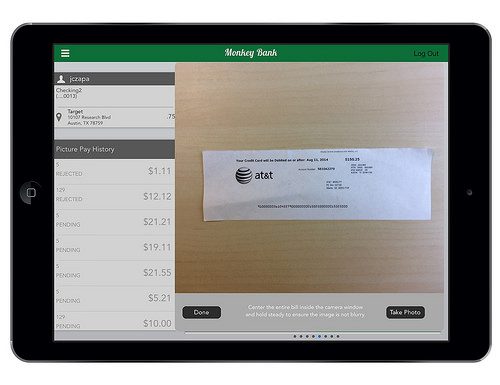
Consider the paper bill. Traditional online bill payment asks the customer to establish a biller before the satisfying part, paying, can begin. PicturePay approached the task through the phone’s camera. Photograph the bill, confirm the payment details and submit. Developed with Allied Payment Network and Mitek technology, it turned a familiar object into an input device.
First Financial Bank in Texas tested the feature before its rollout. By August 2014, First Financial Bankshares reported an 80 percent increase in PicturePay transaction volume and a 35 percent increase in customers using it. These were customer-reported results, rather than evidence that every bank would enjoy the same increase. They nevertheless identify a sensible target for product work: a tedious step people would happily surrender.
“We listen to our data.”Robb Gaynor · 2012
The camera also supported remote check deposits. Malauzai reported helping more than 90 institutions deploy that service by 2014. The common thread was practical: move work from a branch visit or a keyboard to a device already in somebody’s hand. Innovation occasionally arrives wearing the modest disguise of a saved errand.
03 / The desktop gets its revenge
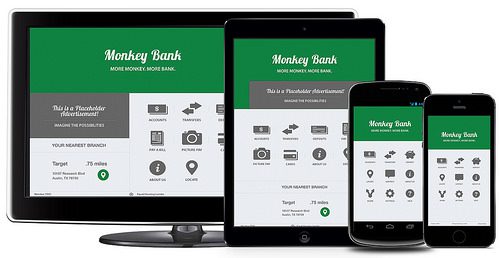
Co-founder Tom Shen later acknowledged that the original phone-only assumption was wrong. Customers still had desktop users, and wanted a matching experience for them. SmartwebApps, launched in September 2014, brought the app approach into the browser. The reversal preserved a recognisable interface while widening the places it could be used.
Shen brought banking-software experience from Software Dynamics and Digital Insight. Robb Gaynor led product; Danny Piangerelli led technology. The unusual name came from Shen’s childhood nickname, a little male monkey in Cantonese. It gave a serious enterprise-software business an identity less solemn than its customers’ balance sheets.
04 / Buying the connections
The commercial model is business-to-business subscription software. A bank buys a platform and offers branded services to account holders. Subscription charges and implementation costs belong in a purchasing discussion; venture funding measures something else. Malauzai raised approximately $6.48 million in 2014, in a Wellington Management-led round, followed by roughly $11 million in July 2015. Contemporary reporting put cumulative financing above $24 million.
Integration helped turn product appeal into distribution. By June 2018, Finastra and Malauzai had accumulated more than 130 joint customers since 2015, with Malauzai connected to the Fusion Phoenix core system. Horicon Bank was one named example. Finastra then bought its partner. The acquisition joined the customer-facing digital layer to a broader banking-software portfolio.
In June 2026, another ownership change arrived: CORA Group acquired Finastra’s US Mid-Market banking business, including MalauzAi Digital Banking, Phoenix, Analyzer IQ and enterprise content management. The announcement promised continuity of products, teams and customer relationships. The familiar “a Finastra company” description now belongs to an earlier chapter.
05 / What to borrow from the little monkey
Today’s product description emphasises React and Ionic, one codebase for mobile and web, open APIs, configurable branding and administrative control. The intended benefit is less duplicated development and quicker changes. A buyer still needs to test those promises against its core connections, business workflows and release requirements.
Alternatives include Tyfone, Q2 and Alkami, alongside offerings from core-software vendors. Malauzai’s distinguishing history is its mobile design carried across screens, its camera-based tools and its community-institution focus. Those details provide useful comparison criteria; a feature checklist alone cannot establish which system fits a particular bank.
The portable lesson is to find the chore, remove unnecessary steps and watch whether people return. Keep the useful design when the original prediction proves too narrow. For a US community institution, that approach can support personal service at digital scale. Where the core cannot connect, or a business workflow exceeds the platform’s capabilities, the attractive interface will not be enough. Customers have a habit of finding the gap.