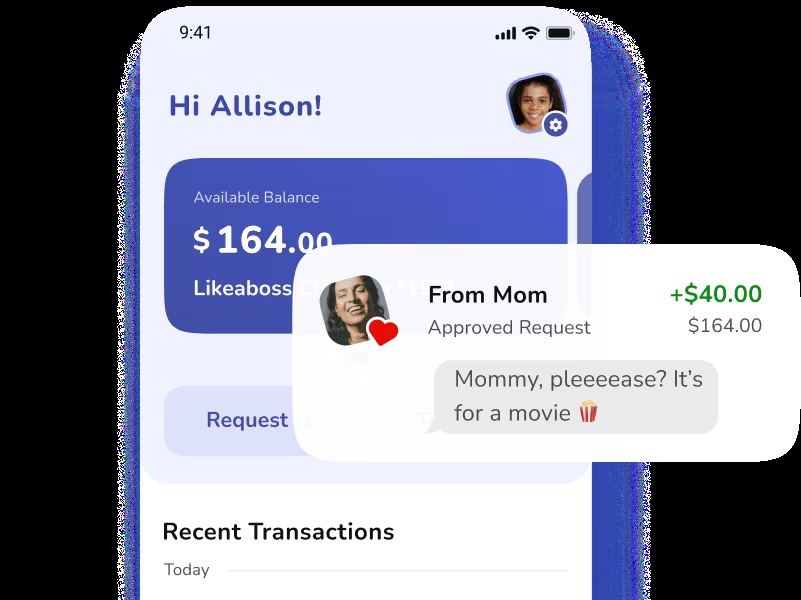
A teenager asks for movie money. A parent approves the request. Forty dollars appears in an account. In BankingON’s Boucoup product artwork, this small domestic negotiation occupies the center of the screen. It is an ordinary exchange with an unusually consequential question attached: when the child thinks about money, whose name will they remember?
- Petra improves an institution’s everyday mobile banking experience.
- Boucoup brings allowances, chores and money lessons into its own accounts.
- The commercial bet is continuity: keep the family, keep the relationship.
BankingON sells software to community banks and credit unions. Those institutions put their brands on the applications and offer them to customers. The company’s role is largely backstage. In a business crowded with companies asking consumers to remember a new name, BankingON earns its place by making an existing name more useful.
01The app was the weak introduction
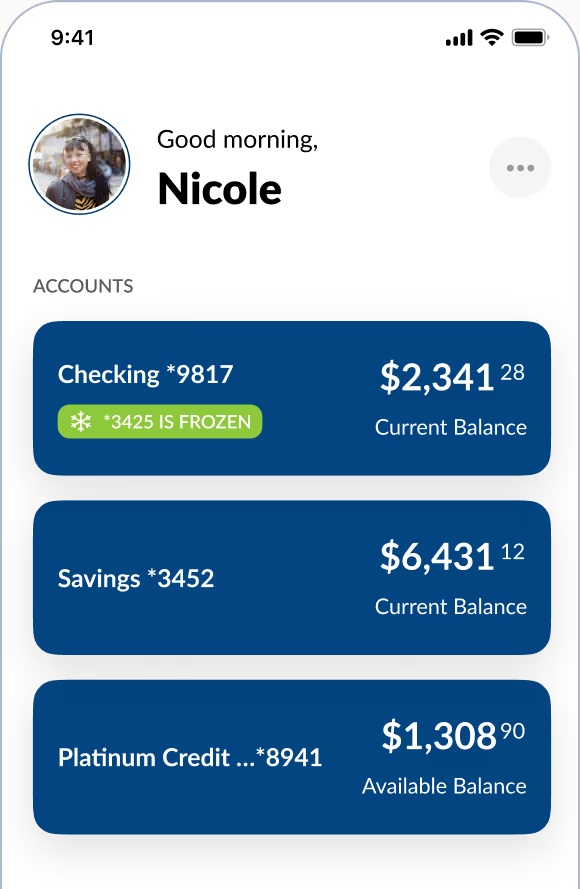
Consider Union Bank & Trust. BankingON’s Petra case study describes an app with a 2.5-star rating and low engagement. Within six months, the company says, the rating reached 4.8, mobile adoption grew 26 percent, and mobile transfer and money-movement usage rose 84 percent. These are vendor-reported results. Still, the choice of measures is revealing: reputation, participation, then behavior.
Petra is a native mobile banking upgrade, advertised for the Fiserv Experience Digital platform. Accounts, transfers, bill payments and upcoming expenses receive deliberate attention. A bank may have a dependable brand and perfectly serviceable accounts; the phone can nevertheless make the relationship feel cumbersome. Improving that encounter gives customers another reason to use what they already have.
“BankingON is my mobile dev team.”Drew Brown, CIO, Union Bank & Trust
Brown’s testimonial also says he cannot build a mobile team for the same cost and effort. That describes the purchasing decision better than a feature inventory does. An institution is buying specialist engineering capacity alongside an application. The economic appeal depends on its own staffing costs, integration needs and appetite for managing a vendor.
For a buyer, the UBT example suggests a sensible sequence: identify the weak encounter, change the experience, then watch whether customers return. An app rating tells you what some reviewers think. Transfer activity tells you something about what people do. Those measures answer different questions, and neither should substitute for the other.
02The allowance has a landlord
Boucoup takes the same approach into family finance. Parents can send allowances, reward chores, set spending controls and receive transaction notifications. Children can practice earning, spending and saving. The credit union or bank remains visible, with its own accounts and debit cards underneath the experience. The pleasant interface has a decidedly practical landlord.
Standalone family finance apps such as Greenlight and GoHenry are part of the competitive backdrop. BankingON argues that community institutions should offer comparable family tools while retaining their own brand and deposits. That is a specific market position: serve the organization that already holds the relationship, then help it earn more of the household’s attention.
The distribution model follows that position. BankingON sells through financial institutions; families encounter their institution’s branded experience. Its 2024 launch announcement described Boucoup as free to parents and teens through credit unions. The software vendor’s institutional contract is a separate transaction. For a buyer, household engagement and implementation expense belong in the same conversation.
The commercial logic is easier to understand at household scale. A child needs a place to save; a parent needs visibility; the institution wants both to keep using its services. Their interests can overlap. The product has to make that overlap convenient enough to become a habit, rather than another forgotten download.
03Behind the charming screen, difficult plumbing
The founders’ backgrounds help explain the combination. CEO Alexey Krasnoriadtsev previously founded Agile Fusion, whose company biography names technology clients including Dell and Intel. Chairman Carl Thong previously led Dynafront, a fintech once part of GE Capital. Public founder listings also identify Anton Antonov. Mobile software experience and banking knowledge meet in a product whose hardest work may be invisible.
In April 2024, BankingON partnered with Janusea to simplify connections across credit union core systems. The announcement describes normalizing member data and speeding implementation. Krasnoriadtsev explained that interfacing with multiple cores is difficult; the partnership would let his team concentrate on Boucoup. The decision is instructive: a specialist product still needs a specialist connection to the systems recording the money.
The customer list supplied for FinovateFall 2025 includes Affinity Plus, FAST, 5Point, American Heritage, Whatcom Educational Credit Union and Union Bank & Trust. BankingON’s website reports supporting more than 500,000 users across its solutions. That broader figure measures the company’s stated footprint; it should not be read as a count of families using Boucoup.
04Parenthood, with repayment terms
In September 2024, Boucoup introduced Loan from Parent. A parent can set the amount and repayment terms; a teenager can see the balance and installment schedule. A request for a bike or concert tickets becomes practice in borrowing. The parent supplies both money and supervision. It is a modestly comic promotion: the household’s habitual benefactor acquires a loan book.
Eagle Venture Fund led BankingON’s January 2024 Series A to support Boucoup’s launch. By July 2026, the company was publishing a live family banking demonstration from Digital Banking Conference. Its September writing turned to what happens when a youth account becomes an adult relationship. The emphasis has developed from getting children started to giving them somewhere familiar to continue.

Practice also gives the family something concrete to discuss. A repayment date and a visible balance make borrowing less abstract than a lesson alone. That is the product’s educational proposition, rather than proof of an educational outcome. The useful question is whether the family actually returns to those tools together.
05Ask about the eighteenth birthday
BankingON’s account-conversion argument is simple: youth banking should lead somewhere. Boucoup uses the institution’s core accounts, so the intended handoff is into that institution’s adult banking experience. Familiarity can carry forward even as parental oversight and product needs change. Whether that produces lasting loyalty remains a question of service, relevant products and execution.
There is a useful lesson here for anyone selecting financial software. Trace the relationship before admiring the interface. Ask who holds the accounts, whose cards are used, which integrations are supported and how graduation works. Then measure actual adoption and repeated use. A family app requires participating families; a branded screen requires reliable operations beneath it. The allowance opens the conversation. The institution still has to deserve the paycheck.