What Two Decades Inside the Machine Teaches You
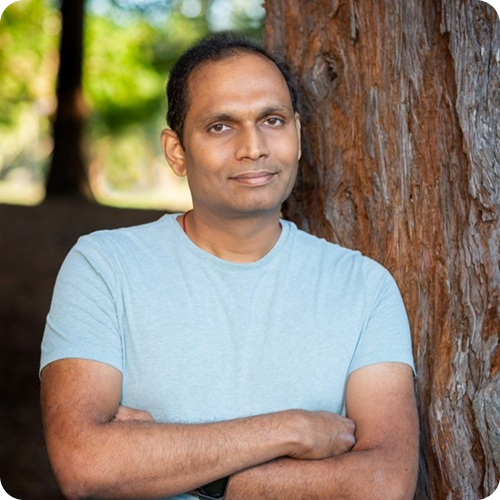
There's a particular kind of frustration that only comes from knowing exactly what the solution is and not being able to build it. Shyam Maddali spent years inside it. At eBay, he led Trust & Safety machine learning. At WePay - the payment infrastructure arm absorbed by JPMorgan Chase - he rose to Senior Director of Data Science & Risk Engineering and stayed for seven years. Seven years watching risk teams juggle spreadsheets, fight false positives, and manually review merchants one by one while billions of dollars moved through the platform.
The pattern was the same everywhere. Valuable data about small businesses - their licenses, reviews, incorporation history, website signals, behavioral anomalies - sat scattered across the open internet, unstructured and unconsumed. Risk teams making multi-thousand-dollar decisions on merchants they barely knew, relying on tools that hadn't meaningfully evolved since the early 2000s. The data existed. The intelligence didn't.
"After years of building risk systems at JP Morgan Chase, Google, eBay, and PayPal, we kept seeing the same problems: teams spending hours juggling spreadsheets and legacy systems, drowning in false positives, and struggling to prove value."
- Shyam Maddali, Co-Founder & CTO, CorisThe insight that became Coris wasn't a eureka moment. It was a slow accumulation of the same headache observed across multiple institutions. Fintechs and payment companies struggled most acutely - they needed real credit and risk data on small businesses, but the information was buried in sources that neither rule-engines nor traditional models could parse. The problem was structural. The fix had to be architectural.
A Different Kind of Startup Story
Shyam co-founded Coris in June 2022 alongside Vinodh Poyyapakkam - a complementary operator with roots at Google, PayPal, Paysafe, and Adyen. Together they carried over 40 years of combined payments and risk experience into Y Combinator's Summer 2022 batch. This was not two engineers with a clever idea. This was two people who had lived the problem at scale and built a company specifically to solve it.
The product they built does something deceptively simple-sounding: it turns the unstructured web into structured merchant intelligence. Licensing records, business incorporation data, online reviews, website content analysis, behavioral signals, legal and bankruptcy alerts - Coris aggregates all of it for 330 million merchants across 50+ countries, then surfaces that intelligence through an API and a risk operations platform that payments teams can actually use. No data science team required. No six-month integration. No spreadsheets.
In February 2024, Coris raised a $3.7 million seed round co-led by Lux Capital and Exponent Capital, with participation from Y Combinator. The announcement came alongside two new products: CorShield, a fraud model targeting business impersonation at onboarding, and MerchantProfiler, a KYB solution covering SMBs in 46 countries. The company's client list by then included GoFundMe, Kajabi, Clio, and Cherry - names that signal not just product-market fit but a specific kind of trust. These platforms can't afford to get merchant risk wrong.
"Fintechs especially struggle to get the right data on quality of small businesses to accurately assess credit exposure. Valuable data on a business remains unstructured in the open internet for models and rules to consume."
- Shyam Maddali on the Coris founding thesisThe Entrepreneur Who Was Always There
Long before Coris, there was FinBuddy. In 2013, while building fraud systems at eBay by day, Shyam co-founded a personal finance mobile app to help retail investors understand their portfolios. FinBuddy made it to Finovate Spring 2014 - a major fintech demo conference - where Shyam presented it live. The app didn't become a category-defining company, but it proved something about Shyam's character: he's a builder who can't stop building.
His path from India to Silicon Valley follows a familiar arc that's easy to summarize but hard to replicate. Electronics and Communications Engineering at NIT Warangal - one of India's premier technical institutions. Then a Master's in Computer Science at Stanford, where the machinery of modern tech gets assembled in real time. Early career stints at Wipro, AirFlash, and Sonasoft sharpened execution instincts before eBay offered something rarer: the chance to build ML systems at genuine scale, on problems that actually mattered.
What's distinctive about Shyam isn't just the credential stack. It's the consistency of focus. For two decades, across five employers and two of his own companies, the problem set has barely changed: how do you assess the risk of a small business you don't know, in real time, with incomplete information? Coris is the version of that answer that finally has product-market fit, distribution, and backing.
His Twitter handle - @mlshyam - is a small tell. He chose that identifier when machine learning was still specialist vocabulary, long before every startup began describing itself as "AI-powered." The discipline was always the anchor.